


In 1274, Mongol warships appeared off the coast of Kyushu. The samurai who rode out to meet them carried tachi - long, deeply curved swords designed for slashing from horseback. Three centuries later, their descendants walked the streets of Edo with a completely different weapon tucked through their belt: the katana.
Same warrior class. Entirely different swords.
That evolution, from tachi to katana, from battlefield odachi to ceremonial tsurugi - tells the story of Japan itself. Each type of Japanese sword was shaped by a specific era, a specific style of combat, and a specific need.
This guide breaks down every major type of Japanese sword still collected, practiced with, and admired today. No filler - just what each blade is, where it came from, and why it still matters.
- The Katana - Japan's Defining Blade
- The Tachi - The Sword That Came Before
- The Wakizashi - The Samurai's Companion
- The Tanto - Small Blade, Serious Purpose
- The Nodachi - Giant of the Battlefield
- The Ninjato - Fact, Fiction & Modern Appeal
- The Naginata - Polearm That Redefined War
- The Chokutō - Japan's Earliest Sword
- The Nagamaki - Half Sword, Half Polearm
- The Tsurugi - Sacred Double-Edged Blade
- Comparison Chart
- Frequently Asked Questions
- Which Sword Is Right for You?
The Katana: Japan's Most Famous Samurai Sword
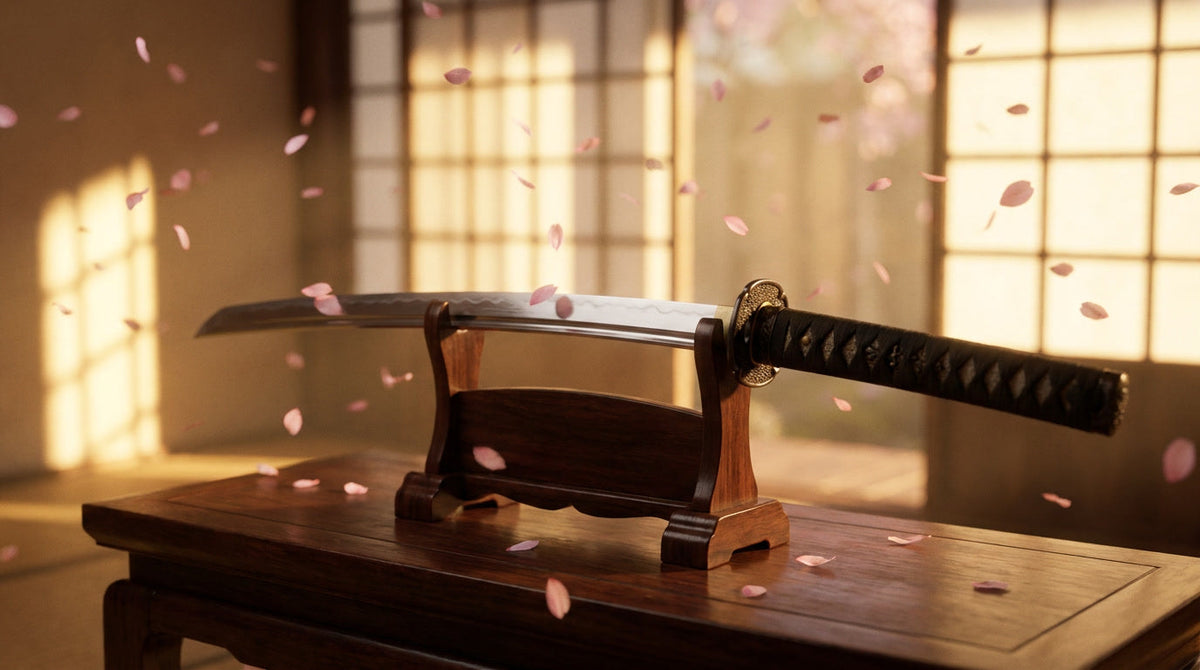
Ask anyone to name a Japanese sword and they'll say "katana." Fair enough - it earned that reputation. But the katana isn't ancient. It only became the dominant sidearm during the Muromachi period (14th - 16th century), when warfare shifted from mounted cavalry to infantry combat in castle towns and narrow streets.
The defining feature? How it's worn. Thrust through the obi belt, cutting edge facing up. That single detail allowed a technique called iaijutsu - drawing and cutting in one fluid motion. Earlier swords couldn't do that. This innovation changed Japanese swordsmanship forever.

The katana reached its artistic peak during the Shintō era (1596-1781). Smiths like Nagasone Kotetsu in Edo and Tadayoshi of Hizen pushed the limits of what a blade could be, not just a weapon, but an heirloom worth passing through generations.
If you want to understand every component from kissaki to kashira, our detailed katana anatomy guide covers all 24 parts.
During the Edo period (1603-1868), samurai were legally required to carry two swords - the katana and a shorter blade. This pair, called the daishō, was the visible badge of their social rank. Commoners caught carrying one could face execution.
The Full Family of Japanese Steel
Katana, wakizashi, tanto - the three classic blades of the samurai.


The Tachi: The Samurai Sword That Came Before the Katana
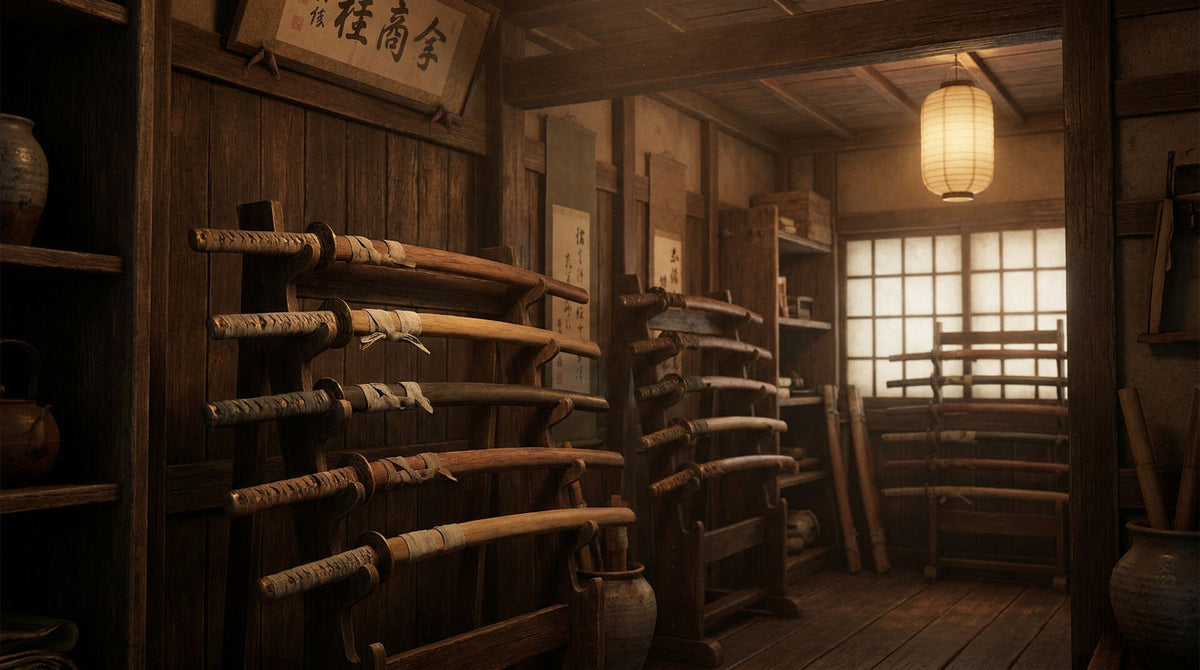
Every katana owes its existence to the tachi. Appearing in the late Heian period (10th - 11th century), the tachi was forged for mounted combat. Samurai on horseback needed a blade they could swing downward with maximum reach and cutting momentum.
Compared to the katana, the tachi runs longer with a deeper, more pronounced curvature. But the real distinction is the carry method - the tachi hung edge-downward from the belt using silk or leather cords. Impractical for quick-draw techniques, but perfect for sweeping cavalry strikes.

The tachi dominated from the Kamakura period through the Mongol invasions. As warfare moved toward infantry, many tachi were shortened (suriage) and remounted as katana. These tachi-kiriage are among the most prized antiques in Japan today.
Quick identification trick: check the tang signature (mei). On a tachi, the signature faces outward when hung edge-down. On a katana, it faces outward when worn edge-up.
We explored the full history and differences between katana and tachi in a dedicated deep-dive.
The Wakizashi: The Samurai's Constant Companion Blade
The wakizashi doesn't get the glory. It should.
With a blade between 30 and 60 cm, it's the shorter half of the daishō pair. But here's what most people miss: when a samurai entered a building, etiquette required leaving the katana at the door. The wakizashi stayed. Always.
It accompanied warriors indoors, during meals, at court, even to sleep. Some historians argue that samurai felt more emotionally connected to their wakizashi precisely because it never left their side.

In combat, the wakizashi served multiple roles - close-quarters fighting in narrow corridors, finishing strikes, and in the most solemn circumstances, as the instrument of seppuku.
Technically, it shares identical construction with the katana. Same forging, same steel options, same anatomy. The only real difference is length. A well-forged wakizashi is not a "lesser" sword - it's a precision instrument.
The Tanto: A Small Japanese Blade With Serious Purpose
Don't let the size fool you. The tanto - blade under 30 cm - was one of the most ubiquitous weapons in Japanese history. Soldiers, monks, and women of samurai households all carried them.
The tanto first appeared during the Heian period but hit its creative peak in the Kamakura era (1185-1333). Smiths like Yoshimitsu of Awataguchi produced blades now classified as National Treasures.

Unlike longer swords, the tanto could be forged in a single day - making it a canvas where smiths tried new techniques before scaling up to katana.
Most blades are hira-zukuri (flat, no ridge) or shobu-zukuri (subtle ridge to tip). Both prioritize thrusting over slashing.
Modern catalog names do not always follow historical length categories exactly. Hagane Tanto and Aozora Tanto both list 33 cm blades, so use their actual measurements when comparing display space.
The Nodachi (Odachi): The Oversized Sword of the Samurai Battlefield
The nodachi - also called odachi - is the most imposing sword in the Japanese arsenal. Blades exceeding 90 cm, some reaching 150 cm. One job: smashing through enemy lines on open battlefields.
Too long to draw from the hip, warriors either carried them on their back or held them unsheathed before battle. The extra length delivered devastating reach against cavalry during the Nanbokuchō period (1336-1392).
Forging a nodachi was a technical nightmare - maintaining consistent heat treatment across that length pushed the best smiths to their limits. Many surviving nodachi were later shortened into katana.
The longest authenticated Japanese sword is an odachi at Yahiko Shrine in Niigata Prefecture. Its blade measures 2.24 meters - over 7 feet. Almost certainly a ceremonial offering, not a combat weapon.
The Ninjato: Fact, Fiction, and Modern Sword Appeal
No solid historical evidence confirms the ninjato existed as a standardized weapon in feudal Japan. No surviving examples, no period illustrations, no mention in texts before the 20th century.
Shinobi likely used whatever was available - repurposed wakizashi, tanto, or farming tools. The iconic straight-bladed ninjato was popularized by 1960s - 80s ninja movies and the Iga-ryu Ninja Museum.
That said, the modern ninjato has become a legitimate category. Straight blade, ~50-60 cm, square tsuba, shorter profile than a katana. It appeals to martial artists and ninja culture fans alike.
For contemporary straight-blade designs, compare the rosewood fittings of Kagehana Ninjato with the wrapped handle and gradient finish of Yoru no Kage Ninjato. These modern models do not establish the historical existence of a standardized ninja sword.
The Naginata: The Polearm That Redefined Japanese Warfare
The naginata isn't technically a sword - it's a polearm with a curved blade on a long shaft. But no guide to Japanese bladed weapons is complete without it.
Its reach was devastating. Shafts of 120-240 cm with blades of 30-60 cm allowed foot soldiers to cut down riders from a safe distance. During the Genpei War (1180-1185), the warrior monk Benkei famously wielded a naginata in his legendary last stand at Gojō Bridge.

As the yari (spear) became cheaper, the naginata transitioned from battlefield weapon to a symbol of feminine martial virtue. During the Edo period, naginatajutsu became core to women's education in samurai households. Today, it remains one of the most practiced martial arts in Japan - predominantly by women.
The Chokutō: Japan's Earliest Straight Sword
Before Japanese swords had curves, there was the chokutō. Straight, single-edged, dating to the Kofun period (3rd - 7th century). Heavily influenced by Chinese and Korean designs.
It was a thrusting weapon - effective against lighter armor but outclassed as warfare grew complex. It lacked the curvature that gives later swords their cutting efficiency.
The chokutō is the ancestor of every curved Japanese sword. And if you watch Naruto, you'll recognize it - Sasuke's weapon is modeled after a chokutō. Replicas in our manga katana collection.
The Nagamaki: The Hybrid Between Sword and Polearm
The nagamaki sits in a strange and fascinating space. Blade roughly katana-length (60-90 cm), but the handle is almost as long. That equal balance creates something that fights like neither a sword nor a polearm - it's both.
Associated with the Nanbokuchō and Muromachi periods, wielded by elite warriors who needed sword cutting power with polearm leverage. The long handle provided enormous torque against armored opponents.
The nagamaki never achieved mainstream popularity - too specialized, awkward to carry. Today, it's primarily a collector's item: rare, unusual, and a guaranteed conversation starter.
The Tsurugi (Ken): Japan's Sacred Double-Edged Blade
The tsurugi - also called ken - is the oldest category. Double-edged and straight, it predates everything else on this list.
The most famous tsurugi isn't even a confirmed physical object. The Kusanagi no Tsurugi is one of the three Imperial Regalia of Japan. Legend says the storm god Susanoo pulled it from an eight-headed serpent. It's supposedly at Atsuta Shrine in Nagoya - though no one outside the imperial household has seen it in centuries.
As a weapon, the tsurugi was ceremonial by the time the tachi emerged. But its sacred associations kept it alive in Buddhist and Shinto rites, where the ken symbolizes cutting away ignorance and evil.
All Japanese Sword Types at a Glance
| Sword | Blade | Edge | Curve | Era | Main Use |
|---|---|---|---|---|---|
| Katana | 60-80 cm | Single | Moderate | Muromachi-Edo | Infantry, dueling |
| Tachi | 70-80 cm | Single | Deep | Heian-Kamakura | Mounted cavalry |
| Wakizashi | 30-60 cm | Single | Moderate | Muromachi-Edo | Close quarters |
| Tanto | <30 cm | Single | Slight | Heian-present | Stabbing, utility |
| Nodachi | 90-150+ cm | Single | Moderate | Nanbokuchō | Anti-cavalry |
| Ninjato | 50-60 cm | Single | None | Modern | Martial arts |
| Naginata | 30-60 cm + shaft | Single | Moderate | Heian-Sengoku | Polearm |
| Chokutō | 50-70 cm | Single | None | Kofun-Nara | Thrusting |
| Nagamaki | 60-90 cm | Single | Moderate | Nanbokuchō | Armored combat |
| Tsurugi | 40-70 cm | Double | None | Kofun & earlier | Ceremonial |
Frequently Asked Questions
How many types of Japanese swords are there?
At least 10 major types, from the ancient tsurugi to the modern ninjato. Including sub-variants and regional specialties, the number exceeds 20. The most collected today are the katana, wakizashi, and tanto.
What is the difference between a katana and a samurai sword?
"Samurai sword" is a Western catch-all that usually means katana. But samurai carried different swords by era, a 12th-century warrior used a tachi, not a katana. The katana specifically refers to the curved, edge-up blade standard after the 14th century.
Which Japanese sword is the longest?
The nodachi (odachi), with blades exceeding 90 cm - ceremonial examples over 2 meters. For total reach, the naginata wins via its shaft, but it's classified as a polearm.
Are all Japanese swords curved?
No. The chokutō and tsurugi were straight, influenced by Chinese designs. Curvature developed during the late Heian period for mounted combat. The ninjato also has a straight blade.
What Japanese sword should a beginner buy?
A katana - the most versatile, best supported by martial arts schools, with the widest range of resources. A functional hand-forged katana in 1060 or T10 steel is ideal. Our beginner's guide walks through every step.
Which Japanese Sword Fits Your Collection?
Ten types. Centuries of history. You don't need to choose just one.
Starting out? A katana is the natural first step. Pair it with a wakizashi later, and you've got a daishō that would make any samurai proud.
Looking for depth? A tanto adds historical texture. Into anime? Our manga collection brings fiction to life with real forging.
Curious about steel? The steel guide breaks it all down.
Whatever blade calls to you - start there. The rest will follow.
Build Your Daisho
Hand-forged Japanese swords across every traditional length - collect them as a complete set.
Share:
Are Katanas Battle Ready? Functional vs Decorative Blades
Are Katanas Legal? 2026 Laws by Country & US State