

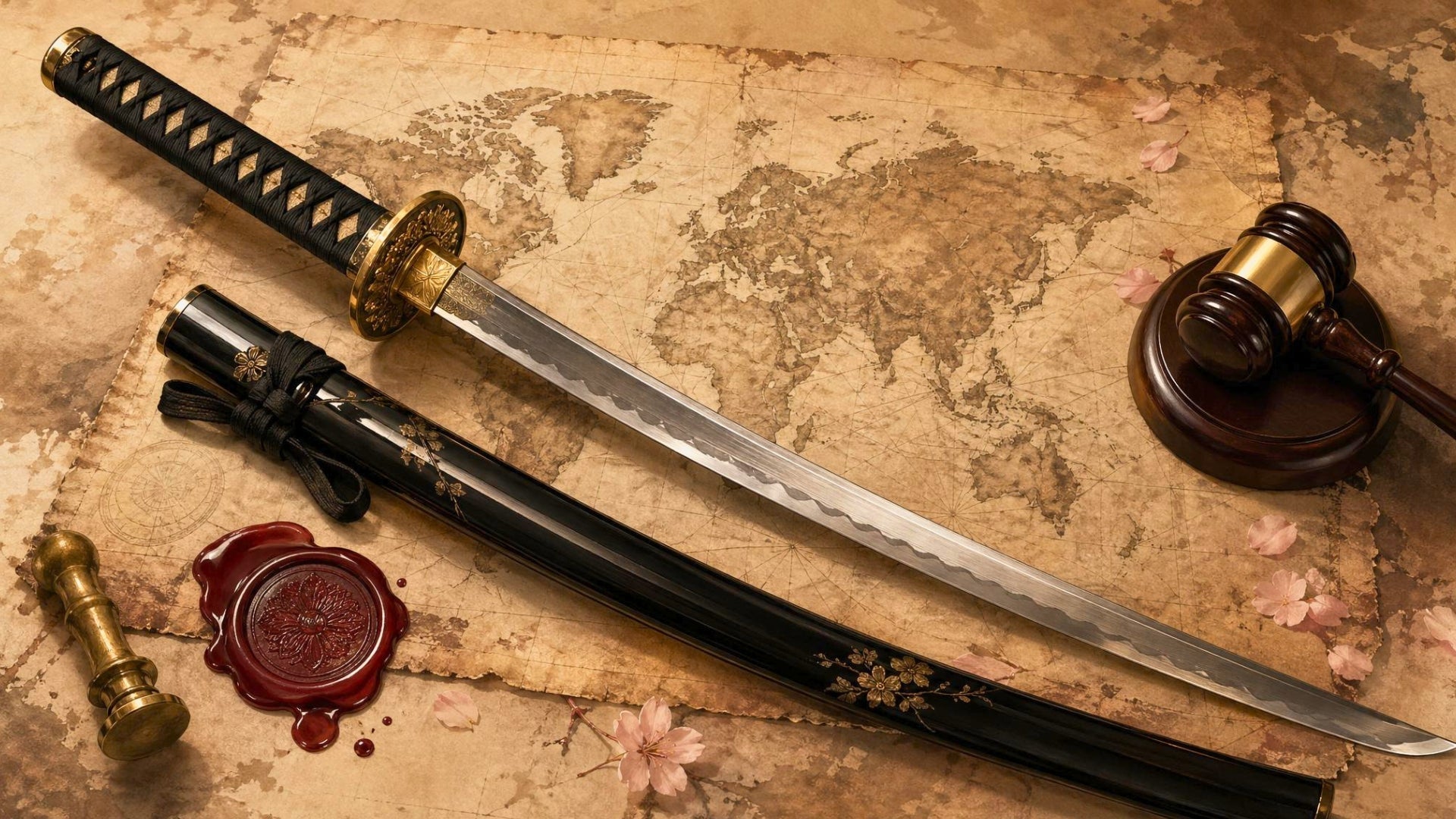
In 2017, a man in Texas walked into a restaurant openly carrying a katana on his hip. Nobody called the police, because it was perfectly legal. That same year, a collector in London had his hand-forged katana confiscated at the border. Same sword, different country, completely different outcome.
The legality of owning a katana is one of the most Googled questions in the sword world, and one of the most poorly answered. Most articles give you a vague "it depends" and leave it at that.
This guide doesn't do that. We break down the actual laws: federal US rules, state-by-state specifics for the strictest and most permissive states, and international regulations across Europe, Asia, and Oceania. Whether you're buying your first katana or shipping one across borders, this is the reference you need.
This article is for informational purposes only and does not constitute legal advice. Laws change frequently. Always verify current regulations with local authorities before purchasing, transporting, or carrying a katana.
- US Federal Law: The Baseline
- State-by-State Breakdown: Where It Gets Complicated
- How to Legally Transport a Katana in the US
- United Kingdom: The 2008 Sword Ban
- Europe: Country by Country
- Japan, China, India & the Rest of Asia
- Australia, New Zealand & Canada
- Buying Online: Customs & International Shipping
- Frequently Asked Questions
- Ready to Buy? What to Know First
US Federal Law: Are Katanas Legal to Own?
Short answer: yes. At the federal level, there is no law in the United States that prohibits the purchase, ownership, or display of a katana. Swords are not classified as firearms, and the federal government largely leaves blade regulation to individual states.
You can legally buy a katana online or in-store, own as many as you want, and display them in your home without any federal permit, license, or registration. This applies to both decorative and functional (sharpened) blades.
No federal ban on katana ownership. No registration required. No age restriction at the federal level (though most sellers require buyers to be 18+). Regulation happens at the state and local level.
However, and this is where people get confused - the federal government does regulate intent. Using any blade as a weapon with intent to harm is a federal crime. Carrying a katana into a federal building, airport, or school is illegal regardless of state law. And shipping a blade across state lines requires proper packaging and carrier compliance.

Legal Steel, Quality Craft
Hand-forged katanas you can legally own and display.


Katana Laws by State: Where It Gets Complicated
Federal law sets the floor. State law sets the ceiling. And the gap between the two can be enormous. In Texas, you can openly carry a katana down the street. In New York City, doing the same thing could land you in handcuffs.
Here's a breakdown of the most notable states:
Most Permissive States
| State | Own | Open Carry | Notes |
|---|---|---|---|
| Texas | ✅ Legal | ✅ Legal (18+) | Since 2017, open carry of blades over 5.5" is legal. Restricted in schools, bars, churches, hospitals. |
| Montana | ✅ Legal | ✅ Legal | Very few restrictions on blade length or carry. |
| Arizona | ✅ Legal | ✅ Legal | One of the most blade-friendly states. No length restrictions. |
| Ohio | ✅ Legal | ✅ Legal | Open carry permitted. Concealed carry of blades over 4" restricted. |
| Georgia | ✅ Legal | ✅ Legal | Blades under 12" can be carried concealed. Over 12" - open carry only. |
Most Restrictive States
| State | Own | Carry | Notes |
|---|---|---|---|
| California | ✅ Legal | ⚠️ Restricted | Ownership legal. Open carry of a sheathed sword at the waist is technically legal, but cities like LA ban it. Concealed carry = illegal. Cane swords banned outright. |
| New York | ✅ Legal | ❌ Very restricted | Home ownership fine. Carrying in NYC is effectively illegal. Transport requires secure case, inaccessible. Gravity knives law historically used to prosecute sword carriers. |
| Massachusetts | ✅ Legal | ❌ Restricted | Ownership legal. Carrying any blade in public classified as a "dangerous weapon" - requires proving lawful purpose. |
| Illinois | ✅ Legal | ⚠️ Restricted | Blade length restrictions vary by municipality. Chicago has strict local ordinances. |
In Texas before 2017, carrying a blade longer than 5.5 inches in public was a crime - even a kitchen knife. The "Texas Knife Law Reform" bill changed everything, making open carry of swords, machetes, and katanas legal for anyone over 18.
Even in permissive states, katanas are banned in schools, government buildings, courthouses, polling stations, airports, and anywhere that posts "no weapons" signs with legal authority. This is universal.
How to Legally Transport a Katana in the US
Owning a katana is one thing. Moving it from point A to point B without legal trouble is another. Even in states where ownership is unrestricted, improper transport can get you charged.
The safest approach, regardless of state:
Never place a katana on the passenger seat, in your lap, or visibly displayed in your car. If pulled over, an accessible sword can be treated the same as an accessible weapon - even if you're just driving home from a martial arts class.
For air travel: katanas must be checked in luggage, never carried on. Use a hard-shell case, declare it at check-in, and pack the blade wrapped in cloth inside the saya. Airlines like Delta and United allow swords in checked bags but require them to be securely sheathed and cased.

United Kingdom: The 2008 Sword Ban Explained
The UK has some of the strictest sword laws in the Western world. In 2008, the Criminal Justice Act was amended to ban the sale, import, and lending of curved swords with blades over 50 cm. This was a direct response to a series of violent incidents involving cheap, mass-produced samurai swords.
But the ban isn't absolute. Key exemptions include:
In practice, this means a hand-forged katana made using traditional methods is legal to buy and own in the UK. Mass-produced, factory-made replicas are not. The distinction matters, and sellers must provide documentation proving traditional manufacture.
Public carry of any sword is illegal in the UK under all circumstances. Transport must be in a secure, locked case with a demonstrable lawful reason (moving house, going to a dojo, etc.).
Katana Laws Across Europe: Country by Country
| Country | Ownership | Carry | Import | Key Notes |
|---|---|---|---|---|
| Germany | ✅ Legal | ❌ Banned | ⚠️ Regulated | Must prove legitimate use (martial arts, collection). ID required for purchase. |
| France | ✅ Legal | ❌ Banned | ⚠️ Regulated | Classified as Category D weapon. Declaration not required for home ownership. Public carry illegal. |
| Italy | ✅ Legal | ❌ Banned | ⚠️ Commercial address only | Shipping to private addresses restricted. Must ship to a business. |
| Spain | ✅ Legal | ❌ Banned | ✅ Permitted | No special restrictions on ownership. Public carry strictly prohibited. |
| Denmark | ✅ With permit | ❌ Banned | ⚠️ Police permit needed | Police permit required to release swords from customs. |
| Poland | ✅ Legal | ❌ Banned | ✅ Permitted | Relatively relaxed. No special permit for ownership. |
The common thread across Europe: owning a katana at home is generally fine. Carrying one in public is illegal virtually everywhere. Import rules vary - some countries require commercial delivery addresses, others need police permits.
Japan, China, India & Asian Katana Laws
Japan: The Strictest Rules on the Planet
Ironic as it sounds, Japan has the most restrictive katana laws in the world. All traditionally forged swords (nihonto) must be registered with the Board of Education and recorded with the police. Unregistered possession is a criminal offense.
Only licensed swordsmiths can forge new nihonto, and production is limited. Buying, selling, or exporting a sword requires specific documentation. Even inheriting a family sword requires immediate registration.
After World War II, the Allied occupation ordered all Japanese swords surrendered and destroyed. Millions of blades were lost. The NBTHK (Society for Preservation of Japanese Art Swords) was formed in 1948 specifically to save historically significant blades from the scrap heap.
Other Asian Countries
| Country | Status | Notes |
|---|---|---|
| China | ❌ Illegal | Swords classified as dangerous weapons. Civilian ownership prohibited. |
| India | ❌ Restricted | Import/export of sharpened swords illegal. Only unsharpened blades permitted. |
| Singapore | ⚠️ Permit required | Temporary import license from police needed. Extensive paperwork discourages most collectors. |
| Philippines | ✅ Legal | No specific restrictions on sword ownership. |
| South Korea | ⚠️ Regulated | Ownership legal with registration. Carrying in public illegal. |
Australia, New Zealand & Canada
Australia
Australian katana laws vary dramatically by state. In Victoria and New South Wales, katanas are classified as prohibited weapons. Owning one requires a Prohibited Weapons Permit - typically granted only to martial arts practitioners, historical reenactors, or collectors who can demonstrate legitimate need. Queensland and other states are less restrictive, but permits are still commonly required.
New Zealand
Similar to Australia. Swords are legal to own but regulated. Import may require customs declaration, and carrying in public is restricted.
Canada
Good news for Canadian collectors: katana ownership is legal with no federal restrictions. Swords are categorized similarly to knives. You must be 18+ to purchase. There are no registration requirements. However, carrying a sword in public without a lawful excuse (moving, going to practice) can result in charges under the Criminal Code's "carrying a weapon dangerous to public peace" provision.
Buying a Katana Online: Customs & International Shipping
If you're ordering a katana from an international seller, or shipping one abroad - customs is the biggest wildcard. A sword that's perfectly legal to own in your country can still be seized at the border if documentation is wrong.
Key rules for smooth customs clearance:
At Katana Corp, we ship to the US with no customs fees - our prices include everything. For international orders, we handle export documentation and label packages appropriately to minimize customs issues. If you're unsure about your country's import rules, check our FAQ or contact us before ordering.
Frequently Asked Questions
Is it legal to own a katana in the US?
Yes. There is no federal law prohibiting katana ownership. You can legally buy, own, and display a katana in all 50 states. Restrictions apply to public carry and vary by state - California and New York are the strictest.
Can I carry a katana in public?
It depends entirely on your state. Texas, Arizona, and Montana allow open carry. California allows sheathed carry in most areas but cities like LA ban it. New York City effectively prohibits all public sword carry. Always check local law before leaving your home with a blade.
Do I need a license or permit to buy a katana?
In the US: no. No license, permit, or registration is required at any level. In the UK, Australia, Denmark, and Singapore, permits may be required depending on blade type and intended use.
Can I fly with a katana?
Yes, but only in checked luggage, never carry-on. Use a hard-shell case, declare it at check-in, and keep the blade sheathed and wrapped. Most major US airlines (Delta, United, American) allow swords in checked bags with proper packaging.
Are katanas legal in the UK?
Hand-forged, traditionally made katanas are legal to buy and own. Mass-produced curved swords over 50 cm are banned since 2008. Antiques made before 1954 and blades used for martial arts are also exempt. Public carry is illegal under all circumstances.
Ready to Buy? What You Should Know First
If you're in the US, you're in the clear - katana ownership is legal in all 50 states. The key is knowing how to transport and store your blade responsibly.
Not sure which sword to start with? Our complete beginner's guide walks you through steel types, blade lengths, and what to avoid.
Already know what you want? Browse our hand-forged katana collection - free U.S. shipping on eligible $200+ orders, no customs fees, 14-day returns.
Own responsibly. Know your local laws. And enjoy the blade.
Add a Real Katana to Your Home
Premium hand-forged blades - legal, beautiful, and built to last generations.

Share:
Types of Japanese Swords: The Complete Guide
How to Care for a Katana: Complete Maintenance Guide