

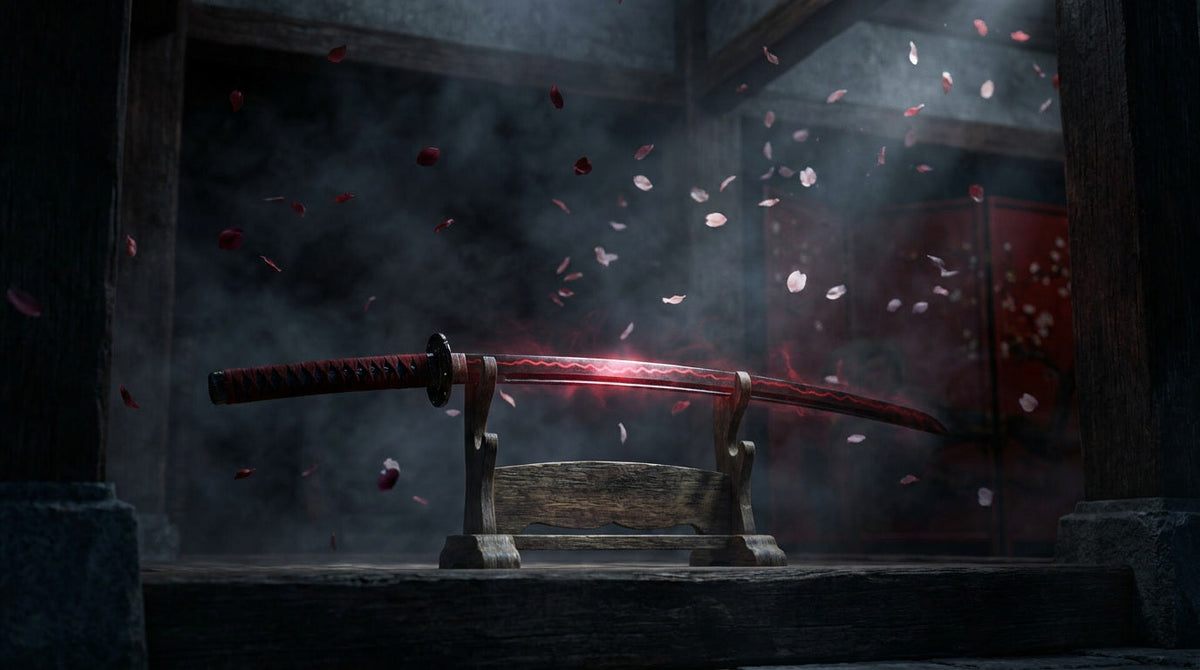
On the morning of January 18, 1946, a young American sergeant arrived at the Mejiro police station in occupied Tokyo to collect a pile of confiscated samurai swords. Among them was the most important sword in Japanese history: a katana forged 600 years earlier by the legendary smith Goro Nyudo Masamune, carried by generations of Tokugawa shoguns, designated a Japanese national treasure. The sergeant signed for the swords. Then he walked out. The blade has never been seen again.
The sword is the Honjo Masamune, and its 80-year disappearance is the single greatest unsolved mystery in Japanese cultural heritage. Generations of historians, government officials, sword collectors, and even the FBI have searched for it. None have succeeded. The blade exists somewhere, presumably in a private American collection, but no credible lead has emerged in decades.
This is the complete story: who forged the Honjo Masamune and why it matters, how it passed through six centuries of Japanese power, how it vanished on a single January morning, and the leading theories about where it sits today.

- What the Honjo Masamune was
- Masamune the smith: the legend behind the legend
- Six centuries of Tokugawa heritage
- December 1945: surrendering a national treasure
- The disappearance of January 1946
- The leading theories: where is it now?
- Modern search efforts and the FBI angle
- Why this sword still matters
- Common questions
What the Honjo Masamune was
The Honjo Masamune (本庄正宗) was a Japanese tachi sword forged in the late Kamakura period - most likely between 1300 and 1320 - by Goro Nyudo Masamune, the most celebrated swordsmith in Japanese history. The blade measured approximately 79 cm (31 inches) in cutting length, with the gentle curvature characteristic of Soshu-school tachi work. Its hamon, the temper line that marks the boundary between hardened edge and softer spine, flowed in an irregular notare pattern that subsequent generations of polishers preserved meticulously.
The sword's name comes from one of its 16th-century owners: a general named Honjo Shigenaga, who reportedly took the blade as battle spoils during the Sengoku period. Before Honjo's possession, the sword had passed through several daimyo lineages; after him, it eventually entered the hands of the Tokugawa shogunate, where it remained for over 300 years as the personal blade of the shogun's main family.
The Honjo Masamune was designated a Japanese national treasure (kokuhō) in 1939 - the highest cultural designation a single object can receive in Japan. At the time of its disappearance, it was widely considered the most historically important sword in existence.
Beyond physical dimensions, the Honjo Masamune was a near-mythological object. The Masamune name carried such weight in feudal Japan that to own one was to claim direct lineage to the highest tier of military aristocracy. The Honjo Masamune was the most prized of all Masamune blades, and one of fewer than 100 surviving Masamune-attributed swords known to exist.
Masamune the smith: the legend behind the legend
Goro Nyudo Masamune (1264-1343) was not just a swordsmith. He was the principle around which Japanese sword philosophy was built. Working in Sagami Province during the Kamakura period, Masamune developed the Soshu school of forging, a tradition that prized exceptional blade hardness, intricate hamon patterns, and what classical writers described as a metaphysical refinement of the steel itself.
Masamune is one of two smiths whose names define Japanese sword history. The other is Muramasa - Masamune's spiritual opposite. A famous legend (mostly apocryphal but widely retold) holds that the two smiths once tested their blades by lowering them into a stream. Muramasa's sword sliced every leaf and fish that drifted past. Masamune's sword refused to cut a single leaf or fish - the current parted around the edge instead. The lesson, taught for centuries to apprentice smiths, was that a great blade cuts what must be cut, not everything in its path. Masamune's swords were considered moral as well as functional.
Of Masamune's many surviving works, several are designated Japanese national treasures and reside in museums: the Daihannya Nagamitsu Masamune at the Tokyo National Museum, the Kotegiri Masamune held by the Imperial Household Agency, and others. The Honjo Masamune was widely considered the finest of them all.
For more on Masamune and other legendary smiths, see our complete guide to famous Japanese swordsmiths.
The signature on a Masamune blade is itself contested. Most surviving Masamune-attributed swords are unsigned - Masamune himself rarely signed his work, and many later attributions were made by Edo-era experts based on metallurgical analysis of the hamon, grain structure (jihada), and overall blade geometry. The Honjo Masamune was attributed through centuries of unbroken provenance, never through a written signature.
Master-Forged Steel
Premium katanas in T10 and Damascus steel - the highest tier of our collection.


Six centuries of Tokugawa heritage
The path of the Honjo Masamune through Japanese history is itself a window into feudal politics.
The sword first emerges in the historical record during the Sengoku period (Warring States era, 1467-1615), when the general Honjo Shigenaga is said to have captured it from a defeated enemy during the conflicts around Kawanakajima. The Honjo family eventually sold or gifted the sword (accounts differ) to Toyotomi Hideyoshi, the unifier of Japan. When Hideyoshi died in 1598 and power transferred to Tokugawa Ieyasu, the Honjo Masamune passed with it.
From that point, the sword remained the personal property of the Tokugawa shogun's main line for nearly 250 years. It was carried in formal court occasions, present at succession ceremonies, and treated as a tangible link between each generation of Tokugawa shoguns and the dynasty's founder.
After the Meiji Restoration ended the Tokugawa shogunate in 1868, the sword remained in the Tokugawa family as a private heirloom. The Tokugawa were no longer politically powerful, but the Honjo Masamune was the single most valuable object they possessed, both monetarily and culturally. It was the proof of three centuries of stewardship over the Japanese state.
By the early 20th century, the sword was in the possession of Tokugawa Iemasa, the 22nd head of the Tokugawa main line, born in 1884. Iemasa held the sword throughout World War II.
December 1945: surrendering a national treasure
Following Japan's surrender in August 1945, the occupying United States Armed Forces issued General Order No. 1, which banned the manufacture, ownership, or trade of swords and similar weapons by Japanese civilians. The order was extraordinarily broad - it covered not only military weapons but also family heirloom katanas, ceremonial pieces dating back centuries, and even practice blades.
The intent of the order was to prevent any continuation of the militarized samurai-bushido ethos that had defined imperial Japan. The practical effect was the largest forced surrender of historical artifacts in Japanese history. Over two million swords were collected nationwide. Many were destroyed, melted for scrap, dumped at sea, or quietly claimed as personal trophies by American servicemen.
Most senior Japanese families, including the Tokugawa - were faced with an impossible choice: surrender the blade or hide it. Many hid them. The Tokugawa family, conscious of their historical role and the need to set an example for a rebuilding nation, chose to comply.
In December 1945, Tokugawa Iemasa personally surrendered 14 of his family's most valuable swords, including the Honjo Masamune - to the Mejiro police station in Tokyo. The blades were officially logged. Iemasa was informed they would be examined and, in some cases, returned to their owners.
The choice to surrender these swords would weigh on Tokugawa Iemasa for the rest of his life. Documentary evidence suggests he believed he was making a temporary sacrifice for the rebuilding of postwar Japan. He did not anticipate that the most important sword in his family's six-century history would simply vanish.
The disappearance of January 1946
The sequence of events between December 1945 and January 1946 is partially documented in US military logs and Japanese police records.
On January 18, 1946, an American sergeant arrived at the Mejiro police station to collect the surrendered blades. The Japanese officers' records - preserved by the Tokyo Society for the Preservation of Japanese Art Swords - recorded his name phonetically as "Coldy Bimore", an unusual rendering that has resisted complete identification despite eight decades of research. He was attached to AFWESPAC, the Armed Forces Western Pacific unit responsible for processing confiscated Japanese swords.
He signed a receipt for 15 swords from the Mejiro station collection, the Honjo Masamune among them. The signature on that receipt is the last definitive trace of the blade.
What happened next is unknown. The standard procedure was for confiscated swords to be transported to a central inspection point, evaluated, and either preserved for repatriation, retained for military study, or destroyed. The Honjo Masamune's path after January 18 has never been reconstructed. It did not appear in any subsequent inspection logs. It was not in any of the trophy lots returned to the United States in later years. It did not surface in any of the family-owned American sword collections that have since been catalogued.
The sergeant himself, "Coldy Bimore" (almost certainly a phonetic misspelling of an American name), has never been identified despite the FBI being asked to assist. Candidate names range from "Cody Belmore" to "Cole D. Bell" to "Coleman Beemore" - none have matched a documented serviceman in the AFWESPAC unit during the relevant weeks.

The leading theories: where is it now?
Four major theories have been proposed about where the Honjo Masamune sits today.
Theory 1: In a private American collection. This is considered the most likely scenario. Many of the swords collected by US servicemen in 1945-46 were taken home as souvenirs, often without knowledge of their historical value. The Honjo Masamune may sit in a basement, attic, or unmarked vault in an American home - unrecognized as the cultural treasure it is. Multiple descendants of US occupation soldiers have come forward with antique Japanese swords over the decades; none have so far matched the documented specifications of the Honjo Masamune.
Theory 2: Destroyed in transit or storage. A meaningful portion of confiscated swords were ordered destroyed as part of bulk processing - particularly blades deemed "non-historical" by inspectors who were not specialists in Japanese sword history. The Honjo Masamune may have been melted down, dumped, or otherwise destroyed before its significance was recognized by anyone in the chain of custody.
Theory 3: In a museum or government vault. A small but persistent theory holds that the sword was identified as significant by US officials, placed into a classified collection (likely for political reasons related to postwar US-Japan diplomacy), and forgotten. The most often-cited candidate is one of several Smithsonian storage facilities, though no documentary evidence supports this. The theory survives mostly because of how perfectly it explains the absolute silence after January 18.
Theory 4: Secretly kept in Japan. A minority theory holds that the surrender to American forces was staged - that the Tokugawa family arranged a substitute blade and hid the actual Honjo Masamune. No evidence supports this either, and Tokugawa family records appear to indicate the surrender was genuine. The theory persists in some Japanese historical circles mostly as a hopeful counter-narrative.
| Theory | Probability | Reasoning |
|---|---|---|
| Private US collection | High | Many trophy swords were taken home unrecognized |
| Destroyed in transit | Medium | Bulk destruction was standard procedure for many blades |
| Government vault | Low | No documentary evidence in declassified records |
| Hidden in Japan | Very Low | Tokugawa records indicate genuine surrender |
The most discouraging aspect of the four theories is that the most probable one - sitting in an American home - offers the least path to recovery. Without a holder coming forward voluntarily, identification would require either an heir recognizing the blade or a public auction listing.
Modern search efforts and the FBI angle
Search efforts for the Honjo Masamune have been ongoing for 80 years.
The Tokyo Society for the Preservation of Japanese Art Swords - closely linked to the NBTHK authentication body - has maintained an active registry of leads since the 1950s. They have evaluated dozens of swords brought forward by descendants of US servicemen; none have so far matched the documented hamon, blade length, and other physical markers of the Honjo Masamune.
The Japanese government has made periodic diplomatic inquiries through the US State Department, particularly in the 1980s and 1990s. The State Department was unable to locate the sergeant who took receipt of the sword or any subsequent record of its disposition. The trail goes definitively cold at January 18, 1946.
The FBI was formally asked to assist with the search in 1997, following a high-profile feature on Japanese television (NHK) that brought international attention to the case. The FBI's response was that they could not investigate without specific evidence of theft from a US owner, a circular requirement given that the sword had been surrendered, not stolen, and its current US owner (if one exists) is by definition unknown.
Civilian and academic researchers have made the most genuine progress. The Japanese genealogist Joel Vorster published the most thorough identification attempt for "Coldy Bimore" in 2008, narrowing potential candidates to a small pool of US sergeants who served in AFWESPAC during the relevant period. None of those candidates produced the blade or any knowledge of it. Several have descendants who have been contacted; all denied any family heirloom matching the description.
Multiple Japanese television documentaries - most notably an NHK special in 2014 - have profiled the case and solicited public information. Each broadcast has generated leads, none have proven productive. The most recent serious search push came in 2021, when a Japanese cultural foundation announced a private reward for information leading to recovery; as of writing, no qualifying lead has emerged.
For more on how Japanese swords are formally authenticated and traced, see our NBTHK authentication guide.
A Japanese antique-sword scholar named Iwao Hakusui claimed in 1981 to have located the Honjo Masamune in the collection of an American family in New England. He travelled to the United States to inspect it in person. The blade, while a genuine Masamune-period sword of significant value - was not the Honjo Masamune. The lead was a dead end, but its very existence confirms that authentic Masamune blades do circulate quietly in private American collections, suggesting the genuine Honjo Masamune may also be sitting unnoticed somewhere in the United States.

Why this sword still matters
Eighty years after the disappearance, the Honjo Masamune remains a focus of Japanese cultural attention. The reasons go well beyond the monetary value of a single artifact.
Cultural continuity. Japan's modern identity was built partly on the preservation of feudal-era artifacts that survived the upheavals of the Meiji Restoration and World War II. The Honjo Masamune is the most symbolically important Japanese sword that did not survive, and its absence is felt as a wound in the cultural inheritance.
Tokugawa legacy. The blade represents the Tokugawa dynasty's three-century stewardship of Japan. Its loss diminishes the family's historical legacy in a way that no other artifact would. Several Tokugawa descendants have publicly spoken about the sword's absence and what its recovery would mean for the family's relationship to its own past.
The mystery itself. Most lost artifacts of comparable importance have known fates: destroyed, stolen, or sold. The Honjo Masamune is unusual in that no credible end-state is documented. It almost certainly exists, somewhere. This uncertainty keeps the case alive in cultural imagination across both Japan and the West.
Recovery is still possible. Each generation of researchers has approached the case with new tools - genealogical databases tracing US servicemen's descendants, online sword forums where private collectors compare notes, public-information requests across federal archives. The blade could surface tomorrow in someone's attic, recognized by a grandchild as something other than "an old Japanese sword from the war."
For collectors, historians, and the Japanese public alike, the Honjo Masamune is the holy grail of cultural-heritage recovery. Returning it to Japan would be among the most significant cultural events of the 21st century.
For more on Japan's surviving legendary blades, see our guide to the famous samurai and their legendary katanas.
Common questions
Is the Honjo Masamune really gone forever?
Almost certainly not destroyed, but possibly unrecoverable in practice. The most probable location is a private American home where the holder does not realize what they have. Without voluntary disclosure or a public auction listing, the blade would remain unidentified indefinitely. Specialists consider eventual recovery possible but unlikely within any specific timeframe.
How much would the Honjo Masamune be worth if recovered?
Any monetary estimate undersells the case. A high-quality unsigned Masamune blade with good provenance has sold for several million US dollars at recent international auctions. The Honjo Masamune - with documented unbroken Tokugawa provenance, national treasure designation, and historical mystique - would likely be the most valuable single sword ever sold. Specialist estimates range from $50 million to $100 million in a private sale, though the Japanese government would likely intervene to prevent commercial sale and return the blade to Japan as national property.
Why didn't the Tokugawa family simply hide it?
Many other prominent Japanese families did hide their valuable swords during the postwar confiscations, and a number of important blades were preserved that way. The Tokugawa family's choice to comply with the surrender order appears to have been a deliberate decision to set a public example as a former ruling family, an act of civic responsibility that, in hindsight, cost them the most important artifact in their possession.
What would happen if someone in the US found it tomorrow?
Under current US-Japan cultural property agreements, the blade would likely be repatriated to Japan as recognized national patrimony. The holder might receive financial compensation depending on negotiated terms, but commercial sale on the open market would be politically and legally complicated. The Japanese government has signaled willingness to negotiate compensation in exchange for return; the practical mechanics would depend on the specific circumstances of discovery.
Are there other lost Masamune swords?
Several. Of the estimated 100-plus surviving Masamune-attributed blades, roughly a dozen are considered "lost" in the sense that their current location is unknown. Most are presumed to be in private collections or destroyed during various conflicts over the centuries. The Honjo Masamune is the most prominent because of its Tokugawa provenance and national treasure status, but it is not unique in disappearing from the historical record.
Why was the postwar confiscation of swords even legal?
Under the terms of Japan's unconditional surrender in 1945, Allied occupation forces had near-absolute authority to issue directives in occupied territory. General Order No. 1 was issued under that authority and applied uniformly to all Japanese civilians regardless of historical or cultural status of individual items. The order was modified in later years to permit retention of items of recognized artistic or historical value, but most of those modifications came after the initial wave of confiscations had already taken place.
For the Serious Collector
Each blade below is forged for collectors who refuse to compromise on steel.


One signature. One sergeant. One lost blade.
The Honjo Masamune remains the most prominent reminder that even the most important objects can vanish on a single morning. Browse our premium katana collection for hand-forged blades in the Soshu tradition that produced Japan's most celebrated swords.
Want to explore more of Japan's legendary swordsmiths? Read our complete guide to famous Japanese swordsmiths.
Eighty years. One January morning. The blade is still out there.
Share:
Katana Buying Guide: Everything You Need to Know