

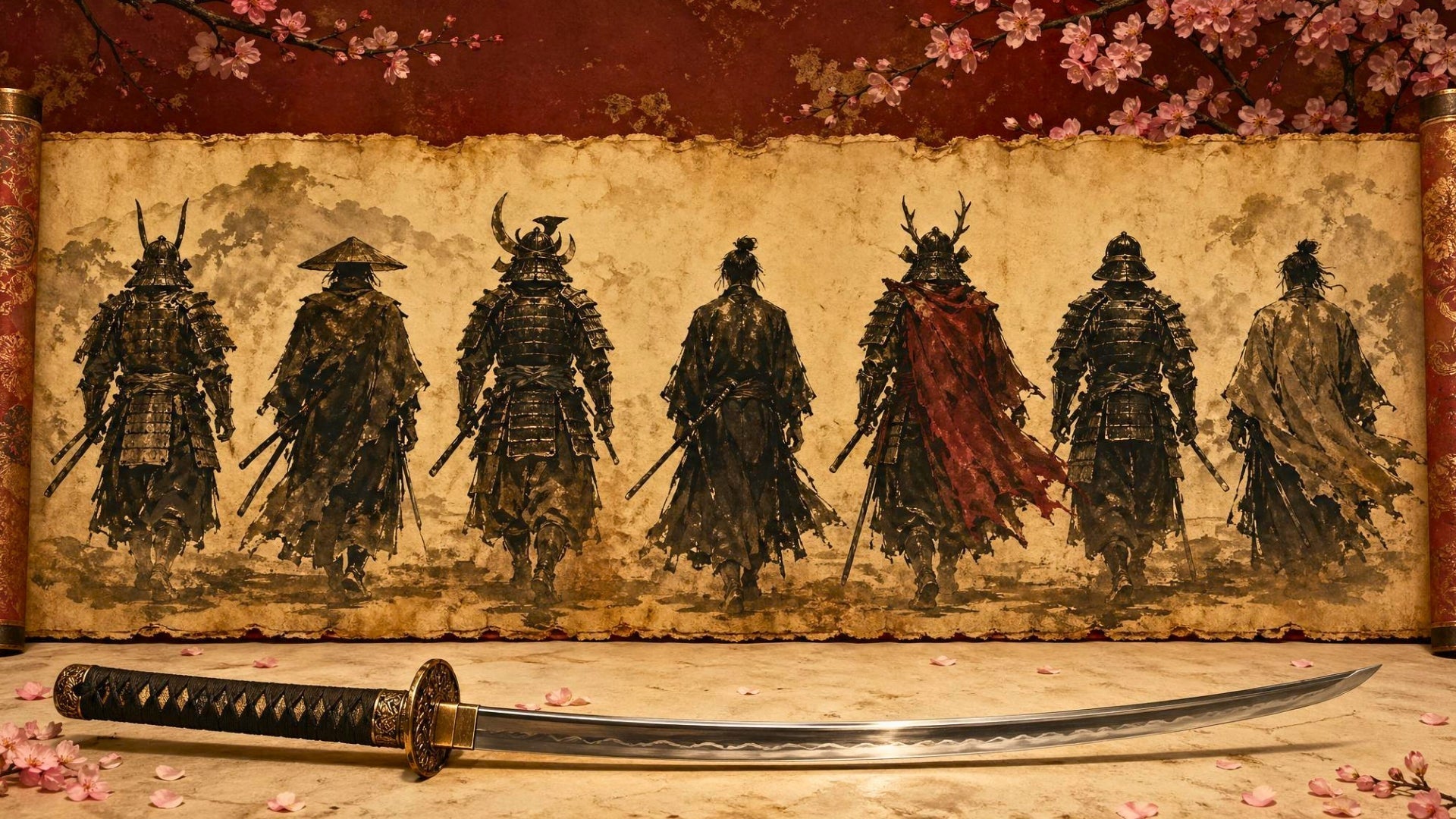
Miyamoto Musashi killed his first opponent at age 13. He fought over 60 duels and never lost one. At 29, he faced the legendary Sasaki Kojirō on a tiny island, and won with a wooden sword he'd carved from an oar on the boat ride over. The man was so dominant that he eventually stopped using real blades because no one could challenge him.
But Musashi is just one name in a lineage of warriors whose lives and swords shaped Japanese history. Behind every great samurai was a blade - forged by a master smith, carried through battles and betrayals, and in some cases, passed down through centuries until it vanished into myth.
This article profiles the most famous samurai in history and the legendary swords they wielded, from blades that still exist in museums to those that disappeared in the chaos of World War II and have never been recovered.
- Miyamoto Musashi - The Undefeated Swordsman
- Oda Nobunaga - The Demon King Who United Japan
- Tokugawa Ieyasu & The Honjo Masamune
- Date Masamune - The One-Eyed Dragon
- Minamoto no Yoshitsune - The Tragic Hero
- Masamune vs Muramasa: The Two Greatest Smiths
- 5 Legendary Swords That Shaped History
- Frequently Asked Questions
- Carry the Legacy
Miyamoto Musashi: The Undefeated Swordsman
Musashi is the most famous swordsman in Japanese history - arguably in all of human history. He developed the Niten Ichi-ryū (two-sword style), fighting simultaneously with a katana in one hand and a wakizashi in the other. This was revolutionary: convention dictated a two-handed grip. Musashi broke convention and never lost.
His most famous duel against Sasaki Kojirō at Ganryū Island in 1612 is the stuff of legend. Musashi arrived late - deliberately, and fought with an oversized wooden sword (bokken) he'd carved from a spare oar. He killed Kojirō with a single blow to the skull. Whether the delay was strategic psychology or simple arrogance, the result was the same: total victory.
Later in life, Musashi retired from dueling and wrote Go Rin No Sho (The Book of Five Rings), a treatise on strategy, combat, and life philosophy that is still studied by martial artists, business leaders, and military strategists today.
Musashi was also an accomplished painter, sculptor, and calligrapher. His ink paintings - particularly his depictions of birds and Bodhidharma - are considered masterworks of Edo-period art. The warrior who never lost a fight also never lost his brush.

Legendary Steel, Modern Forge
Premium katanas forged in the tradition of the great masters.


Oda Nobunaga: The Demon King Who United Japan
Nobunaga was not the greatest swordsman - he was something more dangerous: the greatest strategist. He was the first Japanese warlord to systematically use firearms (arquebus) on the battlefield, smashing the cavalry of the Takeda clan at the Battle of Nagashino in 1575. He began the process of unifying Japan after a century of civil war.
Nobunaga earned the self-proclaimed title "Demon King of the Sixth Heaven", a Buddhist reference to the most powerful demon lord. He was ruthless: he burned the entire Enryaku-ji monastery complex on Mount Hiei, killing thousands of monks, women, and children. He destroyed the power of the Buddhist warrior monks who had opposed him for years.
His assassination in 1582 - betrayed by his own general Akechi Mitsuhide at Honnō-ji temple - is one of the most dramatic moments in Japanese history. Surrounded and outnumbered, Nobunaga reportedly set the temple on fire and committed seppuku rather than be captured. His body was never recovered.
Nobunaga's personal swords included blades by the finest smiths of his era, though his true weapon was innovation itself - he changed Japanese warfare forever.
Tokugawa Ieyasu & The Honjo Masamune
Ieyasu was the patient man of Japanese history. While Nobunaga conquered and Hideyoshi consolidated, Ieyasu waited. After both were gone, he won the decisive Battle of Sekigahara in 1600 and established the Tokugawa Shogunate, a dynasty that would rule Japan for over 250 years.
The sword most associated with Ieyasu's lineage is the Honjo Masamune - widely considered the greatest katana ever forged. Created by the legendary smith Gorō Nyūdō Masamune during the Kamakura period, it became the ultimate symbol of Tokugawa authority. The blade was passed down through the Tokugawa shoguns for generations as a symbol of political legitimacy.
In 1945, after Japan's surrender, the Allied occupation ordered all swords surrendered. The Honjo Masamune was given to a police station in Mejiro by Tokugawa Iemasa, and was never seen again. It remains one of the world's most famous missing artifacts. To this day, its whereabouts are unknown.
The Honjo Masamune, a Japanese National Treasure, the personal sword of the Tokugawa shoguns, and arguably the most important katana ever made - has been missing since December 1945. Historians believe it was either destroyed, sold to an unknowing American soldier, or is sitting in a private collection somewhere, unidentified.

Date Masamune: The One-Eyed Dragon
Date Masamune lost his right eye to smallpox as a child, or, in some accounts, gouged it out himself to prove his resolve. Either way, the missing eye became his signature, along with a distinctive crescent-moon helmet that made him instantly recognizable on the battlefield.
Masamune was one of the most powerful daimyo of his era. He ruled the Date clan's territory from Sendai and was known as both a ruthless military commander and a surprising diplomat - he sent a delegation to the Vatican and the Spanish court, attempting to forge European alliances decades before Japan closed its borders.
His personal swords, commissioned from the finest smiths of the late Sengoku and early Edo periods, were renowned for their quality. The Date clan maintained a strong swordsmithing tradition, and several blades attributed to Masamune's collection survive in museums today.
Date Masamune is one of the most portrayed historical figures in Japanese pop culture. He appears as a playable character in the Sengoku Basara video game series, the Samurai Warriors franchise, and in the anime Masamune-kun's Revenge. His iconic crescent-moon helmet and eyepatch have become visual shorthand for "badass samurai."
Minamoto no Yoshitsune: The Tragic Hero
Yoshitsune is the archetype of the tragic samurai - brilliant in war, destroyed by politics. As a general during the Genpei War (1180-1185), he won a series of legendary victories against the Taira clan using audacious tactics that broke every rule of conventional warfare.
At the Battle of Ichi-no-Tani (1184), he led a cavalry charge down a near-vertical cliff face, an attack so suicidal that it worked precisely because no one expected it. At the naval Battle of Dan-no-ura (1185), he destroyed the Taira fleet and effectively ended the war.
But his older brother Yoritomo, who became the first shogun of the Kamakura Shogunate - grew jealous and suspicious. Yoshitsune was declared an outlaw. He fled north, was cornered at the castle of Koromogawa, and died by his own sword at age 30. His story became the template for the tragic hero in Japanese literature - the warrior too talented to survive the politics of peace.
Yoshitsune's sword - though its specific name varies across accounts - is emblematic of the tachi style that dominated the Heian and Kamakura periods: long, deeply curved blades worn edge-down, optimized for mounted combat. For more on how tachi evolved into the katana, see our history of Japanese swords.
Masamune vs Muramasa: The Two Greatest Smiths
No article about legendary katanas is complete without the two names that defined Japanese swordsmithing, and the legend that binds them.
Gorō Nyūdō Masamune (c.1264-1343)
Masamune is universally regarded as the greatest swordsmith in Japanese history. Working during the Kamakura period in Sagami Province (modern Kanagawa), he developed techniques that other smiths spent centuries trying to replicate. His blades are characterized by brilliant nie (crystalline particles), subtle and refined hamon patterns, and a purity of steel that was extraordinary for an era when raw materials were full of impurities.
His blades carry an almost spiritual reputation: legend says a Masamune sword, placed in a stream, would let leaves float past uncut, a metaphor for the blade's peaceful, restrained character.
Muramasa (active c.1460-1530)
Muramasa of Ise Province was Masamune's polar opposite - at least in legend. His blades were sharper, more aggressive, and gained a dark reputation as cursed weapons that drove their owners to violence and madness. Multiple Tokugawa family members suffered injuries or deaths involving Muramasa blades, leading Ieyasu himself to ban them.
The famous "stream test" legend puts both smiths head to head: Masamune's blade let leaves pass; Muramasa's cut every leaf that touched it. The story concludes that Masamune's restraint made him the greater smith - his blade chose when to cut.
Muramasa blades weren't actually cursed - the Tokugawa association with injury was likely coincidence amplified by superstition. Muramasa was an exceptionally skilled smith, and his blades were widespread. The "curse" narrative served a political purpose: banning Muramasa swords consolidated Tokugawa authority by eliminating weapons associated with their enemies.
5 Legendary Swords That Shaped History
| Sword | Smith / Era | Significance | Status |
|---|---|---|---|
| Honjo Masamune | Masamune, Kamakura | Personal sword of the Tokugawa shoguns. Symbol of political legitimacy for 250 years. | Missing since 1945 |
| Dōjigiri Yasutsuna | Yasutsuna, Hōki Province | One of the "Five Swords Under Heaven." Said to have been used to slay the demon Shuten-dōji on Mount Ōe. | Tokyo National Museum (National Treasure) |
| Kogarasu Maru | Attributed to Amakuni, 8th century | "Little Crow", a rare double-edged tachi considered one of the oldest Japanese swords in existence. | Imperial Collection |
| Kusanagi-no-Tsurugi | Mythological | One of the three Imperial Regalia of Japan. Said to have been found inside an eight-headed serpent by the god Susanoo. | Atsuta Shrine (never publicly displayed) |
| Mikazuki Munechika | Sanjō Munechika, Heian Period | "Crescent Moon" - named for the crescent-shaped patterns on the blade. One of the Five Swords Under Heaven. | Tokyo National Museum (National Treasure) |
Each of these swords represents a different dimension of Japanese blade culture: political power (Honjo Masamune), myth and legend (Kusanagi), craftsmanship (Mikazuki Munechika), demon-slaying folklore (Dōjigiri), and archaeological mystery (Kogarasu Maru).
For a deep dive into how these blades were forged - the steel, the clay tempering, the hamon patterns that made them famous - explore our guide to the forging process and our complete hamon reference.
Frequently Asked Questions
Who was the greatest samurai of all time?
Most historians point to Miyamoto Musashi - he fought over 60 duels without a single defeat. But "greatest" depends on the criteria. For military strategy, Oda Nobunaga transformed Japan. For lasting political impact, Tokugawa Ieyasu created 250 years of peace. For pure tragic heroism, Minamoto no Yoshitsune is unmatched.
What happened to the Honjo Masamune?
It was surrendered to an Allied police collection point in Mejiro, Tokyo, in December 1945. After that, it vanished. It may have been destroyed, sold unknowingly to a foreign collector, or still exist unidentified in a private collection. Despite decades of searching, it has never been recovered.
Were Muramasa swords really cursed?
No. The "curse" was a political narrative amplified by the Tokugawa family after several members were injured or killed by Muramasa blades - likely coincidence, given how widespread his swords were. Banning Muramasa blades served to consolidate Tokugawa authority and eliminate weapons associated with rival clans.
Who was a better swordsmith: Masamune or Muramasa?
They worked in different eras (Masamune in the Kamakura period, Muramasa in the Muromachi period) and had different philosophies. Masamune is considered the greater artist - his blades are purer, more refined, and carry a contemplative quality. Muramasa's blades are sharper and more aggressive. Both were masters of the highest order.
Can I buy a sword inspired by these legendary blades?
You can't buy originals - most are in museums, imperial collections, or missing. But modern swordsmiths create blades using the same techniques Masamune pioneered: hand-forging, clay tempering, and differential hardening. Our katana collection features blades forged in this tradition.
Carry the Legacy
The samurai who shaped history are gone. Their swords - some of them - remain. And the techniques that forged those legendary blades are still practiced today.
Every katana in our hand-forged collection is made using the same principles Masamune pioneered: high-carbon steel, clay tempering, differential hardening, and a real hamon. It's not a museum piece, but it carries the same tradition.
New to the world of Japanese swords? Start with our beginner's guide or explore the full history of the katana.
Legends are forged in steel. This is how they endure.
Stand Among Legends
These hand-forged blades carry the weight of centuries - chosen for collectors who demand the best.
Share:
How to Spot a Fake Katana: 8 Red Flags Every Buyer Must Know
Demon Slayer Swords: Every Nichirin Blade Color Explained