

Search for katanas online and you'll see the same phrase repeated hundreds of times: "clay tempered with real hamon." It's on every product listing, every comparison chart, every review site. But most of those pages never explain what it actually means, or why it should matter to you as a buyer.
Clay tempering isn't a marketing buzzword. It's a 1,000-year-old heat treatment process that fundamentally changes the physics of a blade. A clay tempered katana has two different hardness zones in the same piece of steel: a razor-hard edge for cutting and a flexible spine for absorbing shock. A non-clay-tempered blade has neither - it's a compromise all the way through.
This guide explains what clay tempering does, why collectors and practitioners seek it out, how to verify it's real, and whether the price premium is justified.
What Is Clay Tempering? The 1,000-Year-Old Process Explained
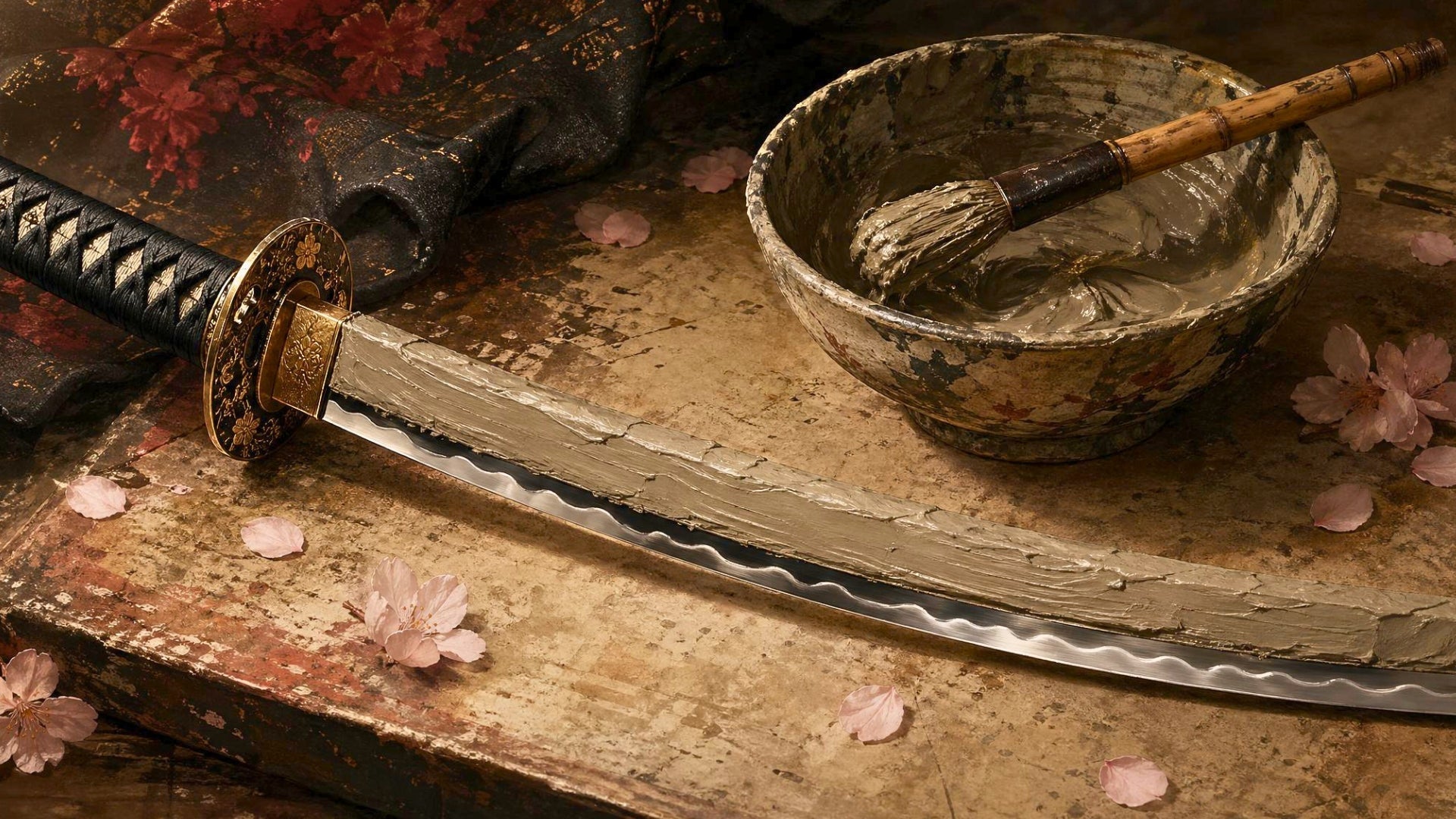
Clay tempering - known in Japanese as tsuchioki (the clay application) and yaki-ire (the quenching) - is a differential hardening technique where the swordsmith controls which parts of the blade become hard and which stay soft.
The process is deceptively simple to describe and terrifyingly difficult to execute:
The smith mixes a clay compound (traditionally clay, charcoal powder, and ground stone - the exact recipe is secret and varies by school). He applies a thick layer to the spine and a thin layer to the cutting edge. The blade is heated to approximately 750-800°C, then plunged into water in a single decisive motion.
The thin-coated edge cools rapidly → hardens into martensite (58-62 HRC). The thick-coated spine cools slowly → stays as pearlite (38-45 HRC). The visible boundary between these two zones is the hamon - the temper line.
Even master swordsmiths fail 10-30% of the time during yaki-ire. If the temperature is wrong, the clay uneven, or the quench speed off, the blade cracks - destroying months of work in an instant. A sharp "ping" during quenching tells the smith the blade is ruined before he even pulls it from the water. This failure rate is a major reason clay tempered katanas cost more.

For the full science behind how this process creates the hamon and the blade's curve, see our complete guide to hamon and our explanation of why katanas are curved.
Clay-Tempered Blades
Each katana below features genuine differential hardening, a real hamon, not an etched imitation.


The 4 Real Benefits of a Clay Tempered Katana
1. Superior Edge Retention
The hardened edge (58-62 HRC) holds its sharpness significantly longer than a through-hardened blade at 50-54 HRC. For practitioners who cut tatami or bamboo regularly, this means fewer sharpening sessions and more consistent performance over months of use.
2. Shock-Absorbing Spine
The softer spine (38-45 HRC) flexes under impact instead of transmitting the full shock to the edge. This dramatically reduces the risk of the blade snapping during a hard cut. A through-hardened blade at the same edge hardness would shatter - there's no soft zone to absorb the force.
3. Real Hamon
The hamon isn't just beautiful - it's proof that the blade was properly differentially hardened. A genuine hamon is the single most reliable visual indicator that you're holding a clay tempered blade, not a through-hardened one with a fake temper line painted on. Collectors prize the hamon as both an aesthetic feature and an authentication tool.
4. Natural Sori (Curvature)
The same process that creates the hamon also produces the katana's curve. The edge expands as it hardens into martensite; the spine doesn't. This differential expansion creates the sori naturally - no mechanical bending required. A clay tempered blade's curve is structural, not cosmetic.
Clay Tempered vs Through-Hardened: What Actually Changes?
A through-hardened (mono-tempered) blade is heated and quenched uniformly - no clay, no differential treatment. The entire blade ends up at the same hardness, typically 50-54 HRC. This is a compromise: hard enough to hold an edge, soft enough to flex, but not optimal at either.
| Feature | Clay Tempered | Through-Hardened |
|---|---|---|
| Edge Hardness | 58-62 HRC | 50-54 HRC |
| Spine Hardness | 38-45 HRC (soft, flexible) | 50-54 HRC (same as edge) |
| Edge Retention | Excellent - stays sharp longer | Good - dulls faster under heavy use |
| Shock Resistance | Excellent - spine absorbs impact | Good - spring-back characteristic |
| Hamon | Real - structural, permanent | None (or fake cosmetic version) |
| Blade Curve | Natural sori from quenching | Mechanically bent or preset |
| Forgiveness | Less forgiving - hard edge can chip on bad cuts | More forgiving - springs back from technique errors |
| Price Range | $250-$800+ | $150-$400 |
| Best For | Serious cutting, collection, authenticity | Beginners, heavy training, budget-conscious |
Through-hardened spring steel (5160, 9260) is actually more forgiving than clay tempered blades - it bounces back from bad cuts that would chip a clay tempered edge. For beginners still learning technique, a through-hardened blade is often the smarter first purchase. Clay tempering becomes the right choice once your form is solid and you want maximum cutting performance.
How to Verify a Real Clay Tempered Katana
The market is full of "clay tempered" claims on blades that are actually through-hardened with a fake hamon. Here's how to check:
Check the Hamon
A real hamon has depth and crystalline activity - tiny sparkling particles (nie) visible under magnification. It's irregular, organic, slightly different on each side of the blade. A fake hamon (acid-etched or wire-brushed) is perfectly uniform, flat, and smooth. Our hamon reference guide shows the visual difference in detail.
Test Hardness Differential
On a clay tempered blade, a hardness tester will show 58-62 HRC at the edge and 38-45 HRC at the spine, a gap of 15+ points. A through-hardened blade reads the same hardness everywhere. Not everyone has a Rockwell tester, but a reliable seller will list edge and spine hardness on the product page.
Check the Product Listing
A legitimate clay tempered katana listing should specify: the steel type (T10, 1095, etc.), the hardening method (clay tempered / differential hardening), edge HRC, and ideally show close-up photos of the actual hamon. If a listing just says "with hamon" and nothing else - be skeptical.

Which Steels Work Best for Clay Tempering?
Not all steels respond equally well to differential hardening. The best candidates are high-carbon steels that undergo a strong martensitic transformation during rapid cooling.
| Steel | Carbon | Clay Temper Suitability | Hamon Quality |
|---|---|---|---|
| T10 | ~1.0% | Check the model’s heat treatment | High contrast, dramatic |
| 1095 | ~0.95% | Excellent - classic choice for clay tempering | Beautiful, slightly softer transitions |
| 1060 | ~0.60% | Good - produces a genuine hamon, more forgiving | Visible but subtler |
| 1045 | ~0.45% | Marginal - low carbon limits martensitic reaction | Faint, often unclear |
| Spring Steel (9260) | ~0.60% | Poor - designed for uniform hardness | Not typically clay tempered |
For serious cutting with a clay tempered blade, T10 and 1095 are the go-to steels. For a more forgiving entry point into clay tempered katanas, 1060 offers a good balance. Our T10 vs 1095 comparison covers the performance differences in detail.
Traditional Japanese nihonto are clay tempered using tamahagane, a steel smelted from iron sand in a tatara furnace with a carbon content of 1.0-1.5%. This high carbon level produces some of the most spectacular hamons in sword history. Modern production katanas replicate this process using industrial T10 or 1095, which have similar carbon levels but far greater consistency.
Is the Price Premium Worth It?
Clay tempered katanas typically cost $50-$200 more than equivalent through-hardened blades from the same forge. That premium reflects the additional labor, the risk of failure during quenching, and the genuine performance upgrade.
You practice tameshigiri and want superior edge retention. You value authenticity and want a real hamon. You're building a collection and appreciate the visual and structural difference. Your technique is solid enough that a harder edge won't chip from bad hasuji (edge alignment).
You're a complete beginner, a through-hardened blade is more forgiving while you develop technique. Budget is tight, a good 1060 through-hardened katana at $200 outperforms a cheap "clay tempered" blade with questionable quality control. You mainly want a display piece - the hamon is beautiful, but a well-polished mono-steel blade can look just as striking on a stand.
Frequently Asked Questions
What does "clay tempered" mean on a katana?
It means the blade was differentially hardened using a clay coating before quenching. The edge becomes extremely hard (58-62 HRC) while the spine stays soft and flexible (38-45 HRC). This creates a real hamon temper line and the blade's natural curve. It's the traditional Japanese swordsmithing method used for over 1,000 years.
Is clay tempered better than through-hardened?
For edge retention and authenticity, yes. For forgiveness and beginner-friendliness, no. Clay tempered blades have a harder, sharper edge but can chip from technique errors. Through-hardened blades are uniformly tough and spring back from bad cuts. The "better" choice depends entirely on your skill level and intended use.
How can I tell if a hamon is real or fake?
A real hamon has crystalline depth (visible nie particles), organic irregularity, and exists through the blade's full thickness. A fake hamon - acid-etched or wire-brushed - is perfectly smooth, uniform, and disappears if polished. Check our hamon guide for visual examples.
Which steel is best for a clay tempered katana?
T10 and 1095 are the top choices - their high carbon content produces strong martensitic transformation and dramatic hamons. 1060 works well for a more forgiving option. Steels below 0.60% carbon (like 1045) don't respond well to clay tempering.
Does clay tempering make a katana more fragile?
The hard edge (58-62 HRC) can chip if struck against a hard surface or if cutting technique is poor. But the soft spine makes the blade far less likely to snap compared to a uniformly hard blade. Overall, a clay tempered katana is more durable than a through-hardened blade at the same edge hardness - the flexible spine acts as a shock absorber.
Two collector models that explicitly list clay tempering are Deep Sea Fang and Shizukesa. Both specify T10 steel, with different fittings and scabbard colors. Their listings describe display swords, not certified equipment for cutting practice.
Find Your Clay Tempered Blade
Clay tempering is the difference between a katana that looks authentic and one that actually is. Every clay tempered blade in our collection features genuine differential hardening, a real hamon, and natural sori.
Browse our high-end katana collection for the finest clay tempered blades, or explore the entry-level range where T10 clay tempered models start at $199.
Want to understand all your steel options? Our steel guide breaks down every choice from 1045 to T10 to Damascus.
The hamon doesn't lie. If it's real, the blade is real. Start there.
Real Hamon, Real Steel
Clay-tempered katanas with hand-applied tempering for an authentic temper line.

Share:
Damascus Steel Katana: Beautiful Art or Marketing Hype?
How to Spot a Fake Katana: 8 Red Flags Every Buyer Must Know