

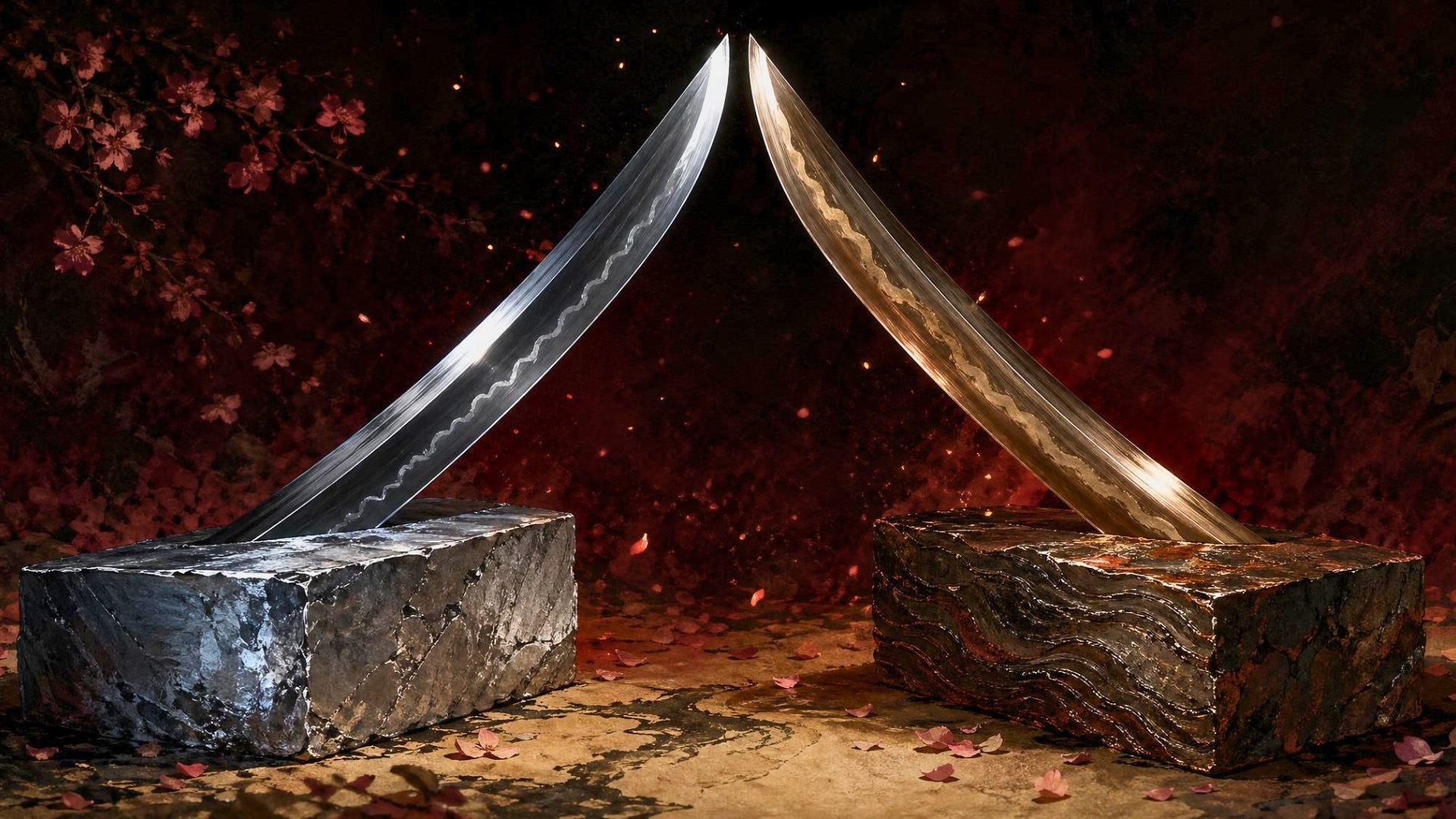
T10 or 1095? A steel name is a useful starting point, but it is not a test result for a finished katana. Compare the actual blade, its construction and its documented specifications before paying more for a label.
What the Steel Names Tell You
T10 and 1095 are steel designations, not complete descriptions of a sword. Do not treat a name as proof of a particular hardness, polishing method or intended use.
T10 belongs to the carbon tool steel family. Nanjing Iron & Steel lists T10A and T8A in its carbon tool steel product data. That reference describes steel grades; it is not a material certificate for Katana Corp products.
A T10 label should not be read as a guarantee of 0.3% tungsten or a performance advantage over 1095. Exact composition requires supporting material documentation for the steel supplied.
For a specific model, check the steel listed on its product page. If exact chemistry matters to your purchase, ask for supporting material documentation before ordering.
Hardness and Edge Retention: Ask for Evidence
A claim such as “60-62 HRC” needs evidence for the finished blade. The letters T10 or the number 1095 alone do not supply that measurement.
We cannot substantiate a universal two-point hardness advantage, a fixed sharpening interval, or a claim that every T10 katana is tougher than every 1095 katana. Compare documented model specifications instead of assuming that a higher price or a different grade proves better performance.
Hamon and Finish: Check the Individual Model
A steel designation does not establish whether a blade was clay tempered. Read the model’s hardening and finish description, and examine clear photos of its temper line. A blade can also have a decorative hamon finish, so the word “hamon” should not be treated as proof of the manufacturing method.
Our hamon guide introduces this feature. For the specific item you are considering, contact us if the description leaves the process unclear.
What to Compare Before Choosing
| Detail | T10 model | 1095 model |
|---|---|---|
| Steel | Confirm the listed grade | Confirm the listed grade |
| Hardness | Request a documented measurement | Request a documented measurement |
| Construction | Check the individual listing | Check the individual listing |
| Hamon | Check the stated process and photos | Check the stated process and photos |
| Size and finish | Compare dimensions, fittings and photos | Compare dimensions, fittings and photos |
| Price | Use the current product price | Use the current product price |
Frequently Asked Questions
Is T10 automatically better than 1095?
No. The grade alone does not establish that one finished katana is harder, tougher or better made than another. Compare the actual models and their supporting specifications.
Does T10 guarantee 0.3% tungsten?
We have no supplier certificate supporting that claim for our products. We therefore do not advertise a fixed tungsten percentage or a performance advantage based on it.
Does T10 guarantee a genuine hamon?
No. The steel name and the manufacturing process are different information. Check the individual blade’s description.
What should a collector prioritize?
Compare the blade finish, dimensions, handle, guard, scabbard and included display accessories. Choose a piece whose documented features suit your collection and budget.
For a blue-finish comparison, Blue Dragon lists T10 steel, while Azure Spirit lists 1095 steel. Compare each model's own finish and hamon details rather than treating the steel number as a performance rating.
Find a Katana for Your Collection
Katana Corp swords are sold for collection and display. A sharpened edge does not certify suitability for cutting practice.
Explore our katana collection or steel guide. For a question about a specific model, write to contact@katana-corp.com.
T10 Steel in Our Forge
Explore individual T10 models and compare their listed construction, finish and dimensions.


Share:
How to Care for a Katana: Complete Maintenance Guide
What Is a Hamon? The Science Behind a Katana's Temper Line