

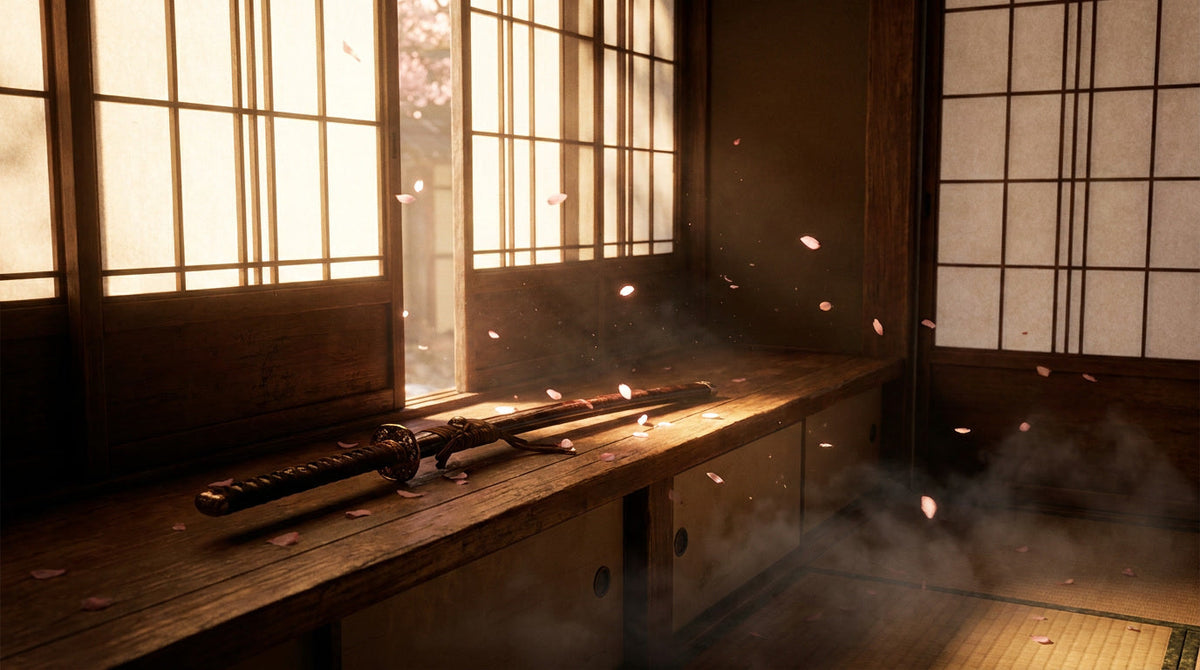
In Japan, handing someone a katana the wrong way is not just rude. It is the kind of error that ends conversations, ruins business relationships, and gets you escorted out of a sword shop. The blade itself is sacred. The handle is the only place a non-owner is allowed to touch. The angle, the direction, the speed of every gesture matters. None of this is decoration - it is centuries of practical safety encoded as ritual.
Japanese sword etiquette is the set of rules that governs how a katana is held, drawn, examined, passed, displayed, and stored. Some of these rules exist for cultural reasons. Most exist because a single careless gesture with a sharp blade can cause serious injury or permanently damage a sword worth more than most cars. Knowing the rules is part of being a serious owner.
This guide covers the practical etiquette that applies whether you are handling your own katana at home, examining a friend's blade, or visiting a Japanese collector who hands you a five-hundred-year-old heirloom and watches what you do next.
Why Japanese Sword Etiquette Matters
The rules of Japanese sword etiquette were not invented to make life difficult for collectors. They evolved over centuries of practical experience with sharp blades in social situations - dueling protocols, sword inspections, gift exchanges between samurai families, and museum-grade examinations of historical artifacts. Most of the rules trace back to a few core principles:
Safety first. A katana edge can cut through bone with a glancing touch. Every etiquette rule about how to hold, pass, or examine a blade is fundamentally about keeping the edge pointed away from people. The cultural framing is layered on top of basic injury prevention.
Protect the sword. A katana is fragile in specific ways. Skin oils etch the steel. Fingerprints become rust spots within weeks. Casual handling damages the polish that took hundreds of hours of work to achieve. Etiquette protects the blade from the people who handle it.
Respect for the maker. Every traditional Japanese sword represents the work of a swordsmith, a polisher, and a fittings craftsman - sometimes spread across generations. Treating the sword carelessly is treating their lifetime of skill carelessly.
Handle With Respect
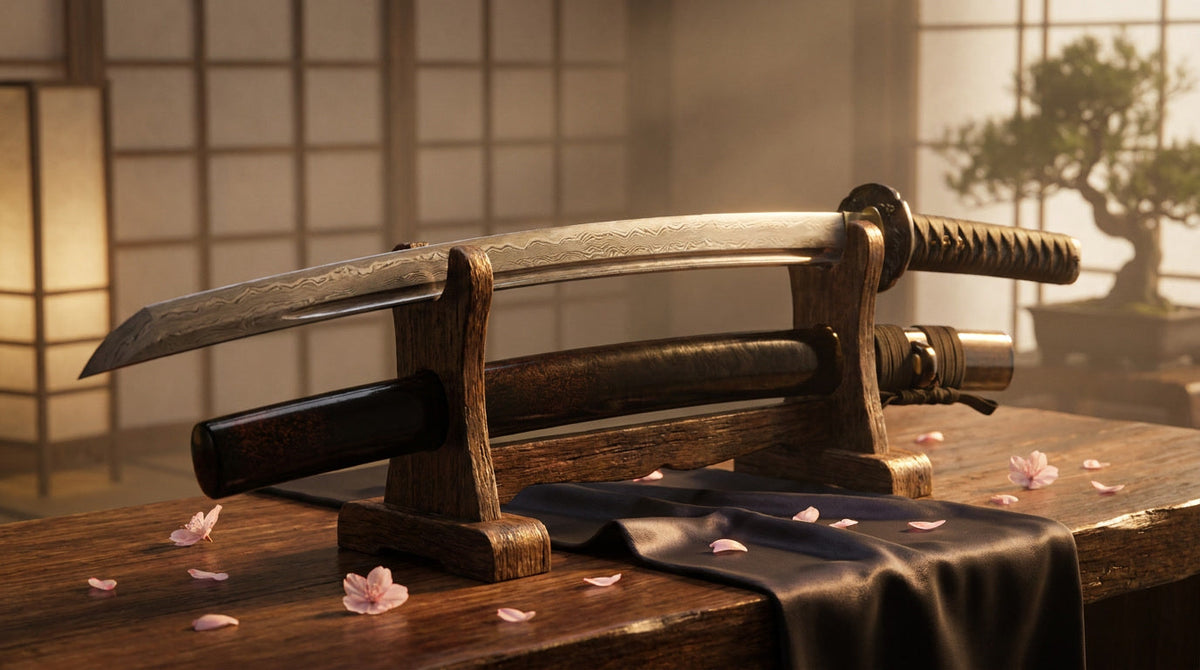
A katana, a stand, a silk bag - everything you need to honor traditional sword etiquette.


Picking Up a Katana
Start with the basics. A katana on a stand or in a saya should be picked up with specific gestures, not grabbed casually.
From a Sword Stand (Kake)
Approach the stand from the front. Place your right hand on the saya near the handle, your left hand near the bottom. Lift the sword horizontally with both hands, edge facing up, handle to your right. Never pick a katana off a stand by the handle alone - the saya can slide off and the blade can fall.
From a Flat Surface
Same principle. Both hands on the saya, lifting horizontally. The katana stays parallel to the ground throughout the motion. Avoid lifting the sword vertically by the handle, which strains the koiguchi (the saya's mouth) and risks dropping the blade.
For more on how the saya itself should be cared for, see our deep dive on the katana saya.
Drawing and Sheathing
Drawing a katana from its scabbard - even just to inspect it - follows specific rules.
The Draw
Hold the saya in your left hand at hip level, edge up. Place your right hand on the handle. Pull the blade out slowly along its curve, keeping the edge facing up the entire time. Never twist the blade as it leaves the scabbard - this scrapes the polish against the wood interior. The first few inches reveal the kissaki tip; the last few inches reveal the habaki collar.
The Sheath
Reverse the motion. Bring the blade to the saya mouth (koiguchi), align the back of the blade with the saya's interior groove, and slide the sword in along the curve. The blade should never touch the saya interior on the edge side - only the spine glides against the wood. A correct re-sheath ends with a soft "click" as the habaki seats into the koiguchi.
The fast draw motions used in iaido require properly fitted iaitō with reinforced koiguchi. Attempting these draws on a normal display katana will crack the saya, chip the polish, and frequently injure the user. Slow, deliberate draws only - unless you have specific training and equipment.
Examining a Blade
If you are examining a katana - your own, a friend's, or a museum piece - the rules tighten considerably.
Never Touch the Blade Directly
Skin oils corrode steel. Within 48 hours of being touched by bare fingers, a polished katana blade develops visible fingerprint-shaped rust spots that require professional re-polishing to remove. If you must touch the blade for any reason, use a clean cloth or wear cotton gloves. The mune (spine) is slightly more forgiving than the edge or surface, but the rule is still: do not touch.
Hold by the Tsuka or Habaki Only
Acceptable contact points: the handle (tsuka), the wrapped wooden grip, and occasionally the metal collar (habaki) at the base of the blade. Everything between the habaki and the kissaki is off-limits to bare hands.
Keep Your Mouth Closed
Saliva droplets corrode steel even faster than skin oil. Speaking, breathing heavily, or laughing while leaning over a drawn blade can cause visible damage. In formal Japanese sword examinations, examiners often hold a folded paper between their teeth (a fukusa) to prevent this.

Examine in Good Light, Slowly
Hold the blade horizontally, edge up, at chest height. Tilt slowly to catch the light along the hamon and grain. Move your eyes along the blade rather than swinging the sword. Never make cutting motions during examination - even "slow" practice cuts in someone else's house with someone else's blade are considered seriously inappropriate.
Passing a Sword to Another Person
This is where most foreigners get it wrong. Handing a katana to another person follows specific rules that signal trust, respect, and lack of hostile intent.
The Sheathed Pass
If the sword is in its saya, hold it horizontally with both hands. Position the handle to your right and the saya tip to your left. Offer it to the recipient with the edge facing up and the handle toward them. They take it with both hands and rotate it 180 degrees so the handle ends up at their right - mirroring your position.
The Drawn Pass (Rare)
Passing a drawn blade is unusual and reserved for formal sword examinations. Hold the blade horizontally, edge up, with the spine resting on a folded cloth across your forearms. The handle points toward the recipient, but you do not push the sword - the recipient leans in and takes the handle while you support the blade. Only after they have a secure grip do you withdraw your hands.
| Wrong Way | Right Way |
|---|---|
| Edge pointing toward the recipient | Edge facing up, away from both parties |
| One-handed transfer | Both hands, slow motion |
| Tossing or sliding across a surface | Direct hand-to-hand exchange |
| Recipient grabs the blade | Recipient takes the handle only |
| Quick swap | Pause for the recipient to confirm grip |
In feudal Japan, presenting a sword with the handle pointing toward someone was a serious gesture of trust - it meant they could draw the sword instantly while you were defenseless. The modern etiquette of handle-toward-recipient passing preserves that historical statement of non-hostility, even though no one is going to attack anyone in a 21st-century sword shop.
Display and Storage
Etiquette extends beyond handling to how the sword is displayed and stored. Proper presentation honors the blade and prevents long-term damage.
Display Direction
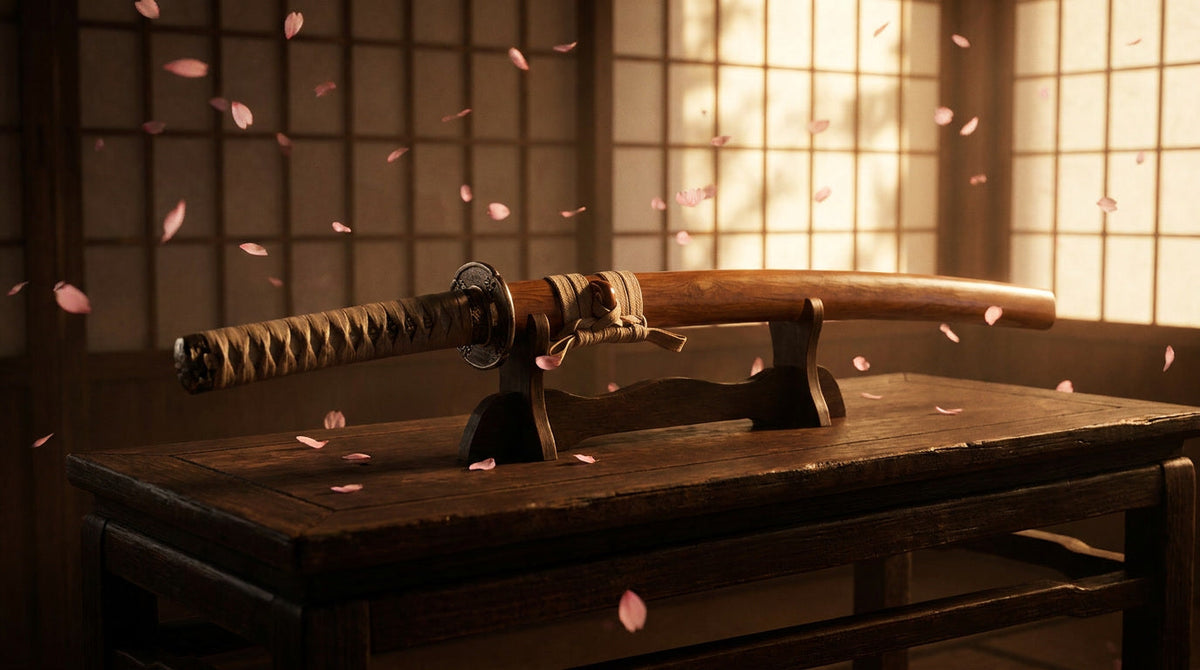
On a horizontal stand, the blade goes edge-up with the handle to the viewer's left. This is the same orientation a samurai would wear it at the belt - ready to draw with the right hand. Reversing this is a recognizable mistake covered in our full guide on how to display a katana.
Storage Position
For long-term storage, a katana should rest horizontally with the edge up. Vertical storage strains the saya fittings and can allow oil to pool at the kissaki. The blade should be lightly oiled with choji oil every six months to prevent rust.
Visiting Etiquette
When visiting a Japanese home or sword shop where katanas are displayed, do not touch any sword without explicit permission. Even pointing at a blade with an extended finger is considered impolite - use an open hand if you need to indicate a specific sword. Asking before touching is always correct; assuming permission is always wrong.
Frequently Asked Questions
Can I touch the blade with clean hands?
No. Even thoroughly washed hands have enough natural oils to start corrosion within 24-48 hours. Use cotton gloves or a clean cloth if you need to handle the blade directly. The only "clean" surfaces on a katana for bare-hand contact are the tsuka (handle) and the habaki collar.
Why is the edge always pointing up?
Two reasons. First, edge-up means the cutting edge is never pointed toward another person during handling, which prevents accidental injuries. Second, samurai wore katanas edge-up in the belt for fast drawing - the etiquette preserves that cultural orientation even when the sword is just being passed across a table.
Is it rude to draw someone else's katana without asking?
Yes, seriously rude. Drawing another person's katana without permission is the equivalent of going into their bedroom and trying on their wedding ring. Always ask, and accept that the answer may be no - some collectors do not let anyone draw their valuable blades, and that is their right.
What about kids and katanas?
Display swords in homes with young children should be stored in a locked case or out of reach. Children naturally want to handle interesting objects, and a katana - even a decorative one - can cause serious injury from a single touch on the edge. The etiquette principles apply to adults; for children, the principle is simply: no access without supervision.
Are these rules expected at sword shops outside Japan?
The serious shops, yes. Reputable Western dealers expect customers to follow proper handling etiquette when examining inventory - cotton gloves provided, edge always up, no fast draws, no swinging motions. Casual sword sellers may be more relaxed, but treating every blade as if you were in a Tokyo dealer's shop is always the safer approach.
Etiquette Is the Sword's Memory
Japanese sword etiquette is the set of habits that have kept blades intact for five hundred years. Every rule comes from someone, somewhere, who learned the hard way, a fingerprint that became rust, a draw that scarred a saya, a careless pass that ended in a hospital visit. Following the rules is how the next five hundred years of these blades survives.
Browse our katana collection for blades worth handling correctly, and read our how to display a katana guide for the visual setup that respects the same tradition.
Hold the handle. Mind the edge. Pass with both hands. The rest is detail.
Respect the Blade
Real katanas paired with the accessories that allow you to handle and store them properly.
Share:
Best Katana Steel: Complete Buyer's Guide