

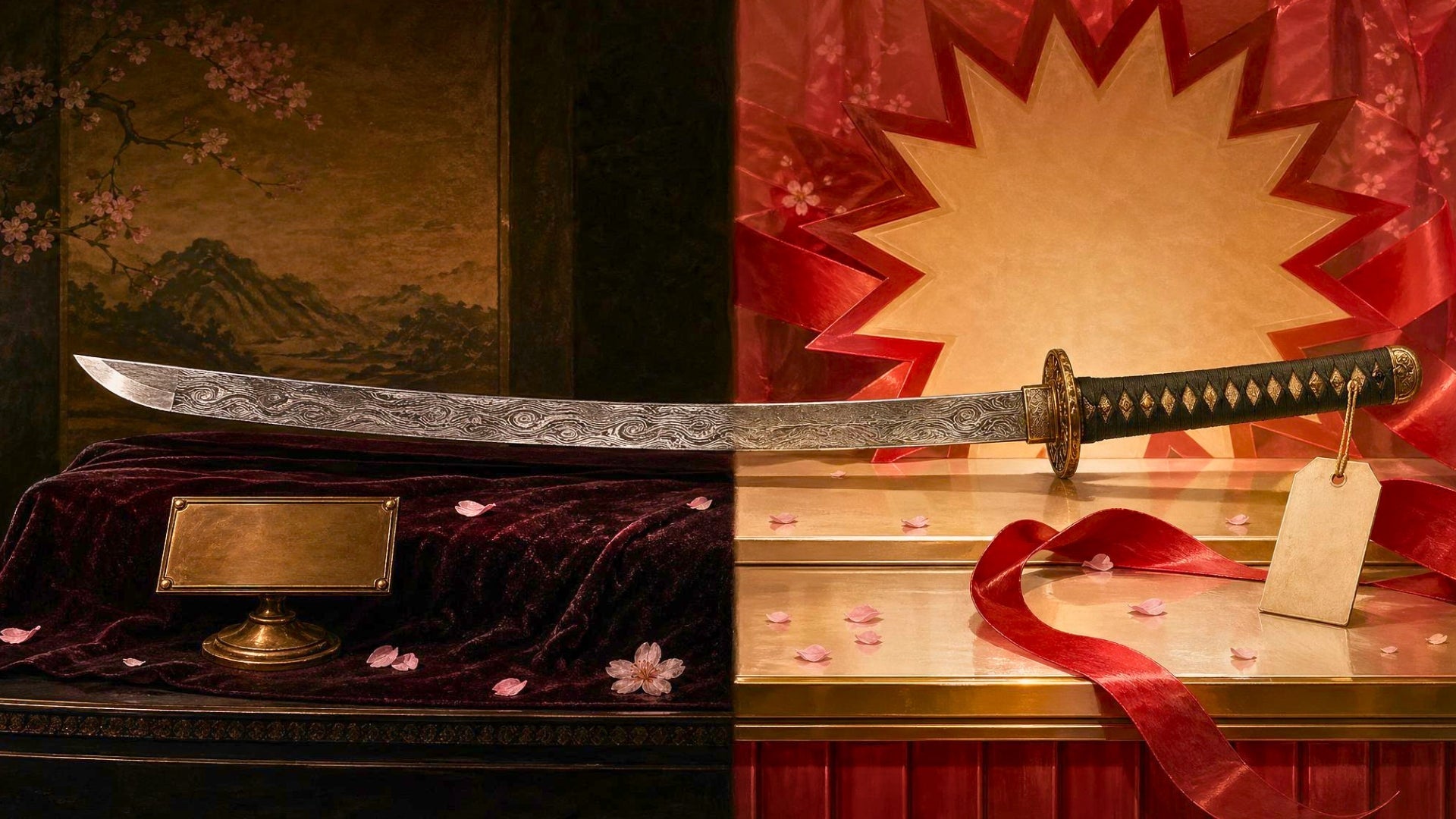
Type "Damascus steel katana" into any sword shop and you'll see prices from $150 to $1,500 - all claiming the same thing: genuine Damascus steel, hand-forged, traditional craftsmanship. The blades look stunning. Flowing water patterns. Waves frozen in steel. But here's the uncomfortable question nobody in the marketing copy answers: does the Damascus pattern actually make the sword better? Or are you paying a premium for aesthetics?
The answer is more nuanced than either side of the debate admits. Damascus steel katanas are real, they can be beautiful, and some are genuinely well-made. But the term "Damascus" is also one of the most abused words in the sword industry - used to sell everything from masterwork blades to cheap wall-hangers with laser-etched patterns.
This guide tells you what Damascus steel actually is, what it isn't, how to spot fakes, and when it's worth your money.
- What "Damascus Steel" Actually Means in 2026
- Damascus vs Traditional Japanese Folded Steel
- Performance: Does Damascus Cut Better?
- Real vs Fake Damascus: How to Tell
- Damascus vs Mono-Steel: Honest Comparison
- When to Buy Damascus, And When to Skip It
- Frequently Asked Questions
- See Damascus for Yourself
What "Damascus Steel" Actually Means in 2026
First, the history lesson that changes everything: the Damascus steel you see on katanas today has almost nothing to do with the original Damascus steel from the Middle East.
Ancient Damascus (Wootz Steel)
True Damascus steel originated in India as "Wootz", a high-carbon crucible steel that was traded through Damascus, Syria. It was produced by melting iron and carbon in sealed clay crucibles, creating a steel with unique internal carbon nanostructures that gave it remarkable strength and a subtle, flowing "watered" pattern. The last known Wootz blades were produced around 1750. The technique is lost - nobody today can fully reproduce it.
Modern "Damascus" (Pattern-Welded Steel)
What the sword industry calls "Damascus" in 2026 is pattern-welded steel. Two or more steel types (typically a high-carbon steel like 1095 and a nickel-containing steel like 15N20) are stacked, forge-welded together under extreme heat, then folded and hammered repeatedly. The resulting billet is forged into a blade, then acid-etched to reveal the contrast between the different steel layers - producing that distinctive wave, raindrop, or ladder pattern.
The term was revived in the 1970s by American bladesmith Bill Moran. It stuck. Now every sword shop uses it.
A 2006 study found that authentic Wootz Damascus steel contained carbon nanotubes - structures that wouldn't be understood by science until the late 20th century. Ancient Indian metallurgists achieved nanotechnology 1,500 years before the rest of the world knew it existed.

Damascus Blades in Our Forge
Damascus-pattern katanas with hand-folded steel layers and visible grain.


Damascus vs Traditional Japanese Folded Steel: They're Not the Same
This is where most buyers get confused. Damascus steel and traditional Japanese folded steel (hada) look superficially similar, both show visible grain patterns on the blade. But they're created through completely different processes with different goals.
| Feature | Damascus (Pattern-Welded) | Japanese Hada (Folded) |
|---|---|---|
| Process | Two+ different steels forge-welded together | Single steel (tamahagane) folded repeatedly |
| Purpose of Folding | Create visual contrast between different metals | Purify impure iron, distribute carbon evenly |
| Pattern Source | Different steel alloys reacting differently to acid | Carbon density variations within one steel |
| Visual Result | Bold, high-contrast waves or geometric patterns | Subtle, fine grain visible only in proper light |
| Traditional? | No, not part of Japanese swordsmithing tradition | Yes - foundational technique of nihonto |
Key point: a genuine antique nihonto (Japanese sword) will never have what we call a "Damascus" pattern. Its hada is subtle - almost invisible unless you know how to look. The bold, high-contrast patterns you see on "Damascus katanas" are a modern aesthetic choice, not a traditional one. Some iaido schools actually don't allow Damascus-patterned blades because they're considered non-traditional.
Performance: Does Damascus Actually Cut Better?
This is the question that matters. And the honest answer will disappoint some people.
No - Damascus does not cut better than a well-made mono-steel blade. The pattern is aesthetic. The cutting performance depends on the core steel, the heat treatment, and the geometry of the edge, not on whether the blade has visible layers.
In fact, Damascus blades carry a structural risk that mono-steel blades don't: if the forge-welding between layers is imperfect, the layers can delaminate under stress. This means the layers separate, a catastrophic failure that can happen mid-cut. Cheap Damascus katanas are particularly prone to this because the forge-welding is rushed.
A $300 T10 mono-steel katana with proper clay tempering will almost always outperform a $300 Damascus katana in edge retention, toughness, and durability. At that price point, the Damascus premium goes entirely to the visual pattern, not to performance.
At higher price points ($600+), where forge-welding quality is more consistent and the core steels are premium, Damascus blades can perform well. But "well" means "comparable to a good mono-steel", not better. You're still paying for the look.
Our T10 vs 1095 comparison covers the performance steels that serious cutters actually choose.
Real vs Fake Damascus: How to Spot the Difference
The Damascus market is flooded with fakes. Here's how to tell what you're looking at.
Real Pattern-Welded Damascus
The pattern runs through the entire blade - spine, flats, edge, and tang. If you polish a section and acid-etch it again, the pattern reappears because it's structural. The pattern is organic and slightly irregular - no two areas look identical. Real Damascus has visible texture you can feel with a fingernail running across the blade.
Acid-Etched Fake
A mono-steel blade with a pattern chemically applied to the surface. The pattern disappears if polished away. Both sides may show identical patterns (physically impossible with real Damascus). The surface is perfectly smooth - no texture. This is the most common fake and the hardest to spot for beginners.
Laser-Etched Fake
A pattern literally engraved into the steel by machine. Perfectly uniform, repeating patterns. No variation, no depth, no texture. Usually found on sub-$100 blades. Easy to spot once you know what to look for.

Damascus vs Mono-Steel: Which Should You Actually Buy?
| Category | Damascus | Mono-Steel (T10, 1095, 1060) |
|---|---|---|
| Visual Appeal | Stunning - flowing patterns, unique per blade | Clean, polished - beauty comes from hamon and polish |
| Cutting Performance | Good at high price points, risky at low ones | Excellent - consistent and predictable |
| Edge Retention | Depends on core steel - variable | Depends on steel grade - well-documented |
| Durability Risk | Delamination possible on cheap blades | No delamination risk - solid throughout |
| Traditional Authenticity | Not traditional Japanese | Closer to traditional (especially with hamon) |
| Price (comparable quality) | 15-30% higher | Lower - better value for cutting performance |
| Best For | Display, gifts, collection, light cutting | Tameshigiri, martial arts, serious cutting |
When to Buy Damascus: And When to Skip It
The sword is primarily for display or collection - the pattern is the feature you'll see every day. You're buying a gift and visual impact matters. You want a conversation piece that stands out from standard polished blades. Budget is $400+ and the seller specifies the steel types, layer count, and heat treatment method. You plan light cutting only (bottles, pool noodles, soft targets).
You need maximum cutting performance for tameshigiri or martial arts. Budget is under $300 - at that price, mono-steel outperforms Damascus every time. The product listing says "Damascus steel" without specifying which steels are used or the heat treatment. You want traditional Japanese authenticity - real nihonto don't use Damascus. You need a blade that can handle mistakes in technique without delamination risk.
If you want the Damascus look with functional reliability, look for blades where Damascus layers wrap around a mono-steel core (similar to sanmai construction). This gives you the visual pattern on the flats while the cutting edge is a single, consistent, high-carbon steel. It's the best of both worlds - when it's done right.
Our steel guide breaks down every option from 1045 to T10 to Damascus, and our beginner's buying guide helps you decide what matters most for your first blade.
Frequently Asked Questions
Is Damascus steel good for a katana?
It can be - at higher price points ($400+) where forge-welding quality is consistent. Damascus katanas are excellent for display and collection. For serious cutting performance, mono-steels like T10 or 1095 are more reliable and cost-effective.
Is Damascus the same as folded steel?
No. Modern Damascus is pattern-welded from two or more different steels. Traditional Japanese folded steel (hada) is a single steel folded to purify and distribute carbon. They produce different visual results through different processes with different goals.
How can I tell if Damascus is real or fake?
Real Damascus has organic, irregular patterns visible on the spine, edge, and tang - with physical texture you can feel. Fakes have perfectly uniform surface patterns that disappear when polished. If both sides of the blade show identical patterns, it's fake.
Is Damascus steel stronger than regular steel?
Not inherently. Damascus combines two steels, which can theoretically balance hardness and flexibility. But in practice, a well-heat-treated mono-steel blade (T10, 1095, 9260) is often tougher and more predictable. Damascus's advantage is visual, not mechanical.
Why does Damascus steel cost more?
The pattern-welding process is labor-intensive - stacking, forge-welding, folding, and acid-etching add hours of work. You're paying for craftsmanship and aesthetics. Whether that premium is worth it depends on whether you value the look or prioritize cutting performance.
Compare the silver-colored Damascus blade of Kamakura with the red and copper-toned finish of Kiso Hida. Both list Damascus steel, but their surface finish and fittings create different display effects.
See Damascus for Yourself
Damascus steel is beautiful. That's not marketing - it's fact. Whether it's right for you depends on what you want from a blade.
Browse our full katana collection - we carry Damascus, T10, 1095, and 1060 blades, each with clear specs so you can compare honestly.
Not sure which steel fits your goals? Our steel guide has the breakdown you need.
Know what you're buying. Then buy what you love.
See Damascus for Yourself
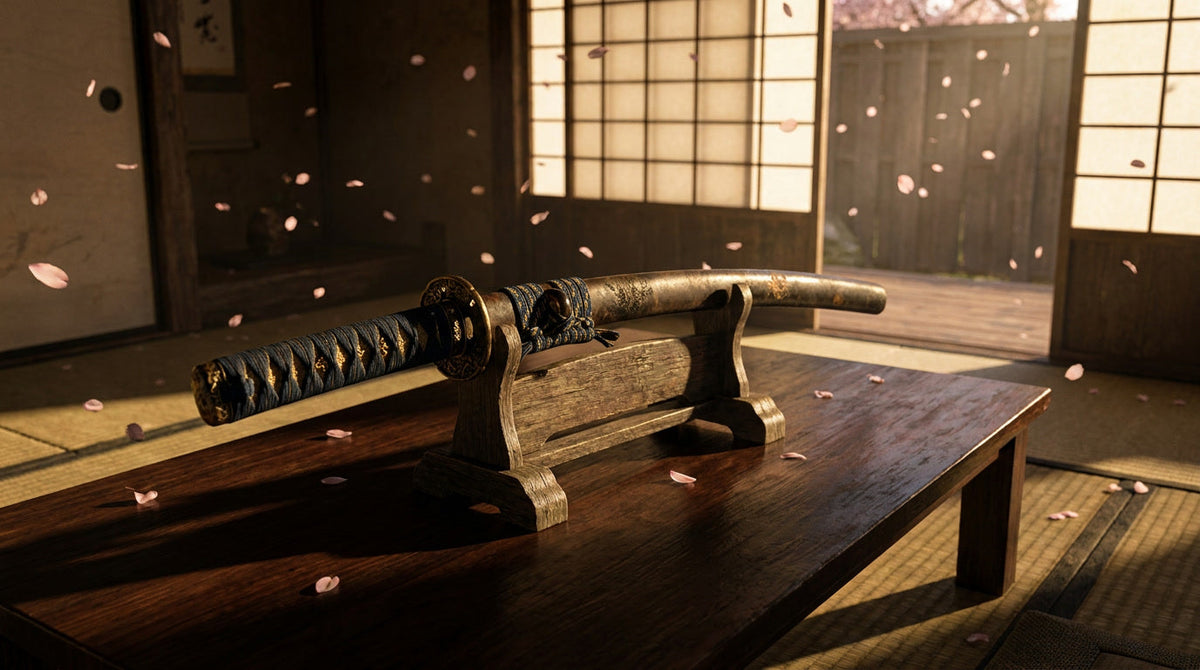
Each blade reveals a unique pattern formed during the forging process - no two are exactly alike.

Share:
Can a Katana Cut Through Steel? Myths vs Reality
Clay Tempered Katana: What It Is & Why Collectors Love It