

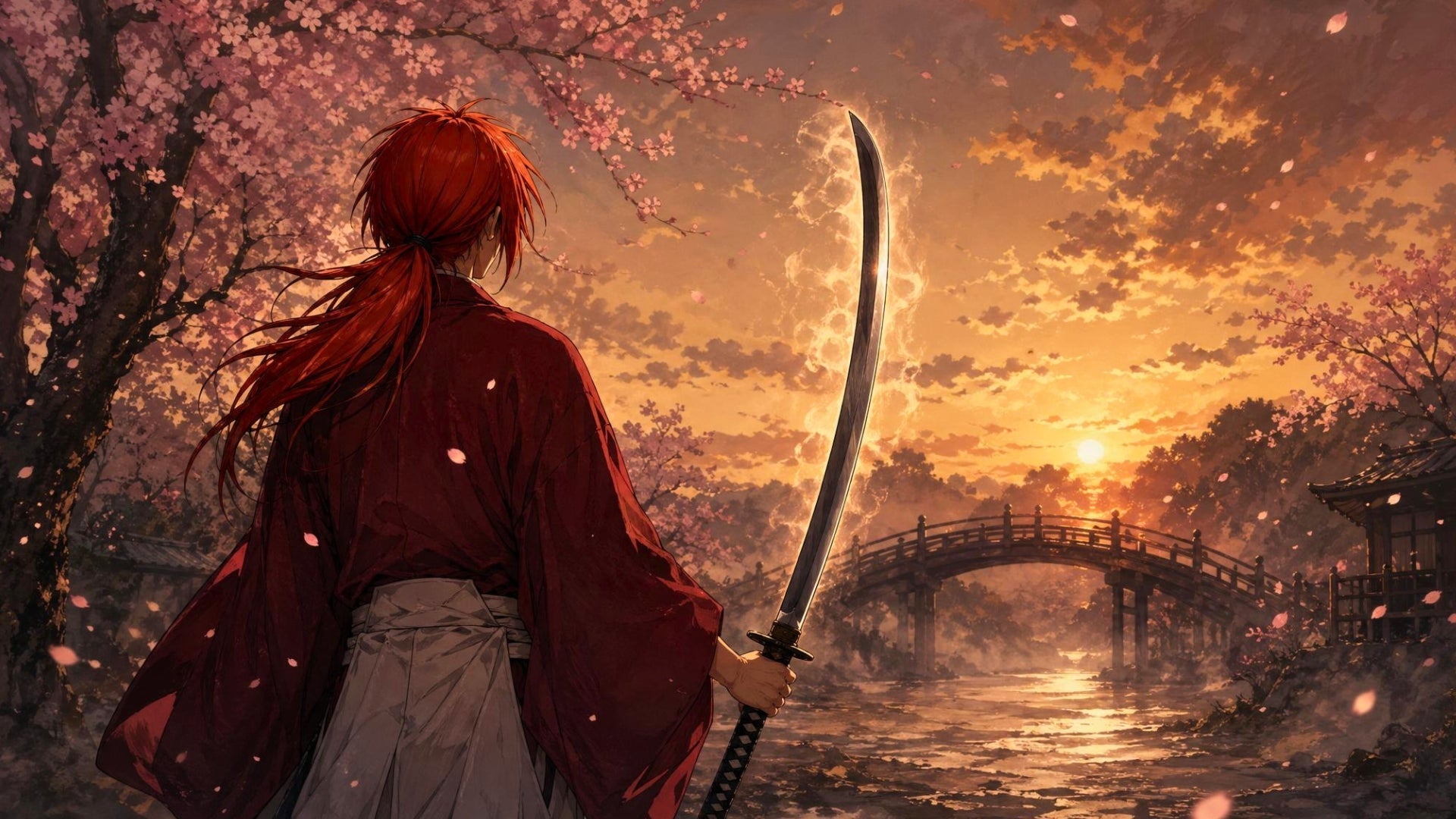
A katana with its sharp edge on the wrong side. That's the sakabato - the reverse-blade sword carried by Himura Kenshin, the most deadly assassin of the Bakumatsu, who swore a vow never to kill again. Every time he draws the blade, the blunt spine faces the enemy. Every time he strikes, the blow incapacitates instead of cuts. To kill with it, he'd have to flip the sword, a deliberate, conscious reversal that forces him to choose death over mercy.
It's one of the most brilliant weapon concepts in fiction. But here's the question people have been asking since 1994, when Nobuhiro Watsuki first drew it in the pages of Shonen Jump: did the sakabato ever actually exist?
The answer is more interesting than "yes" or "no." It involves an Edo-period discovery in a storage cellar, a modern master swordsmith who spent months forging the real thing, and a fundamental debate about what a sword is for.
- What Is a Sakabato? The Design Explained
- Kenshin's Sakabato: The Anime Lore
- Did the Sakabato Ever Exist in Real History?
- The Real Sakabato: Forged by a Living Swordsmith
- Would a Reverse Blade Actually Work in Combat?
- Why the Sakabato Matters: Symbolism Over Steel
- Frequently Asked Questions
- Own the Blade
What Is a Sakabato? The Design Explained
A standard katana has its cutting edge (ha) on the outer curve of the blade - the convex side. This is fundamental to how a katana works: the curve pulls the edge through the target during a slashing motion, maximizing cutting efficiency.
A sakabato (逆刃刀, literally "reverse-blade sword") flips this. The sharp edge is on the inner curve - the concave side. The outer curve, which normally carries the edge, is left blunt. When the wielder swings naturally, the blunt spine strikes the opponent. To use the sharp edge, the sword must be deliberately reversed in the grip, an unnatural motion that works against the blade's own geometry.
The concept is elegant: a weapon that forces its wielder to choose mercy by default and violence only through conscious effort. It's a sword that philosophically opposes what swords are built to do.

Anime-Inspired Blades in Stock
Hand-forged katanas that channel the spirit of legendary anime swordsmen.


Kenshin's Sakabato: The Anime That Made It Famous
The sakabato entered global consciousness through Rurouni Kenshin (also known as Samurai X), one of the most beloved manga and anime series of the 1990s. Set in early Meiji-era Japan (1878), it follows Himura Kenshin, a former government assassin known as "Battōsai the Manslayer", who wanders Japan carrying a sakabato as a symbol of his vow to never kill again.
In the story, two sakabato were forged by the fictional master smith Arai Shakkū as his final works - "holy swords" dedicated to the peace of the new era:
Sakabato Kageuchi (Shadow Forge)
The first version - a "practice" copy that Kenshin carried for a decade. It was eventually destroyed in his fight against Seta Sōjirō, the fastest member of the villain Shishio's forces. Sōjirō's sword, the legendary Kikuichimonji Norimune, snapped the Kageuchi in half.
Sakabato Shin'uchi (True Forge)
The superior version, originally housed in the Hakusan Shrine. Kenshin acquired it and used it for the remainder of the series. Hidden inside the hilt, Shakkū had engraved a poem: "Slashing myself, I have trained countless blades. My son reviles, but for my grandson, I bleed." In 1882, Kenshin passed the Shin'uchi to his student Yahiko as a coming-of-age gift.
The Hiten Mitsurugi-ryū - Kenshin's sword style - is fictional, but its techniques are inspired by real Japanese kenjutsu schools including Shinkage-ryū and Hokushin Ittō-ryū. The battōjutsu (quick-draw) emphasis is particularly authentic to real Meiji-era swordsmanship. Our history of Japanese swords page covers the Bakumatsu period when Kenshin's story takes place.
Did the Sakabato Ever Exist in Real History?
This is where it gets fascinating. For decades, the sakabato was considered purely fictional, a concept invented by Watsuki for the manga. There was no historical record of reverse-blade katanas in feudal Japan.
Then, in October 2013, a discovery in Chiba Prefecture changed the conversation. In the storage cellar of an old family estate in Shiroi City, researchers found a short sword, a kogatana measuring about 22 cm (8.6 inches) - covered in rust. When cleaned, it revealed something unexpected: the cutting edge was on the inner curve. Dragon engravings decorated the blade. The sword dated to the Edo period (1603-1868).
The Japanese media immediately drew the Rurouni Kenshin comparison. The sword was donated to the prefecture's cultural archive, and the story went international.
The Chiba discovery is the only known historical example of a reverse-blade weapon in Japan. It's a kogatana (short blade), not a full katana, but its existence proves that at least one Japanese swordsmith experimented with the concept during the Edo period, centuries before Watsuki imagined it for his manga.
Does one small blade prove the sakabato was a real weapon class? No. It's more likely an anomaly, a curiosity, an experiment, or a ritual object. But it proves the concept wasn't entirely invented in 1994. Someone, somewhere in Edo Japan, had the same idea.
The Real Sakabato: A Master Swordsmith Brings Fiction to Life
In 2019, swordsmith Ogawa Mitsuo, a fully licensed Japanese katana-kaji - was commissioned to forge a real, full-size sakabato for display at the Museum Meijimura in Inuyama, Aichi Prefecture. The museum, which preserves buildings from the Meiji era (the same period as Rurouni Kenshin), hosted a special exhibition featuring the blade.
Ogawa faced a challenge no swordsmith had ever tackled: the sakabato's design fluctuates from scene to scene in the manga. Watsuki drew it differently depending on what visual impression he needed - speed, weight, sharpness. Ogawa had to synthesize all of these into one real, three-dimensional blade.
He settled on a gunome hamon pattern - irregularly undulating waves with gentle transitions - as a metaphor for Kenshin's turbulent inner struggles held in check by his gentle nature. The blade was forged using traditional methods: hand-hammered tamahagane, clay tempered, with the hamon visible on the inner curve where the cutting edge sits. The real-world sakabato is now one of the most photographed anime replicas ever created.

Would a Reverse Blade Actually Work in Combat?
The honest answer: as a lethal weapon, no. As a non-lethal tool in the hands of an expert, maybe, but with serious limitations.
The katana's curve exists for a reason: it concentrates cutting force along the outer edge during a natural slashing arc. Putting the edge on the inner curve reverses this advantage. A sakabato cutting strike fights against the blade's own geometry - force is dispersed instead of concentrated. The cut would be shallower, less efficient, and harder to control.
As a blunt weapon, the sakabato would function - the spine of a katana is already quite heavy and capable of breaking bones on impact. A skilled swordsman could certainly incapacitate an opponent with spine strikes. But they could do the same thing with a standard katana by using the flat of the blade (mune-uchi), which real samurai actually practiced.
The sakabato is a brilliant narrative device, a physical manifestation of a moral philosophy. As a practical weapon, it sacrifices the katana's core advantage (cutting efficiency) for a symbolic commitment to non-lethality. In a story, that's profound. On a battlefield, it would be a liability. Kenshin makes it work because he's fictional and impossibly skilled. In reality, a swordsman who wanted non-lethal options would simply use the flat or spine of a standard katana.
Why the Sakabato Matters: The Sword as Moral Statement
The sakabato resonates with audiences because it transforms a weapon into a philosophical argument. In Japanese sword culture, the katana is called "the soul of the samurai", an extension of the warrior's identity. By reversing the edge, Kenshin doesn't just change how the sword works. He changes what it means.
A standard katana says: "I can kill." The sakabato says: "I choose not to." Every fight Kenshin wins with the blunt side is a statement that skill and mercy are not opposites - that the strongest swordsman is the one who doesn't need to kill. It's bushido reimagined for a post-war era, and it's why Rurouni Kenshin remains one of the most thematically rich anime ever made.
This philosophy - the sword as a protector rather than a destroyer - echoes the real Masamune-Muramasa legend we covered in our guide to legendary samurai swords. Masamune's blade, placed in a stream, let leaves pass uncut. The sakabato is the same idea, taken literally: a blade that refuses to cut.
Frequently Asked Questions
What is a sakabato?
A sakabato (逆刃刀, "reverse-blade sword") is a katana with the cutting edge on the inner (concave) curve instead of the outer (convex) curve. When swung normally, the blunt spine hits the opponent. It was popularized by the anime Rurouni Kenshin as the weapon of protagonist Himura Kenshin, who uses it to fight without killing.
Is the sakabato a real historical weapon?
It was long considered purely fictional. However, in 2013, a small Edo-period reverse-blade (kogatana) was discovered in Chiba Prefecture - the only known historical example. It's not a full katana, and it's likely a curiosity rather than a battle weapon. In 2019, a licensed swordsmith forged the first official full-size sakabato for museum display.
Would a reverse blade sword work in a real fight?
As a cutting weapon, no - the reversed geometry works against efficient slicing. As a blunt-force tool, it could incapacitate opponents with spine strikes. But a standard katana can do the same thing using the flat of the blade (mune-uchi), making the sakabato a less practical choice. Its value is symbolic, not tactical.
What does sakabato mean in Japanese?
Sakabato (逆刃刀) translates literally to "reverse-blade sword" or "inverted-edge sword." "Saka" means reverse/inverted, "ba" means blade/edge, and "tō" means sword.
Can I buy a sakabato replica?
Yes. Several sword makers produce sakabato replicas in both decorative and functional grades. Our manga katana collection includes hand-forged sakabato with real carbon steel and reversed edge - faithful to Kenshin's design.
Own the Blade That Chose Mercy
The sakabato isn't just a sword - it's a statement. Whether you're a Rurouni Kenshin fan, a collector of unique blades, or someone who appreciates the idea of strength through restraint, a sakabato replica is one of the most meaningful swords you can own.
Our manga katana collection includes hand-forged sakabato with the reversed edge, faithful to Kenshin's design. Real carbon steel, full tang, sharp or display-grade.
Want to explore the real history behind samurai swords? Our complete history guide covers the Bakumatsu and Meiji eras that shaped Kenshin's world.
"I will not kill. I will not allow anyone to be killed. That is the oath of this blade." - Himura Kenshin
Bring the Legend Home
Each blade is forged from high-carbon steel - built for collectors, fans, and fighters.

Share:
Ichigo's Zangetsu Explained: Every Form of Bleach's Iconic Blade
The 10 Most Iconic Katanas in Anime