

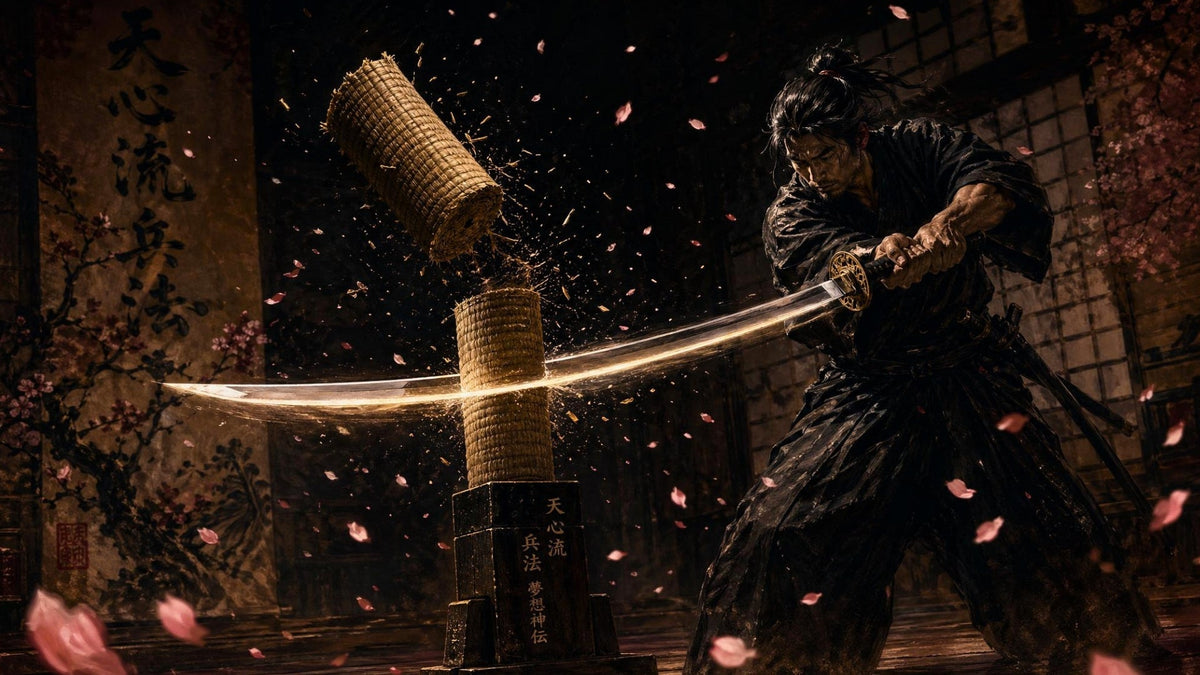
In 1662, the swordsman Yamada Asaemon cut through two stacked human bodies with a single stroke. He wasn't a criminal. He wasn't at war. He was performing tameshigiri — the formal testing of a Japanese sword's cutting ability — and the results were inscribed directly onto the blade's tang. That katana, with its cutting record permanently etched into the steel, would be worth more than an untested blade for the rest of its existence.
This is the most visceral tradition in Japanese sword culture. Where polishing reveals a blade's beauty and forging defines its soul, test cutting answers the only question that ultimately matters on a battlefield: does this sword actually cut?
This article covers the full history — from the brutal Edo-period practice of cutting corpses and condemned prisoners, to the modern martial art practiced worldwide using rolled tatami mats. Along the way: the standard cuts, what they reveal about a blade, and how to get started safely.
- What Is Tameshigiri?
- The Edo-Period Origins: Cutting Bodies for Quality Control
- The Yamada Clan: Japan's Official Sword Testers
- The Standard Cuts: Names and Techniques
- Modern Tameshigiri: Tatami, Technique, and Training
- What Test Cutting Reveals About a Blade
- Getting Started: Equipment and Safety
- Frequently Asked Questions
- Put Steel to the Test
What Is Tameshigiri?
Tameshigiri (試し斬り) translates literally to "test cutting." In its original form, it was the practice of testing a newly forged Japanese sword's cutting ability on a physical target — historically, human bodies. In its modern form, it's a martial art discipline focused on cutting rolled tatami mats (tatami omote) or bamboo using proper technique with a live blade.
The practice serves two purposes that haven't changed in four centuries: proving the sword's quality, and proving the swordsman's skill. A clean cut requires both — a sharp, well-balanced blade and a wielder with correct edge alignment, body mechanics, and follow-through. One without the other produces a ragged, incomplete result that tells you exactly what went wrong.
Cutting-Grade Steel
Hand-forged katanas built for tameshigiri — clay-tempered T10, full tang, sharp edge.


The Edo-Period Origins: Cutting Bodies for Quality Control
During the Edo period (1603–1868), this wasn't a martial art. It was industrial quality control — the sword equivalent of a stress test. When a daimyō commissioned a blade, he needed proof it could perform. The most reliable proof was cutting through the most demanding target available: the human body.
Test subjects were bodies of executed criminals, or occasionally condemned prisoners. The practice was officially sanctioned by the Tokugawa shogunate. Professional testers performed standardized cuts — through torso, limbs, and stacked bodies — and the results were meticulously documented.
These cutting records were then engraved on the sword's nakago (tang) as a permanent certificate of performance. A blade inscribed with "futatsu-dō" (two bodies) or "mittsu-dō" (three bodies) commanded a premium. The inscription wasn't bragging — it was a guarantee. The buyer knew exactly what the steel could do because someone had proven it on the hardest test imaginable.

Some Edo-period blades carry inscriptions recording cuts through stacked bodies — "futatsu-dō setsudan" means a single stroke passed through two torsos. These swords, called "saidan-mei" (cutting inscription blades), are among the most valued antiques in Japanese sword collecting. The inscription proves the blade didn't just look good — it performed.
The Yamada Clan: Japan's Official Sword Testers
The most famous name in this history is Yamada Asaemon — though it wasn't one man. It was a hereditary title passed through nine generations, who served as the shogunate's official sword testers and executioners from the early 1600s through the Meiji Restoration.
The Yamada family occupied a paradoxical position. Their skill was essential — every major swordsmith wanted a Yamada cutting certificate on their blade. But their work involved constant contact with death, placing them in a social category associated with spiritual impurity. Respected for their expertise, avoided for their profession.
Across nine generations, the family tested thousands of blades and created a classification system for cutting performance that influenced sword valuation for centuries. Their records remain important references for nihonto scholars today.
The Standard Cuts: Names and Techniques
The practice uses a standardized set of cuts, each targeting a specific angle and testing a specific aspect of technique. Whether you're cutting tatami in a modern dojo or reading about Edo-period body cutting, the terminology is the same.
| Cut Name | Direction | What It Tests |
|---|---|---|
| Kesagiri | Diagonal downward (shoulder to hip) | Edge alignment, power transfer |
| Gyaku Kesagiri | Diagonal upward (hip to shoulder) | Rising control, wrist strength |
| Yokogiri | Horizontal | Level consistency, hip rotation |
| Suihei | Horizontal (alternate term) | Same as yokogiri |
| Makko Giri | Straight vertical downward | Centerline precision, full commitment |
| Kiriage | Vertical upward | Lifting power, edge control under resistance |
The most basic drill is a single diagonal kesagiri through a standing tatami roll. Advanced practitioners perform multiple cuts on the same mat without it falling — changing angles mid-sequence while maintaining perfect edge alignment. A common advanced test is a five-cut sequence: kesa, gyaku-kesa, horizontal, reverse horizontal, and a final downward makko giri — all before the mat topples.

Modern Tameshigiri: Tatami, Technique, and Training
Modern practice replaced human targets with rolled tatami mats (tatami omote) — specifically, the woven rush surface of traditional Japanese floor mats. When soaked in water overnight, a single rolled mat approximates the cutting resistance of a human limb. This makes it the standard target in dojos worldwide.
The practice is found today within several martial arts traditions. Iaidō practitioners use it to validate kata forms. Battōjutsu schools emphasize the quick-draw cut. Dedicated cutting groups compete in events where precision and clean cuts are scored.
The key insight is immediate, honest feedback. In kata practice, you can hide flaws in edge alignment because there's no resistance. The moment steel meets a soaked tatami mat, every flaw is exposed. A blade that's slightly off-angle tears instead of slicing. Insufficient follow-through leaves the mat hanging by fibers. The cut doesn't lie.
Miyamoto Musashi's principle of "cutting with the mind, not just the arms" becomes real here. Body mechanics — hip rotation, weight transfer, relaxed grip transitioning to firm impact — matter more than arm strength. Our Musashi profile explores how his philosophy shaped sword technique.
What Test Cutting Reveals About a Blade
Cutting practice doesn't just test the swordsman. It tests the sword. A session with a live blade reveals qualities that no amount of visual inspection can confirm.
Edge Geometry
A blade with proper niku (cross-section convexity) glides through the target. Too thin and it wedges. Too thick and it pushes instead of slicing. Cutting exposes geometry flaws instantly.
Balance and Handling
A well-balanced katana feels like an extension of the arm. Too heavy at the tip and it pulls you forward. Too light and it lacks authority through the target. Appreciating how different types of Japanese swords are balanced helps explain why certain blades cut differently.
Heat Treatment
The true test of a clay tempered katana: the hardened edge holds through repeated cuts without chipping, while the softer spine absorbs impact without bending. A blade that chips on tatami would have failed catastrophically in combat.
Steel Quality
Higher-grade steels — T10, 1095, tamahagane — maintain their edge through dozens of cuts. Lower-quality steel dulls rapidly. Our T10 vs 1095 comparison breaks down how steel choice affects cutting performance.
Experienced practitioners can feel the difference between steel grades within a few cuts. T10 tool steel is a modern favorite for cutting practice — its high carbon content and vanadium traces hold an edge longer than most alternatives, and it responds beautifully to clay tempering.
Getting Started: Equipment and Safety
This is not a beginner activity. Swinging a live blade at a physical target involves real danger — to yourself, to bystanders, and to the sword. Proper preparation is non-negotiable.
Prerequisites
Most dojos require at least one year of iaidō or kendō training before allowing students to attempt live cutting. You need foundational grip technique, footwork, and an understanding of cutting angles before a sharp blade enters the equation.
Equipment
The sword must be functional — full tang, properly tempered carbon steel, sharp edge. Stainless steel wall-hangers are dangerous for cutting: they can snap under stress, sending fragments in unpredictable directions. Our guide to spotting fakes explains how to tell the difference.
Never attempt cutting practice alone as a beginner. Always work under an experienced instructor with a clear radius of at least 6 meters. Inspect the blade before every session — nicks, chips, or a loose handle can cause catastrophic failure mid-swing.
After every session, clean and oil your blade immediately. Tatami fibers and moisture accelerate rust on carbon steel. Our maintenance guide covers the full post-session routine.
Frequently Asked Questions
What is tameshigiri?
Tameshigiri (試し斬り) is the Japanese art of test cutting — historically performed on human bodies to prove a sword's quality, now practiced as a martial discipline using rolled tatami mats. It tests both blade performance and swordsman technique.
What were tameshigiri targets in the Edo period?
Bodies of executed criminals and occasionally condemned prisoners. The practice was officially sanctioned by the Tokugawa shogunate. Results were inscribed on the sword's tang as a permanent certificate. These inscribed blades (saidan-mei) are highly valued antiques.
What do you cut in modern tameshigiri?
Rolled tatami omote (woven rush mats) soaked in water for 12–24 hours. A single soaked roll approximates the resistance of a human limb. Bamboo is also used for harder targets. The mat is mounted on a wooden dowel stand at roughly waist height.
Can any katana be used for tameshigiri?
Only functional, full-tang katanas with properly tempered carbon steel edges. Stainless steel decorative swords can snap under stress, which is extremely dangerous. The blade should be sharp, well-maintained, and inspected for damage before every session.
How do I start learning tameshigiri?
Begin with at least one year of iaidō, kendō, or battōjutsu training to develop proper grip, footwork, and edge alignment. Then find a dojo that offers supervised tameshigiri sessions. Never attempt cutting practice alone as a beginner — live blades demand respect and experience.
Put Steel to the Test
A katana is forged to cut. This practice is how you prove it — to the blade, and to yourself. There's no feeling like a clean cut through a target that doesn't lie.
Every blade in our hand-forged katana collection is built for real cutting — full tang, properly tempered, sharp and ready. For blades specifically designed for cutting practice, explore our high-end collection in T10 and clay-tempered steel.
The cut tells the truth. Make sure your sword can handle it.
Put Steel to the Test
Each blade below is built to actually cut tatami, not just look pretty on a shelf.

Share:
Japanese Sword Polishing: The Art of the Togishi