

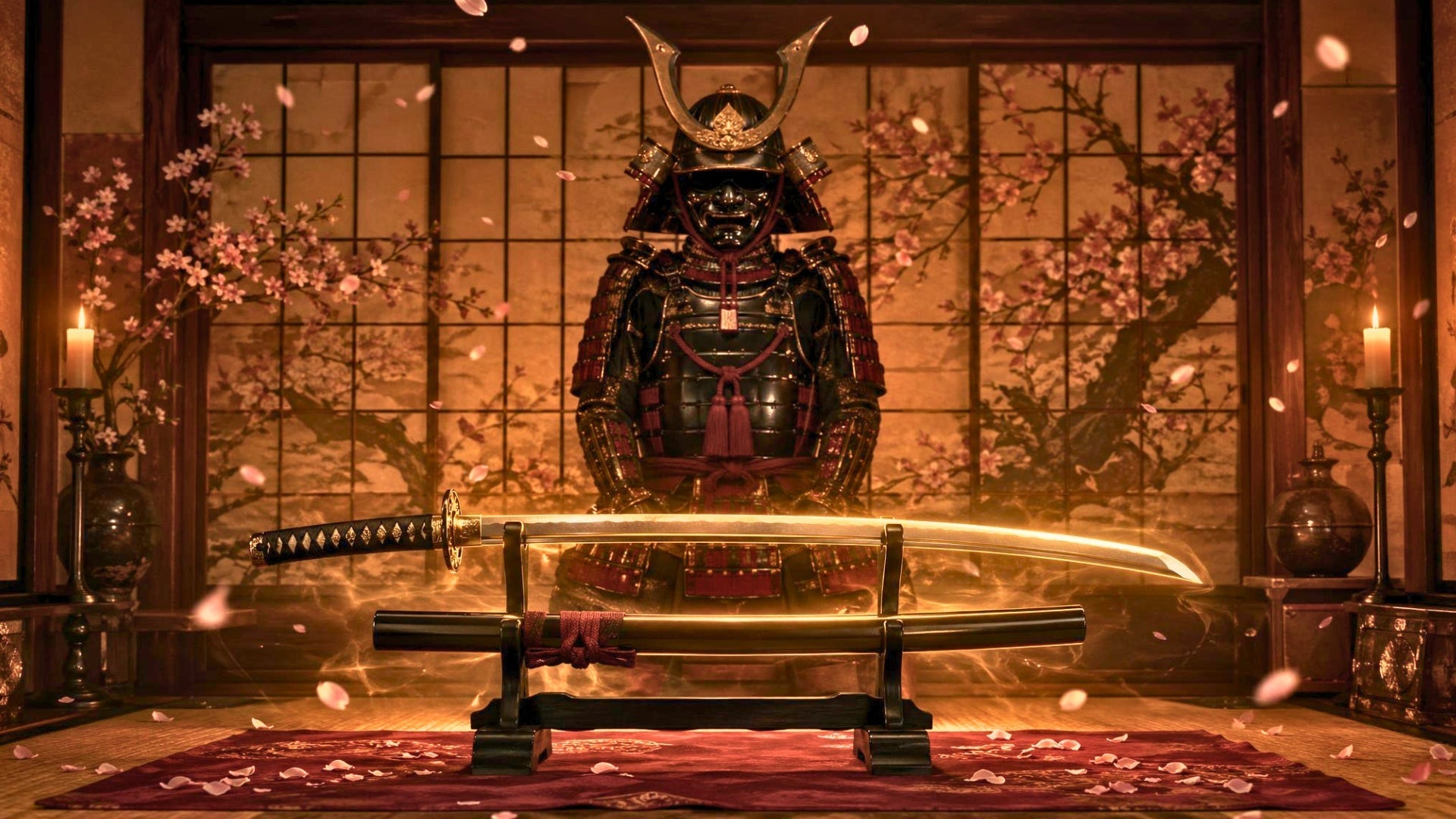
"Katana wa bushi no tamashii" - the katana is the soul of the samurai. This isn't a metaphor. It isn't poetry. For centuries, the Japanese warrior class treated it as literal truth. The sword didn't represent the samurai's identity - it was the samurai's identity, forged in steel, carried at the hip, and present at every significant moment of his life: his coming of age, his wedding, his battles, and his death.
No other culture on earth elevated a weapon to this level of spiritual and cultural significance. European knights valued their swords, but they didn't name them after Buddhist principles. Viking warriors were buried with their blades, but they didn't purify the forge before hammering steel. The katana occupies a category of its own: simultaneously a weapon, a work of art, a spiritual artifact, a legal symbol of social status, and a family heirloom carrying generations of meaning.
This article explores why - tracing the katana's significance through Shinto spirituality, Buddhist philosophy, Bushido ethics, lifecycle rituals, aesthetics, and the blade's enduring relevance in modern Japan.
- "The Soul of the Samurai" - What It Actually Means
- Shinto: The Sword as Sacred Object
- Zen Buddhism: The Sword That Cuts Ignorance
- Bushido: The Sword as Moral Compass
- Social Status: Who Could Carry a Katana
- Lifecycle Rituals: From Birth to Death
- Aesthetics: Mono no Aware in Steel
- The Katana in Modern Japan
- Frequently Asked Questions
- Carry Something That Matters
"The Soul of the Samurai": What It Actually Means
The phrase "katana wa bushi no tamashii" (刀は武士の魂) appears throughout Edo-period literature, but its meaning runs deeper than modern readers typically assume. It doesn't mean the samurai loved his sword the way a guitarist loves his guitar. It means the katana was understood to contain a part of the warrior's spirit, not metaphorically, but in the animist worldview of Shinto, literally.
In this framework, the forging process wasn't manufacturing. It was creation, a spiritual act that imbued the steel with energy from the smith, the fire, the water, and the prayers spoken over the anvil. When the finished blade passed to its owner, a transfer of spiritual responsibility occurred. The sword absorbed the wielder's experiences - his victories, his failures, his moral choices. Over time, it became inseparable from his identity.
This is why losing a sword was not merely inconvenient. It was a loss of self. And it's why, even today, antique nihonto are treated with the same reverence as religious relics in Japan, because they are believed to carry the accumulated spirit of everyone who held them.

Steel Born of Tradition
Hand-forged katanas that honor the cultural soul of Japan.


Shinto: The Sword as Sacred Object
In Shinto - Japan's indigenous spiritual tradition, every natural object can house a kami (spirit). Mountains, rivers, ancient trees, and remarkable stones are all considered potential dwelling places for divine energy. The katana, forged from iron sand extracted from the earth and tempered in water, inherits this animist logic: it is a vessel for spiritual power.
This belief shaped every aspect of the forging process. Traditional swordsmiths (katana-kaji) performed ritual purification (misogi) before beginning work - fasting, cleansing in cold water, and hanging shimenawa (sacred ropes) around the forge to create a sanctified space. The act of heating steel and plunging it into water was treated as a sacred transformation, not a mechanical process.
Swords were also offered to Shinto shrines as devotional objects - symbols of purity, protection, and divine authority. The most famous example is the Kusanagi-no-Tsurugi, one of the three Imperial Regalia of Japan, a mythological sword said to have been discovered inside an eight-headed serpent by the god Susanoo. It has been housed at Atsuta Shrine in Nagoya for centuries and has never been publicly displayed. The sword isn't just a relic - it's a literal symbol of imperial legitimacy.
The Kusanagi-no-Tsurugi is so sacred that it has never been photographed. Its exact appearance is unknown to the public. During imperial ceremonies, a wrapped object representing the sword is used - the actual blade, if it still exists, remains hidden from all eyes.
Zen Buddhism: The Sword That Cuts Ignorance
While Shinto gave the katana its spiritual presence, Zen Buddhism gave it philosophical depth. Zen arrived in Japan from China during the Kamakura period (1185-1333) - the same era when the katana was being perfected as a weapon of war. The convergence was not accidental.
In Zen philosophy, the sword became a metaphor for enlightenment: just as a blade cuts through physical material, the disciplined mind cuts through delusion, attachment, and ego. The concept of mushin (無心, "no-mind"), a state of pure awareness without conscious thought - became central to both Zen meditation and sword technique. The greatest swordsmen didn't think about cutting. They simply cut. The gap between intent and action dissolved.
This philosophy influenced everything from how samurai trained (endless repetition to achieve unconscious mastery) to how they faced death (with acceptance and composure). Miyamoto Musashi's final text, the Dokkōdō, reads like a Zen poem: twenty-one precepts for living without attachment. Our Musashi profile covers how this philosophy shaped the greatest swordsman in history.
Bushido: The Sword as Moral Compass
If Shinto made the katana sacred and Zen made it philosophical, Bushido made it ethical. The samurai code - formalized during the Tokugawa era and codified by Nitobe Inazō in 1899 - placed the katana at the center of a moral universe defined by seven virtues: righteousness, courage, benevolence, respect, honesty, honor, and loyalty.
The sword embodied every virtue simultaneously. Drawing it required courage. Using it demanded righteousness. Sheathing it showed restraint. Maintaining it demonstrated discipline. Passing it down expressed loyalty to lineage. Every interaction with the blade was a moral act, which is why katana etiquette was (and still is) extraordinarily detailed.
For the full breakdown of each virtue and its connection to the katana, see our complete guide to the 7 Virtues of Bushido.
Social Status: Who Could Carry a Katana
During the Edo period (1603-1868), the right to carry a katana was legally restricted to the samurai class. The daishō - the paired set of katana and wakizashi - was the visible badge of samurai status. Commoners, merchants, and farmers were forbidden from carrying swords in public. To wear a katana was to declare: "I am a warrior. I have the authority to kill in service of my lord."
This social function made the katana the most powerful status symbol in feudal Japan. It was more than jewelry or clothing - it was a legal declaration of class. When the Meiji government abolished the samurai class in 1876 with the Haitōrei edict (the Sword Abolishment Edict), it didn't just remove a weapon. It dismantled an entire social identity. Many former samurai experienced the loss of their swords as a loss of self - echoing the phrase "soul of the samurai" in the most painful way possible.
The 1876 Haitōrei edict didn't ban sword ownership - it banned the public carrying of swords. Samurai could keep their blades at home. But the visible, daily presence of the katana - the thing that told the world who you were - was gone overnight. For a class whose identity was built around the sword, this was existential.
Lifecycle Rituals: The Katana from Birth to Death
The katana accompanied the samurai through every major milestone of his life:
Birth
A sword was placed beside the newborn, a guardian object intended to protect the child from evil spirits (a practice called mamori-gatana). The sword's presence at the very beginning of life established the bond that would define the child's identity.
Coming of Age (Genpuku)
When a boy reached maturity (typically between 11 and 15), he received his first real sword in a formal ceremony. This was the moment he became a warrior, not symbolically, but legally and socially. The sword was his passport into adulthood and the samurai class.
Battle
The katana was both weapon and witness. Every cut carried moral weight. Bushido demanded that the sword be used justly, not for personal vengeance or cruelty, but in service of duty and righteousness.
Death
In seppuku (ritual suicide), the katana or a shorter blade (tantō or wakizashi) served as the instrument of honorable death. A trusted second (kaishakunin) stood behind with a katana to deliver a swift finishing blow. The sword that began the samurai's life also ended it.
Inheritance
After death, the sword passed to the next generation - carrying the accumulated experiences, victories, and moral weight of its previous owners. A family's katana collection was its most precious inheritance, valued far above material wealth.
Aesthetics: Mono no Aware in Steel
The katana also embodies one of Japan's most profound aesthetic concepts: mono no aware (物の哀れ) - the bittersweet beauty of impermanence. A katana is beautiful, but it's also fragile: the hard edge can chip, the soft spine can bend, the steel can rust if neglected. Its beauty exists in tension with its vulnerability - just like the samurai's life, which could end in any battle.
The hamon - the temper line that marks the boundary between hard edge and soft spine - is the visual expression of this tension. It's the most admired aesthetic feature of a katana, and it exists precisely because the blade is a composite of opposing forces: hardness and flexibility, aggression and restraint, destruction and preservation. Our complete hamon guide explains the science and artistry behind this feature.
Even the saya (scabbard) carries meaning. The blade is yang - power, aggression, action. The saya is yin - restraint, protection, calm. Together, they form a complete system: the warrior who can fight and the wisdom to know when not to.
The Katana in Modern Japan
The samurai class is gone. The battlefields are corporate offices now. But the katana's cultural resonance hasn't faded - it has evolved.
In modern Japan, the katana survives in martial arts (iaidō, kendō, battōjutsu), where practitioners study not just technique but the philosophy and discipline embodied by the blade. Antique nihonto are protected by law: registered as cultural properties, evaluated by the NBTHK (Society for Preservation of Japanese Art Swords), and treasured in museums and private collections.
The katana also appears in ceremonies, festivals, and corporate culture. The Japanese concept of monozukuri (craftsmanship excellence), a national value that drives everything from Toyota's production system to haute cuisine - has direct roots in the swordsmith's ethic of relentless quality and zero waste. Musashi's "Do nothing which is of no use" could be a Toyota factory slogan.
And then there's anime and manga, which have introduced the katana to hundreds of millions of people worldwide. Series like Demon Slayer, Bleach, One Piece, and Rurouni Kenshin have made the katana the most recognizable weapon in global pop culture. Our ranking of anime's most iconic katanas explores how fiction carries the tradition forward.
Frequently Asked Questions
Why is the katana called "the soul of the samurai"?
Because the samurai's Shinto-influenced worldview held that the sword literally contained a part of the wielder's spirit. Through decades of use, the katana absorbed the warrior's experiences, moral choices, and identity. Losing the sword was equivalent to losing the self.
What role did the katana play in Shinto?
Swords were considered sacred objects capable of housing kami (spirits). Swordsmiths performed purification rituals before forging, and finished blades were offered to shrines as devotional objects. The Kusanagi-no-Tsurugi - one of the three Imperial Regalia - is a mythological sword housed at Atsuta Shrine that has never been publicly displayed.
Could anyone carry a katana in feudal Japan?
No. During the Edo period, only samurai were legally permitted to carry the daishō (katana + wakizashi) in public. It was a visible badge of warrior-class status. The 1876 Haitōrei edict ended this privilege, effectively dismantling the samurai class's visible identity.
Is the katana still culturally important in modern Japan?
Yes. Antique nihonto are protected as cultural properties. Martial arts like iaidō and kendō preserve sword philosophy and technique. The katana appears in ceremonies and festivals. And Japanese manufacturing culture (monozukuri) traces its ethic of relentless quality directly to the swordsmith's tradition.
What does mono no aware mean in relation to the katana?
Mono no aware is the Japanese concept of "the beauty of impermanence." The katana embodies it: the hard edge can chip, the soft spine can bend, the steel can rust. Its beauty exists in tension with its fragility - just like life itself. The hamon visually expresses this tension between opposing forces.
Carry Something That Matters
A katana is never just a sword. It carries centuries of philosophy, spirituality, and craftsmanship in every inch of steel. Whether you display it, practice with it, or simply hold it - you're connecting to a tradition that spans a thousand years.
Explore our hand-forged katana collection - each blade made with the same principles that Japanese swordsmiths have honored for generations.
To understand the warriors who carried these blades, start with our guide to famous samurai. To understand the code they lived by, read our 7 Virtues of Bushido.
The soul of the samurai lives in the steel. Now it can live in your hands.
Own a Piece of the Soul
A katana is more than a sword - it is the embodiment of a thousand-year-old culture.
Share:
Miyamoto Musashi: The Greatest Swordsman Who Ever Lived
Japanese Sword Polishing: The Art of the Togishi