

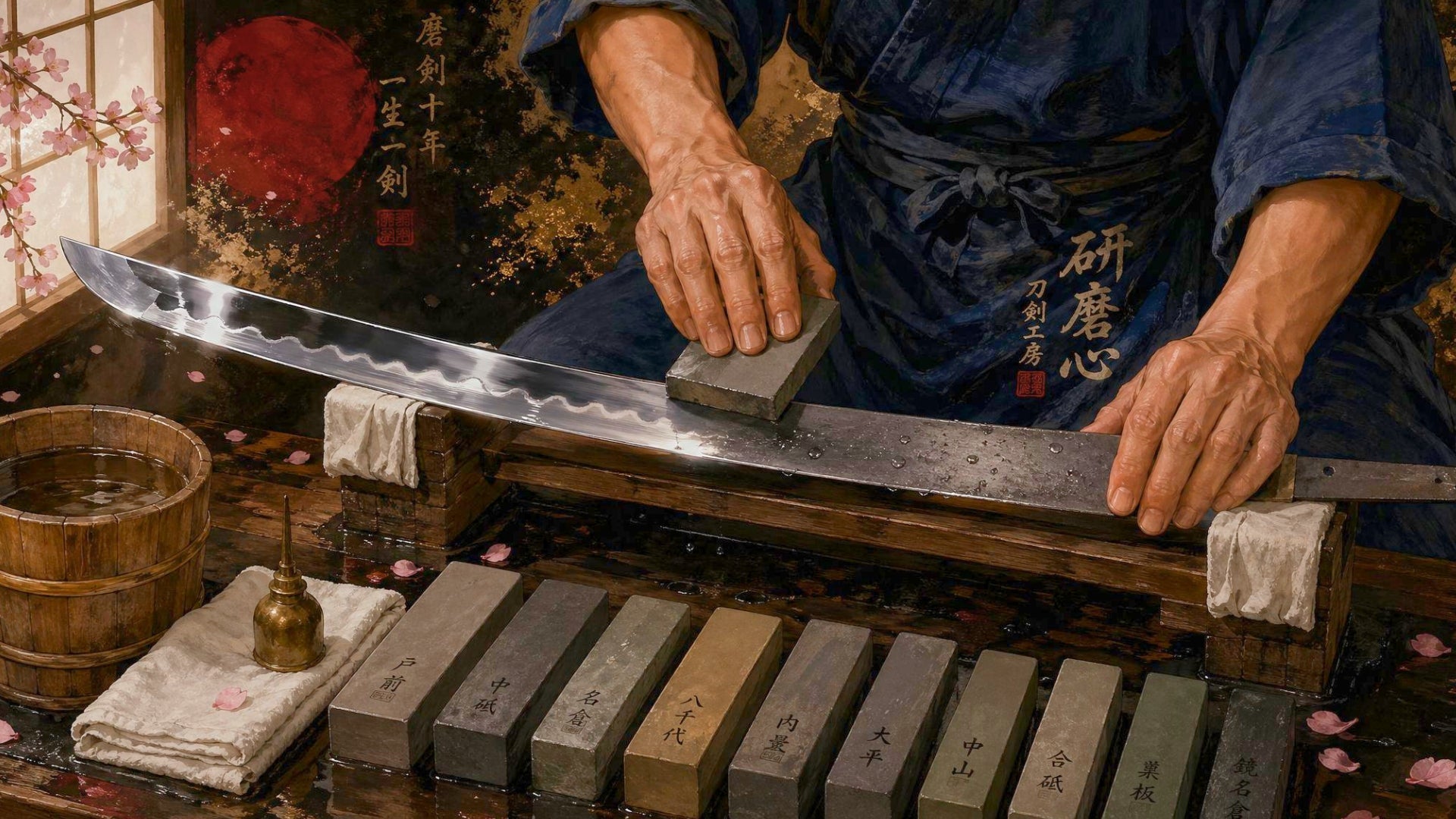
A swordsmith spends weeks forging a katana. A togishi spends months making you see it. Without his work, even a blade by Masamune would look like a dull iron bar. The hamon stays hidden. The grain of the steel remains invisible. The sword exists, but it doesn't speak.
Japanese sword polishing is one of the most misunderstood crafts in the nihonto world. Western collectors sometimes imagine a man with a buffing wheel making metal shiny. The reality is the opposite: the togishi sits on the floor, working by hand with natural stones, through up to fourteen stages that can take 100 to 300 hours per blade. He doesn't add anything to the steel. He removes - layer by microscopic layer - everything that conceals the sword's true character.
This article breaks down the full process: the philosophy behind it, the stones and stages involved, how polishing reveals (or destroys) a hamon, and why a $200 blade and a $2,000 blade are often separated by nothing more than the quality of the finish.
Who Is the Togishi?
In feudal Japan, the togishi held a position of enormous responsibility. The swordsmith created the blade's soul. The polisher revealed it. A careless finish could obscure a masterpiece, or worse, alter the edge geometry and ruin the sword's cutting ability forever.
Training traditionally required a minimum of ten years under a master. In modern Japan, the craft survives through the NBTHK (Society for Preservation of Japanese Art Swords) and a handful of practitioners - some holding the title of Living National Treasure, who continue teaching the old methods.
Before touching stone to steel, the togishi diagnoses the blade: its shape (sugata), curvature (sori), existing damage, and the tradition that produced it. A Bizen blade gets a different approach than a Yamato blade. A Kamakura-era tachi demands different treatment than an Edo-period katana. Every decision serves the sword's identity, never the polisher's ego.

Polished by Hand, Built to Shine
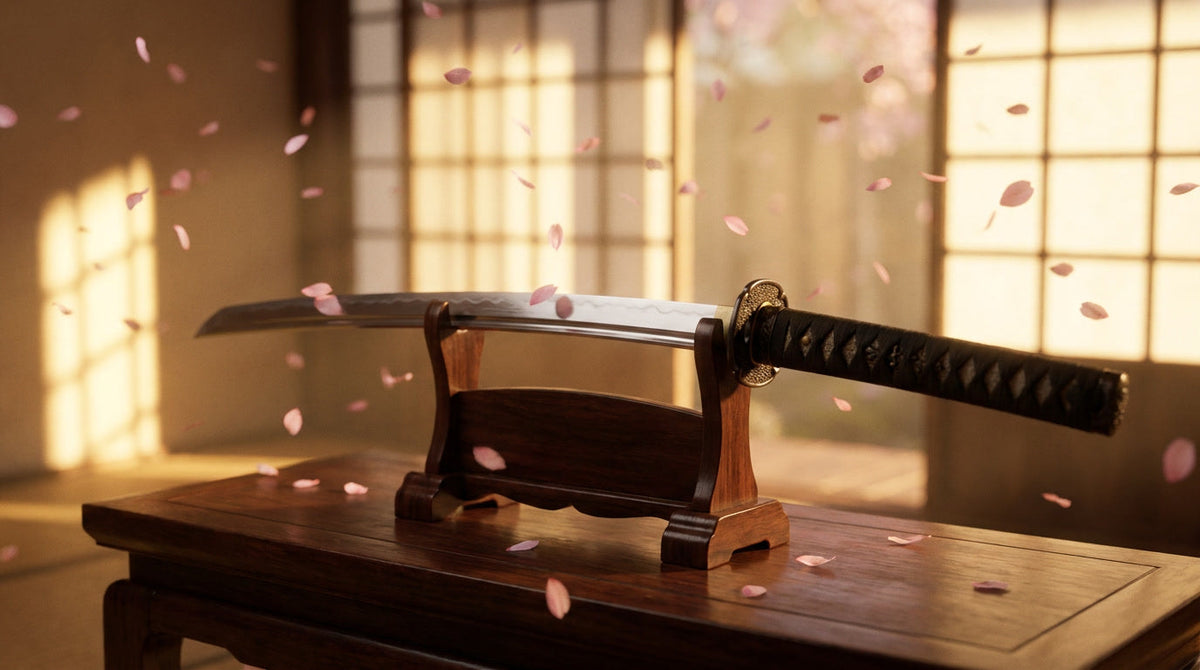
Premium katanas that show the result of traditional hand polishing.


The Philosophy: Revealing, Not Decorating
Here's the fundamental difference between Japanese sword polishing and what the rest of the world calls "polishing": the goal is not to make the blade shiny. It's to make the blade true.
Western metalwork applies a uniform mirror finish that conceals the steel's internal structure. The togishi does the opposite - using varying abrasion across different parts of the blade to reveal the hamon (temper line), the hada (grain pattern), and the jigane (skin steel). The result is a surface where you can read the sword's biography: how it was forged, what steel was used, and which tradition shaped it.
The smith speaks in steel. The polisher translates it into light.
A properly finished nihonto displays different surface textures simultaneously: the ji (flat) shows grain, the ha (edge) reveals the hamon, and the shinogi-ji (ridge) has its own distinct finish. All achieved by hand with progressively finer stones - no machinery at any stage.
The Two Phases: Foundation and Finish
Shitaji Togi: The Foundation
The first phase shapes the blade's geometry and removes damage. It's physically demanding and accounts for the majority of the hours. The togishi works through progressively finer natural stones, from the coarse kongō-do (used only for serious damage) through binsui, kaisei, and several grades of nagura, down to the final foundation stone, koma-nagura.
Each stone must completely erase the scratches left by the previous one before the next can begin. At the binsui stage, the polisher sits on the floor with the stone braced between his legs on a wooden stand, working in long controlled strokes, a position and rhythm unchanged for centuries. Rushing leaves marks that compound at every subsequent stage.
Shiage Togi: The Artistry
If shitaji is construction, shiage is painting. The primary material is uchigumori, an extraordinarily fine stone quarried near Kyoto - applied as tiny finger stones (hazuya and jizuya) backed with lacquered paper.
Hazuya stones work the edge area, awakening the hamon: the nie (individual martensite crystals) and nioi (dense crystal clusters) become visible, and the temper line's full pattern emerges. Our complete hamon guide explains the science behind what you're seeing. Jizuya stones work the flat to reveal the hada - masame (straight grain), itame (wood grain), or mokume (burl), depending on how the smith folded the steel.
A final step of nugui (iron oxide and clove oil to darken the ji) or hadori (whitening the hamon) adds contrast. This is where a clay tempered katana truly comes alive - differential hardening becomes visible art.

How Polishing Reveals the Hamon
Something that surprises many collectors: the hamon exists inside the blade from the moment of quenching. Without polishing, you can't see it. It's like a photograph that hasn't been developed.
During forging, the smith applies clay unevenly - thicker on the spine, thinner on the edge - before plunging the heated blade into water. Thin-clay areas cool fast and harden into martensite. Thick-clay areas cool slowly and remain as softer pearlite. The boundary is the hamon. The finishing stones exploit the way these different crystal structures scatter light, making an invisible metallurgical event visible as a pattern of extraordinary complexity.
Two identically forged blades can look completely different after finishing. The polisher's choices, which stones, how much pressure, what angle - determine how much detail the viewer ultimately sees. Understanding different types of Japanese swords becomes much richer once you appreciate what skilled hands reveal in the steel.
NBTHK appraisers evaluate nihonto under precise natural daylight at a specific angle. Polish quality can mean the difference between a Tokubetsu Hozon ("Especially Worthy of Preservation") rating and a lower designation. The finish doesn't just affect beauty - it affects valuation.
Why It Costs So Much: and What Goes Wrong
A professional polish typically runs $100-$200 per inch of blade length. For a standard katana, that's $2,800-$5,600. Museum-grade work on an important blade can exceed $10,000. The price reflects time (100-300 hours by hand), materials (increasingly rare natural stones - some Kyoto quarries are entirely depleted), and the scarcity of expertise worldwide.
For modern reproduction katanas, this expense is neither necessary nor practical. A well-finished production sword with a proper maintenance routine serves a collector or martial artist perfectly well. But for antique nihonto - where the finish determines both visual experience and monetary value, a qualified professional is not optional.
What Amateur Polishing Destroys
Power tools remove steel too fast and generate heat that softens the hardened edge. Wrong stones leave scratch patterns that traditional methods struggle to erase. And over-polishing across successive restorations thins the blade to structural failure. Kamakura-era blades have survived 700 years because each generation's polisher removed only what was strictly necessary. The ethic is conservation, not perfection.
The rule is simple: antique nihonto, never touch it yourself. Modern reproduction - basic care with choji oil and proper storage is all you need.

Frequently Asked Questions
What does a togishi do?
A togishi uses a sequence of natural stones to reveal a blade's hamon, hada (grain pattern), and jigane (surface steel). The process takes 100 to 300 hours per blade, entirely by hand. The goal is to reveal the sword's inner character, not to add shine or decoration.
How much does professional sword polishing cost?
Typically $100-$200 per inch of blade length - roughly $2,800-$5,600 for a standard katana. Museum-grade work on historically important blades can exceed $10,000, reflecting hundreds of hours of labor, rare stones, and decades of training.
Can I polish a katana myself?
For antique nihonto: never. Power tools and wrong stones cause irreversible damage - loss of geometry, softened edge, destroyed historical surface. For modern reproductions, professional polishing is unnecessary. A choji oil routine and proper storage are sufficient.
What's the difference between shitaji togi and shiage togi?
Shitaji togi is the foundation phase - shaping geometry and removing damage with progressively finer stones. Shiage togi is the artistic finishing - using ultra-fine finger stones to reveal the hamon, grain, and surface texture. One is structural, the other is interpretive.
How does polishing make a hamon visible?
The hamon exists inside the blade from quenching, but it's invisible unpolished. Finishing stones exploit the way hardened martensite and softer pearlite scatter light differently, making the boundary between them visible as a distinct temper line pattern.
To examine finished-blade photos, compare the listed hamon on Enbanaito with the Damascus grain and notare hamon of Kuroki. These modern product examples do not imply that a traditional Japanese togishi polished them.
See the Difference for Yourself
The gap between an unpolished blade and a properly finished one is the gap between silence and music. Every katana in our collection is hand-finished to show its hamon and grain, because a sword that hides its steel is hiding its soul.
Browse our hand-forged katana collection and see what quality finishing looks like. For the science behind the temper line, read our complete hamon guide.
The togishi doesn't create beauty. He uncovers what was always there.
See the Polish in Person
Hand-finished blades, and the maintenance kit that keeps them gleaming.
Share:
The Katana in Japanese Culture: Why It's Called the Soul of the Samurai
Tameshigiri: The Ancient Art of Japanese Sword Test Cutting