

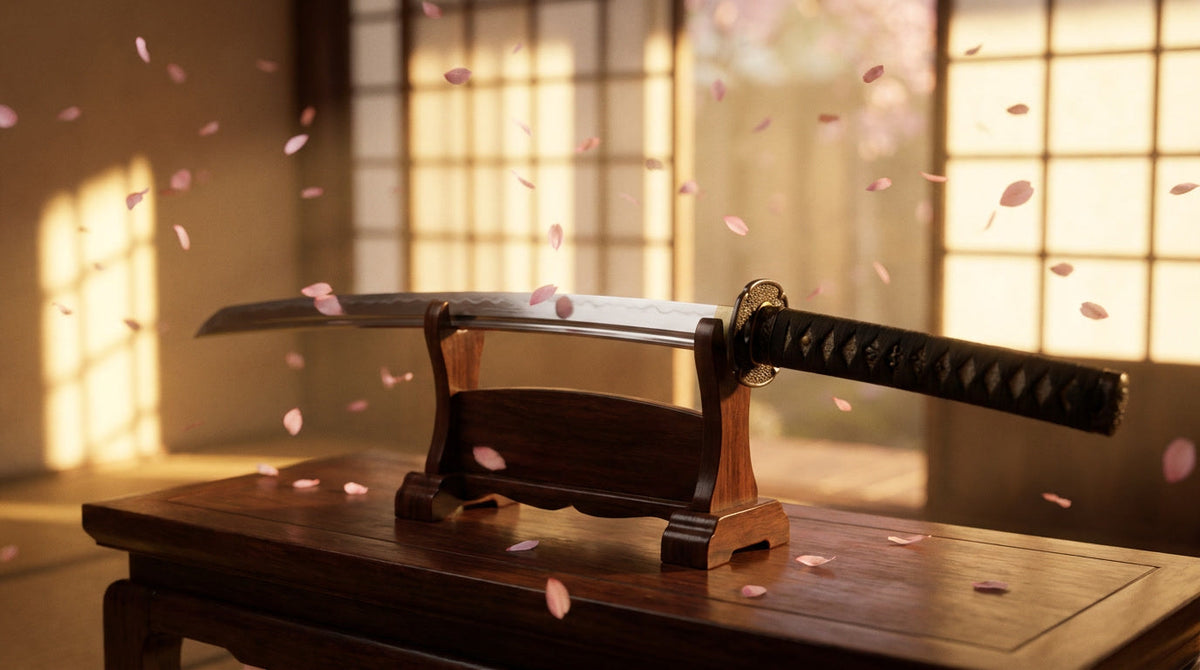
A katana is not a single object. It is roughly thirty distinct components, each with its own Japanese name, its own function, and its own role in why the sword cuts the way it does. The blade alone has a dozen named parts. The handle has another half dozen. The scabbard, the fittings, the metalwork - each layer of detail comes from a different craftsman and a different tradition. Knowing what you are looking at is the first real step from owner to collector.
Most online guides to the parts of a katana are surface-level vocabulary lists. This one is structured around what each part actually does - why it exists, how it shapes the sword's behavior, and what to look for when you examine one. By the end, you will be able to look at any katana and read it the way a Japanese collector does: as a system of intentional parts, each one telling you something about the sword.
This guide breaks the katana into three zones - blade, handle, scabbard, and walks through every named part in each.
Parts of the Blade
The blade itself, from the tip down to where the handle begins - has more named parts than any other section of the sword. Each one identifies a specific feature of the geometry, the surface, or the temper line.
Kissaki (切先): The Tip
The kissaki is the curved tip of the blade. It is bordered by a small line called the yokote that separates the tip section from the rest of the blade. The kissaki is the most technically demanding part to polish correctly, a botched kissaki is the most visible defect on any katana.
Yokote (横手): The Tip Line
The yokote is the precise line where the kissaki tip meets the main blade body. On a properly polished blade, the yokote is razor-straight and sharply defined. On a poor polish, it is fuzzy or absent.
Ha (刃): The Cutting Edge
The ha is the cutting edge of the blade - the side that does the work. On a katana, the ha runs the full length of the blade from kissaki to habaki.
Mune (棟): The Spine
The mune is the back of the blade, opposite the cutting edge. Most katanas have a triangular cross-section at the mune called iori-mune; some have a flat-topped mune called mitsu-mune.
Shinogi (鎊): The Ridge Line
The shinogi is the ridge that runs along the side of the blade between the cutting edge and the spine. It is the structural backbone of the standard katana cross-section, called shinogi-zukuri. Damaging the shinogi is one of the worst things that can happen to a katana, since restoring it requires removing material from the entire blade.
Hamon (刃文): The Temper Line
The hamon is the visible wavy line near the cutting edge. It marks the boundary between the hard, differentially tempered cutting edge and the softer body of the blade. The hamon is both functional (it shows the differential hardening was successful) and artistic (its shape is one of the main aesthetic features of the blade). Our deep dive on the hamon covers this in detail.
Hada (肌): The Grain Pattern
The hada is the grain pattern visible on the polished surface of the blade. On a folded steel blade, the hada appears as flowing, organic patterns - wood grain (itame), straight grain (masame), or burl grain (mokume). See our guide to folded steel katana for what hada says about a blade.
Bo-Hi (棒橋): The Groove
The bo-hi is the long groove (sometimes called a fuller or "blood groove") running along the side of some katana blades. It reduces weight and adds the audible whoosh during cutting practice. Detailed coverage in our bo-hi guide.
Habaki (鎖): The Blade Collar
The habaki is the metal collar wrapping the base of the blade where it meets the handle. It locks the blade into the saya and tightens the handle assembly. Often overlooked, the habaki is one of the most carefully fitted parts of the entire sword.
Nakago (茂): The Tang
The nakago is the tang - the part of the blade hidden inside the handle. On real Japanese swords, the nakago bears the smith's signature (mei). The shape, file marks, and rust patina of the nakago are how experts authenticate antique blades. See our breakdown on full tang vs rat tail for why the nakago must run the full length of the handle.

Every Part, Crafted with Care
From kissaki to tsuka, every component of these blades is built to traditional spec.


Parts of the Handle
The handle (called the tsuka) is a layered assembly of wood, metal, leather, and silk or cotton. Each layer has a name and a function.
Tsuka (柄): The Handle Itself
The tsuka is the entire handle assembly. Underneath the wrap, it is a wooden core (made of two halves of honoki wood) shaped to fit the nakago. The wood is lightweight and gentle on the steel.
Same (鳥): The Ray Skin
Underneath the visible wrap is a layer of ray skin, called same. The pebbled texture provides grip for the wrap and prevents the handle from slipping during cuts. Our tsuka-ito guide covers same and its alternatives.
Ito (糸): The Wrap
The ito is the cord wrapped around the tsuka in the diamond pattern. Traditionally cotton, silk, or leather. The wrap pattern is called tsukamaki, and there are dozens of recognized styles. The ito provides grip and locks the menuki ornaments in place.
Menuki (目貊): The Handle Ornaments
The menuki are small decorative metal ornaments tucked under the ito on each side of the handle. Originally functional grips, they evolved into purely artistic features. Common motifs: dragons, cranes, family crests (kamon), or scenes from Japanese mythology.
Mekugi (目釘): The Bamboo Peg
The mekugi is the small bamboo peg that passes through the handle and through a hole in the nakago, locking the blade to the handle. Most katanas have one mekugi; some have two for extra security. Bamboo is preferred because it flexes slightly under shock instead of cracking like metal would.
Fuchi (縁): The Handle Collar
The fuchi is the metal collar at the base of the handle, where the tsuka meets the tsuba. It strengthens the handle and provides a visual transition between the wrap and the guard.
Kashira (頭): The Pommel Cap
The kashira is the metal cap at the end of the handle. The ito wraps around the kashira and ties off underneath, holding the entire handle assembly together. Often paired aesthetically with the fuchi.
Parts of the Scabbard
The saya - the scabbard - has its own anatomy, less complex than the handle but with several named parts.
Saya (鞘): The Scabbard
The saya is the entire scabbard, traditionally made from two halves of honoki wood, glued and lacquered. The interior is precisely fitted to the blade so that only the spine touches the wood when sheathed. See our full katana saya guide for materials, finishes, and care.
Koiguchi (鯉口): The Saya Mouth
The koiguchi is the opening at the top of the saya where the blade enters. Often reinforced with a horn or metal collar to prevent the wood from splitting. The fit between koiguchi and habaki is what produces the satisfying "click" when sheathing a sword properly.
Kojiri (鎋尻): The Saya Tip
The kojiri is the bottom tip of the saya. On battle-grade swords, it was reinforced with metal to absorb impact if the saya was dropped. On display swords, the kojiri is often left unreinforced.
Sageo (下緒): The Cord
The sageo is the silk or cotton cord tied around the saya, used to secure the sword to the obi (belt). The sageo is removable and replaceable, often matched in color to the ito wrap on the handle.
Kurikata (栗形): The Cord Knob
The kurikata is the small carved knob on the side of the saya through which the sageo is threaded. Usually made of horn or wood, sometimes metal on higher-end pieces.
Decorative Fittings
Several metal fittings sit at the boundary between blade, handle, and saya. Together they are called koshirae when assembled, and they often share a unified design across a single sword.
Tsuba (鯩): The Hand Guard
The tsuba is the round (or sometimes oval, square, or polylobed) hand guard between the blade and the handle. It protects the hand from sliding onto the edge during cuts and from incoming blade contact in combat. Tsuba designs are one of the most collected aspects of Japanese sword art - some antique tsuba sell for more than the swords they came with.
Seppa (切羽): The Spacers
Seppa are the small metal washers on either side of the tsuba. They tighten the assembly and prevent the tsuba from rattling. A katana usually has two seppa - one on each side of the tsuba.
| Fitting | Position | Function |
|---|---|---|
| Habaki | Base of blade | Locks blade into saya |
| Seppa | Either side of tsuba | Tighten the assembly |
| Tsuba | Between blade and handle | Hand guard |
| Fuchi | Base of handle | Strengthen and finish handle |
| Kashira | End of handle | Cap, anchor for ito |
| Menuki | Sides of handle | Decorative, slight grip aid |
The metal fittings on a katana - tsuba, fuchi, kashira, menuki - are often made by specialist artisans called kinko, who never make blades themselves. A high-end Edo-period koshirae set could be commissioned over years, with the tsuba alone taking months to complete. Some legendary kinko families like the Goto and Mino schools are as historically important as the swordsmiths whose blades they decorated.
Full Anatomy at a Glance
Roughly thirty named components, made by four to six different specialists. A katana is not a single object - it is a small ecosystem of crafts. Even the cheapest mass-produced sword still has all of these parts; the difference is just in how carefully each one is made and fitted.
Why the Vocabulary Matters
Knowing the parts of a katana is not just trivia. It changes how you buy, how you maintain, and how you talk about swords.
When evaluating a katana, the vocabulary lets you specify exactly what you are looking for and what you have noticed: "the koiguchi is loose," "the hamon is acid-etched," "the menuki are missing on one side," "the kashira does not match the fuchi." Without these terms, you can only say "something is wrong with the handle," which is useless when describing a problem to a seller, restorer, or fellow collector.
When maintaining a katana, the vocabulary tells you what each part needs. The blade needs oil. The same does not. The ito can be re-wrapped without disassembling the rest. The mekugi should be checked monthly. Each part has its own care routine, and knowing the name is the first step to knowing the routine.
Pick up your katana. Can you point to and name the kissaki, yokote, hamon, shinogi, habaki, tsuba, fuchi, kashira, menuki, mekugi, koiguchi, and kojiri? If you can name ten of those twelve, you are ahead of most casual owners. If you can name all twelve, you are starting to think like a collector. The vocabulary is small enough to learn in an afternoon and large enough to matter for the rest of your life with the sword.
Frequently Asked Questions
How many parts does a katana have in total?
Roughly 25 to 30 named parts depending on how you count overlapping or optional components. The blade has about 10 distinct parts, the handle assembly has 7, the saya has 5, and the koshirae fittings add 6 more. Some swords have additional features like double mekugi or specialized tsuba parts.
What is the most important part of a katana?
Functionally, the nakago (tang) and the mekugi are the parts that hold the entire sword together - if either fails, the blade comes off the handle. Aesthetically and structurally, the hamon and the shinogi are usually considered the most important parts. They define both the cutting performance and the visual identity of the blade.
Can I name the parts of a katana in English instead of Japanese?
Some of them, but the Japanese terms are universal in the sword community worldwide. Western terms like "hilt," "crossguard," or "scabbard" are loose approximations that lose the specific meaning of Japanese terms. Serious collectors and dealers always use the Japanese vocabulary.
What is the difference between a tsuba and a hand guard?
None functionally - they are the same thing. "Tsuba" is just the Japanese name for the hand guard on a katana. The term is preferred because Japanese tsuba have specific design conventions (round shape, off-center mounting hole, decorative motifs) that distinguish them from European hand guards on swords like rapiers or broadswords.
Are all the parts of a katana removable for maintenance?
Most are, with the right tools. Pushing out the mekugi peg releases the blade from the handle, allowing every part - tsuba, seppa, fuchi, kashira, menuki, ito, same - to be removed and replaced individually. Disassembly is a normal part of long-term sword care. Reassembly should be done carefully or by a professional to avoid damaging the nakago or the wrap.
The Sword Is the Sum of Its Names
Every part of a katana has a name, a function, and a craftsman behind it. Learning the vocabulary changes how you see the sword, not as one object, but as thirty intentional components held together by tradition and a single bamboo peg. Once you can read the parts, the sword starts speaking back.
Browse our katana collection for traditionally constructed swords with all parts properly fitted, and read our saya guide and tsuka-ito guide for deeper coverage of the major sub-assemblies.
Thirty parts. One sword. One bamboo peg holds it all together.
Hold Every Part in Your Hand
Hand-forged katanas where every component - blade, fittings, scabbard - is made with intention.
Share:
The Honjo Masamune: Japan's Lost National Treasure
How to Sharpen a Katana: Methods, Mistakes & When Not To