

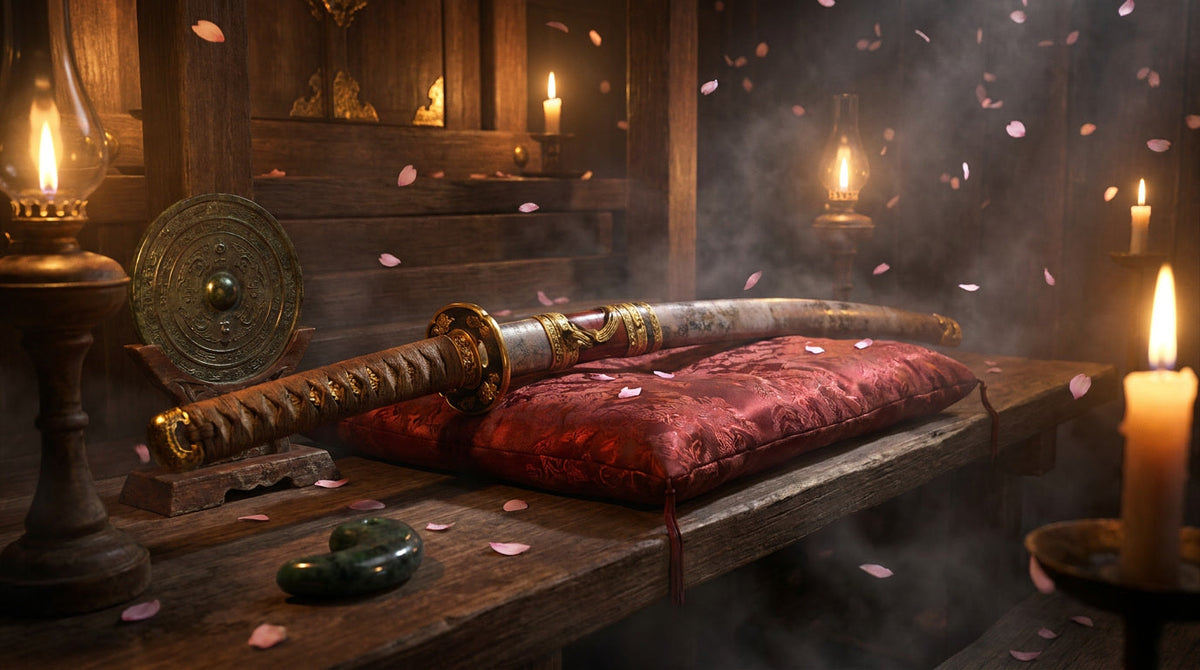
In a sealed inner chamber of a Shinto shrine in Nagoya, behind walls that no living person has been permitted to enter for over a thousand years, sits a sword. According to Japan's oldest written history, it was pulled from the tail of an eight-headed serpent by a thunder god, gifted to the first emperor's ancestress, and has been carried into every imperial enthronement ceremony since the late 7th century. Its name is Kusanagi no Tsurugi - the Grass-Cutting Sword, and it is the oldest object in Japanese civilization that anyone can name. Almost no one is allowed to see it. Even the Emperor of Japan likely has not.
Kusanagi no Tsurugi (草薙剣) is one of the Three Sacred Treasures - the imperial regalia of Japan, the physical symbols of legitimate sovereignty over the Japanese state. Alongside the sacred mirror (Yata no Kagami) and the curved jewel (Yasakani no Magatama), the sword represents one of the three pillars on which the Japanese imperial line claims its mandate. To possess the regalia, traditionally, is to be the legitimate emperor.
This is the complete story: where the sword comes from in mythology, the legendary prince who carried it into battle, why it sits today at the Atsuta Shrine, the centuries-old debate about whether the real sword is still there, and why a 21st-century imperial enthronement still places it at the center of the ceremony.

- What Kusanagi no Tsurugi is
- The myth: Susano-o and the eight-headed serpent
- Yamato Takeru: the prince who carried it
- The Three Sacred Treasures of Japan
- Atsuta Shrine: where the sword resides
- The duplicate question: is the original still there?
- The modern role: imperial enthronement ceremonies
- Why this sword still matters
- Common questions
What Kusanagi no Tsurugi is
Kusanagi no Tsurugi (草薙剣) translates literally as the Grass-Cutting Sword. The earlier name in the most ancient sources is Ame no Murakumo no Tsurugi (天叢雲剣) - "the Sword of Heaven's Gathering Clouds" - referring to a celestial omen said to gather above its original location. The shorter and more familiar name comes from a specific incident in the legend of Yamato Takeru, discussed later.
The sword's physical form is officially unknown. No verified description exists of the actual blade housed at Atsuta Shrine, because no one outside the inner Shinto priesthood is permitted to see it. The chronicles describe it as a single-edged straight sword (a tsurugi, not a curved katana), which is consistent with the form of swords produced in Japan during the Yayoi and Kofun periods - roughly 300 BCE to 538 CE. The actual blade, if the original survives, would predate the development of the curved Japanese sword by several centuries.
Crucially, Kusanagi is described in primary sources as a divine object rather than a battle weapon. Its existence in mythology precedes any human use; the chronicles describe it as having been forged in the celestial realm and given to mortals as a sacred gift. The historical reality is more complicated and more interesting.
The myth: Susano-o and the eight-headed serpent
The origin story of Kusanagi appears in both of Japan's oldest written histories - the Kojiki (compiled 712 CE) and the Nihon Shoki (compiled 720 CE). The two accounts differ slightly, but the core narrative is consistent.
The god Susano-o no Mikoto, brother of the sun goddess Amaterasu, was banished from the heavenly realm for a series of offenses against his sister. He descended to the human world, landing in the Izumo region of western Japan. There he encountered an elderly couple and their daughter Kushinada-hime, weeping by a river. The couple explained that an eight-headed dragon named Yamata no Orochi had been devouring their daughters one per year, and Kushinada was the last surviving daughter - scheduled to be eaten that same night.
Susano-o agreed to slay the dragon in exchange for Kushinada's hand in marriage. His plan was clever: he had the parents prepare eight enormous vats of strong sake, each placed behind a separate gate. When Orochi arrived, each of the dragon's eight heads found its own vat, drank deeply, and fell asleep. Susano-o then approached the unconscious serpent and began cutting it apart with his own sword.
Cutting through one of the dragon's tails, his blade struck something solid and was chipped. He carefully cut the tail open and discovered, embedded inside, a perfect sword of unknown origin. This sword was Ame no Murakumo no Tsurugi - the celestial sword that would later be renamed Kusanagi.
Susano-o, recognizing the sword as a sacred object too significant to keep for himself, presented it to his sister Amaterasu in the heavens as a peace offering. Amaterasu accepted the gift and, generations later, passed it down to her descendant Ninigi, when he descended from heaven to begin the imperial line of Japan.
The Yamata no Orochi narrative has been interpreted by some modern Japanese scholars as a mythologized account of an actual military or political event in pre-historic Izumo - possibly a victory by an early Yamato-aligned chieftain over a rival tribal confederation whose symbol was a serpent or dragon. In this reading, the "sword in the tail" would represent captured weapons or treasures from the defeated faction. This is one of several theories for how a real historical artifact may have entered the mythological tradition.
Master-Forged Steel
Premium katanas in T10 and Damascus steel - the highest tier of our collection.


Yamato Takeru: the prince who carried it
The sword passes through several mythical generations before re-entering the historical narrative with one of Japan's most famous semi-legendary figures: Yamato Takeru (literally, "the Brave of Yamato"), traditionally identified as Prince Ōusu, son of the 12th emperor Keikō.
Yamato Takeru's story occupies a central place in the Kojiki and Nihon Shoki. He is described as a fearsome warrior whose father feared his strength and repeatedly sent him on dangerous campaigns hoping he would die in combat. Yamato Takeru survived each one, conquering rebellious clans in the western and eastern regions of Japan and dramatically expanding the early imperial state's territory.
Before one of his eastern campaigns, his aunt - the high priestess of the Ise Shrine - gave him the sword Ame no Murakumo for protection. The campaign was treacherous. At one point, Yamato Takeru was lured onto a vast grassland by a treacherous local chieftain, who then set the grass on fire to trap him. Surrounded by flames, the prince used the sword to cut down the burning grass around himself, then used a fire-starting tool to ignite a counter-fire that burned outward toward his enemies. The chieftain and his men perished; Yamato Takeru escaped unharmed.
From that incident, the sword received its more famous name: Kusanagi no Tsurugi - "the Grass-Cutting Sword." This is the moment when the divine sword becomes inseparably associated with the imperial line as a weapon of survival and conquest.
Yamato Takeru carried Kusanagi for the remainder of his campaigns. According to the chronicles, his eventual death, from a fever contracted after challenging a mountain deity without his sword - was attributed in part to having left Kusanagi behind with his wife Miyazu-hime for safekeeping. After his death, Miyazu-hime enshrined the sword at the location where she lived. That shrine, expanded and rebuilt over centuries, became Atsuta Shrine - where the sword resides to this day.
The Three Sacred Treasures of Japan
Kusanagi is not a solitary artifact. It is one of three objects that together constitute the Imperial Regalia of Japan (Sanshu no Jingi, 三種の神器), the physical symbols of legitimate imperial sovereignty.
| Treasure | Name | Represents |
|---|---|---|
| The Mirror | Yata no Kagami | Wisdom and self-reflection |
| The Sword | Kusanagi no Tsurugi | Valor and protective force |
| The Jewel | Yasakani no Magatama | Benevolence and harmony |
The three treasures correspond to the three traditional virtues of a Japanese sovereign: wisdom, valor, and benevolence. According to the mythology, all three were given by the sun goddess Amaterasu to her descendant Ninigi when he descended to govern the human world, and they have been passed down through every legitimate emperor since.
The three treasures are physically separate. The sacred mirror is housed at the Inner Shrine (Naiku) of the Ise Shrine, in Mie Prefecture. The sword Kusanagi is housed at Atsuta Shrine in Nagoya. The jewel, and traditionally a replica of the sword and mirror - is housed at the Imperial Palace in Tokyo. During an enthronement ceremony, the replicas (or in some interpretations, the actual objects) are temporarily brought into the same ritual space.
The exact custody arrangement is deliberately kept ambiguous. The Imperial Household Agency has historically declined to confirm the exact physical state, age, or appearance of any of the three treasures. The official position is that the treasures exist, are properly housed, and are not subject to public inspection or scientific examination. This silence has been maintained continuously for over a millennium.
Atsuta Shrine: where the sword resides
Atsuta Shrine, located in the modern city of Nagoya, is the home of Kusanagi no Tsurugi. The shrine is one of the most important Shinto sites in Japan - second only to the Ise Shrine in religious significance.
The shrine was founded, according to tradition, by Miyazu-hime, the wife of Yamato Takeru, after his death. She enshrined the sword at the site in approximately the 1st or 2nd century CE - though no archaeological evidence confirms the precise founding date. The shrine has been rebuilt many times over the centuries, most recently in 1955 in the modern Shinmei-zukuri architectural style.
The sword itself is housed in an inner sanctuary called the honden, accessible only to the shrine's senior Shinto priests. Access is governed by ancient protocols: even the highest-ranking visitors, including reigning emperors - are not permitted into the chamber where the sword physically resides. The sword is occasionally brought out for specific ceremonial purposes, but always wrapped, encased, and kept from direct view.
Atsuta Shrine receives approximately 9 million visitors annually, primarily worshippers who come for blessings, weddings, and seasonal festivals. The shrine grounds are extensive - approximately 200,000 square meters of forested precinct in the middle of Nagoya, and include a small museum where antique swords, including several historically significant blades donated by samurai families across the centuries, are publicly viewable. None of those publicly-viewable swords are Kusanagi.

The duplicate question: is the original still there?
This is the most famous controversy surrounding Kusanagi. There is a serious historical question about whether the actual ancient sword still exists or whether it was lost centuries ago and replaced with replicas.
The central historical event in this debate is the Battle of Dan-no-ura, fought on April 25, 1185. This naval battle ended the Genpei War between the Taira and Minamoto clans and effectively transferred political power in Japan from the Taira to the Minamoto. The battle is famous, among other reasons, because the seven-year-old Emperor Antoku - held by the Taira side - drowned during the defeat. According to the contemporary chronicles, his grandmother (the dowager empress) carried the imperial regalia into the sea with her when she leapt from the ship rather than be captured.
After the battle, Minamoto forces recovered the sacred mirror and the magatama jewel from the wreckage and the surrounding waters. The sword Kusanagi was not recovered. Multiple search efforts were undertaken in the days and weeks following the battle. The sword was never found.
The official Imperial Household position, since the 12th century, has been that the sword housed at Atsuta Shrine is the original Kusanagi, never lost at Dan-no-ura. According to this view, the sword carried by Emperor Antoku was already a replica produced sometime in the Heian period for ceremonial use, and the actual divine sword had remained safely at Atsuta throughout. This interpretation is supported by some shrine documents but disputed by others.
The alternative, and historically more probable - view is that the original Kusanagi was lost at sea in 1185, and a replacement was either commissioned or designated from among existing temple holdings. Multiple medieval and Edo-period scholars wrote treatises arguing for one position or the other. The debate has never been formally resolved because the Imperial Household has refused, and continues to refuse - to permit examination of either the Atsuta blade or any of the regalia.
A small body of evidence supports the "still original" position. Atsuta Shrine records describe specific physical attributes (chips, surface markings) consistent with an ancient blade that would have been present before 1185. But these records have never been independently verified, and the sealed inner sanctuary prevents independent inspection.
The cultural-political answer is that it does not matter. The imperial regalia function symbolically. Whether the physical sword is the literal object given to Susano-o in mythology, or a replacement produced in the 12th century, the institutional and ritual continuity makes the sword Kusanagi for all functional purposes.
The modern role: imperial enthronement ceremonies
Kusanagi remains an active participant in Japanese state ceremony into the 21st century. Every Japanese imperial enthronement, including the 2019 enthronement of Emperor Naruhito - has included a ritual called the Kenji-tō-Shōkei no Gi, the "Inheritance of the Sacred Treasures."
In this ceremony, the sword (or its ceremonial counterpart) and the magatama jewel are formally presented to the new emperor as the physical confirmation of his accession. The mirror, kept at the Ise Shrine, is not physically present but is symbolically represented. The ceremony is brief, deeply formal, and traditionally closed to all but immediate Imperial Household participants and a small number of senior government officials.
In 2019, the ceremony was conducted on May 1, the day Emperor Naruhito formally ascended to the throne following Emperor Akihito's abdication. The ceremony was broadcast in a limited form by NHK; the actual moment of regalia transfer was off-camera, in accordance with traditional secrecy. The new emperor accepted the regalia and gave a brief formal address; the entire process lasted approximately 11 minutes.
The fact that the imperial regalia remain at the literal center of Japanese state ceremony - in a 21st-century democratic constitutional monarchy - is one of the most distinctive features of Japanese governance. No other modern state requires the formal handing over of a Bronze Age sword to its head of state at the moment of accession. The tradition's continuity is itself part of what makes the regalia significant.
The Imperial Palace in Tokyo houses copies of the sword and the mirror for use in ceremonies where the original objects cannot or should not be moved. The exact status of these copies, whether they are themselves consecrated and therefore quasi-sacred, or merely placeholders - is deliberately ambiguous. During the 2019 enthronement, the ceremony reportedly used the palace copies rather than transporting the actual Atsuta sword. This compromise has been standard practice since at least the Meiji era.
Why this sword still matters
Kusanagi no Tsurugi occupies an unusual position in modern Japanese culture. It is simultaneously a religious relic, a political symbol, an active participant in state ceremony, an unverified historical artifact, and a cultural touchstone referenced across centuries of Japanese art, literature, and entertainment.
National identity. Along with the mirror and the jewel, the sword is one of the few continuously preserved objects connecting modern Japan to its earliest mythologized origins. Every other major civilization has lost its founding artifacts to time, conquest, or institutional collapse. Japan's continuous imperial line and its preservation of the regalia (in some form) for over 1,300 years is genuinely exceptional in world history.
Religious continuity. The Shinto religious tradition - in which Kusanagi is embedded - represents one of the only major living polytheistic traditions in the modern world. Most ancient polytheisms (Greek, Roman, Egyptian, Norse) survive only as scholarly subjects. Japanese Shinto remains an active practice with millions of regular adherents, and the regalia are physical anchors of that tradition.
Cultural resonance. Kusanagi appears across Japanese popular culture as a recurring symbol of legitimate authority, sacred power, and ancient mystery. Many works of fiction across print, screen, and video games reference the sword - often as the explicit name of a fictional weapon meant to evoke similar significance. The cultural shorthand is established and stable: invoking Kusanagi means invoking imperial legitimacy and divine authorization.
For more on Japan's legendary swords across history, see our guide to famous samurai and their legendary katanas. For the broader context of Japanese sword development, see our overview of the types of Japanese swords.

Common questions
Has anyone seen Kusanagi in modern times?
Almost certainly no. The most recent confirmed sighting in any historical record is from approximately the 12th century, with a possible glimpse in the 17th century by a senior shrine priest who reportedly wrote a brief description before destroying his notes in shame at having looked. The current head priest of Atsuta Shrine, by tradition, does not look at the sword either. The chamber is opened only by ranking attendants for specific preservation rituals, and even then the sword remains wrapped.
Why won't they let anyone examine it?
The Imperial Household Agency considers the regalia to be religious objects whose function depends on continuous ritual purity. Permitting examination would, in this view, fundamentally alter the relationship between the objects and the imperial line. There is also a practical concern: confirming or denying the sword's age, composition, or condition would settle the duplicate question and potentially undermine the institutional continuity. The deliberate ambiguity is itself part of how the regalia function.
What does Kusanagi look like, supposedly?
Atsuta Shrine records describe the sword as approximately 80 cm in total length, with a tarnished steel blade and ancient bronze or iron fittings. The blade is said to be straight rather than curved, which would place it in the pre-Heian era of Japanese sword development. These descriptions come from secondary sources and may be unreliable; no independent confirmation exists.
What happened to the sword that drowned at Dan-no-ura?
Officially, no sword drowned at Dan-no-ura - only a ceremonial replica. Unofficially, most modern historians believe the actual ancient sword was lost in the battle. If so, the original Kusanagi may still be on the seabed in the strait between Honshu and Kyushu. Several modern marine-archaeology expeditions have searched the area without success. The water is deep, currents are strong, and any iron-based artifact would have corroded substantially over 840 years.
Can I visit Atsuta Shrine?
Yes. Atsuta Shrine in Nagoya is open to the public daily, with no admission fee. You can approach the main shrine building and offer prayers in the standard Shinto manner. The inner chambers where Kusanagi is housed are not accessible to visitors and never will be. The shrine also operates a museum on the grounds where you can see other historically significant donated swords.
Why is the sword called the "Grass-Cutting Sword" if it's a divine artifact?
The name comes from the Yamato Takeru episode, when the prince used the sword to cut down burning grass during an ambush. The original name - Ame no Murakumo no Tsurugi, "Sword of Heaven's Gathering Clouds" - referred to a celestial omen and a heavenly origin. The post-incident renaming reflects the sword's transition from purely divine artifact to instrument of imperial conquest. Both names are used in modern Japanese, but Kusanagi is by far the more common.
How does Kusanagi compare to other legendary swords like Excalibur?
The closest Western parallel is the Lia Fáil ("Stone of Destiny") of medieval Irish kingship, a coronation object whose legitimacy was tied to ritual rather than physical inspection. Excalibur is a closer aesthetic match but a much more recent literary creation (12th-century Welsh tradition) and was never a real consecrated object. Kusanagi is unique among major sword myths in that the actual object, or something institutionally identified as the actual object - has been continuously preserved at a single physical location for at least 1,000 years.
For the Serious Collector
Each blade below is forged for collectors who refuse to compromise on steel.


One sword. One unbroken thread. Fourteen centuries.
Whether Kusanagi at Atsuta Shrine is the literal sword pulled from the serpent's tail or a 12th-century replacement, it remains the single oldest object in Japanese civilization that anyone can name. Browse our complete katana collection for hand-forged blades that continue the tradition Kusanagi inaugurated.
Want to explore more of Japan's legendary swords? Read our breakdown of famous samurai and their legendary katanas, or our guide to the types of Japanese swords.
A serpent's tail. A grassland fire. A sealed chamber. Fourteen hundred years of sovereignty.
Share:
Tessaiga: The Fang Sword of Inuyasha Explained (Forms, Origins & Real-World Inspiration)