

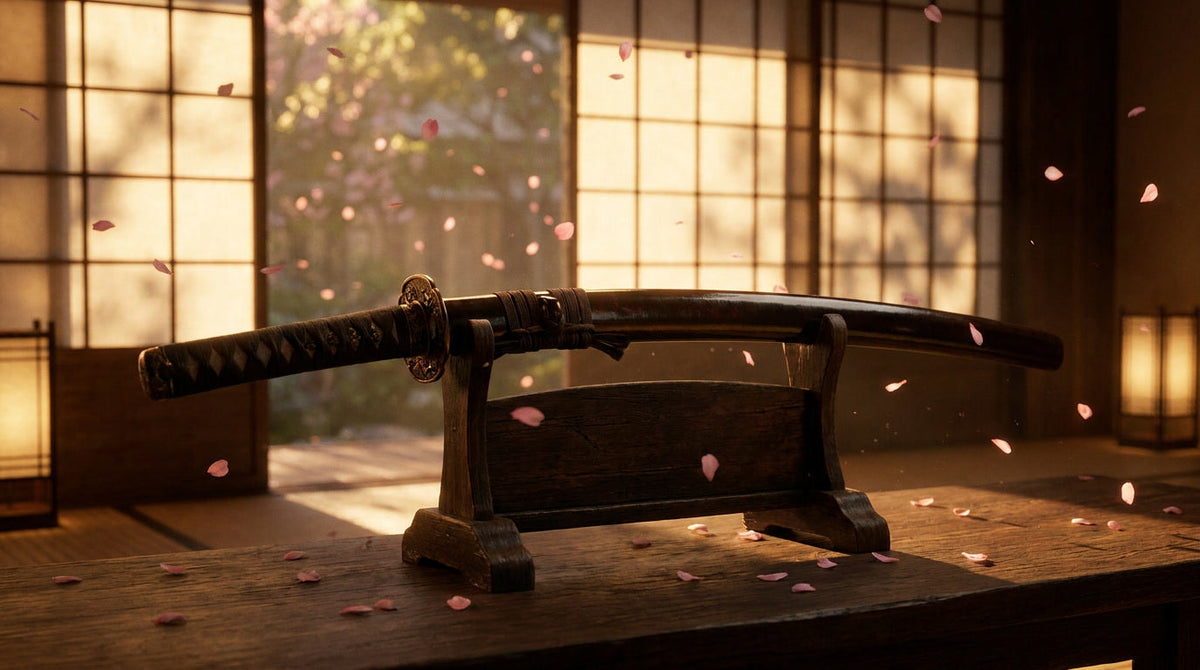
A traditional Japanese sword polisher spends 100 to 150 hours on a single katana. Across that time he uses fifteen progressively finer stones, his bare thumb as the final pressure gauge, and water as his only lubricant. He charges $100 to $150 per inch of blade. The first time you understand why, you will stop wanting to sharpen your katana yourself.
"How to sharpen a katana" is one of the most-searched questions in the sword world, and most of the answers online are wrong in ways that will damage your blade. The shortest honest answer is: do not. The slightly longer answer involves understanding the difference between sharpening and polishing, what a katana actually needs, and the narrow range of cases where a careful owner can do something useful at home.
This guide covers what is actually safe, what is dangerous, and what belongs only in the hands of a professional togishi.
Sharpening vs Polishing: Two Different Things
The first confusion to clear up: when most people ask how to sharpen a katana, they actually mean polish it. The two operations are different in goal, technique, and result.
Sharpening creates or restores a cutting edge. On a Western kitchen knife, you grind the edge bevel against a stone at a fixed angle until you can shave with it. The work is concentrated on the last millimeter of blade.
Polishing is the Japanese tradition. It works on the entire blade surface, not just the edge. The polisher reshapes the geometry, restores the hamon, brings out the grain pattern of the steel, and as a side effect produces an edge that cuts. The edge is downstream of the polish, not its target.

This is why a katana that has been "sharpened" with Western knife-sharpening tools usually looks ruined to a Japanese eye. The cutting bevel may now be sharp, but the rest of the blade - the shinogi ridge, the kissaki tip, the surface grain - has been damaged. The sword cuts but is no longer a katana in any meaningful sense.
Steel That Holds an Edge
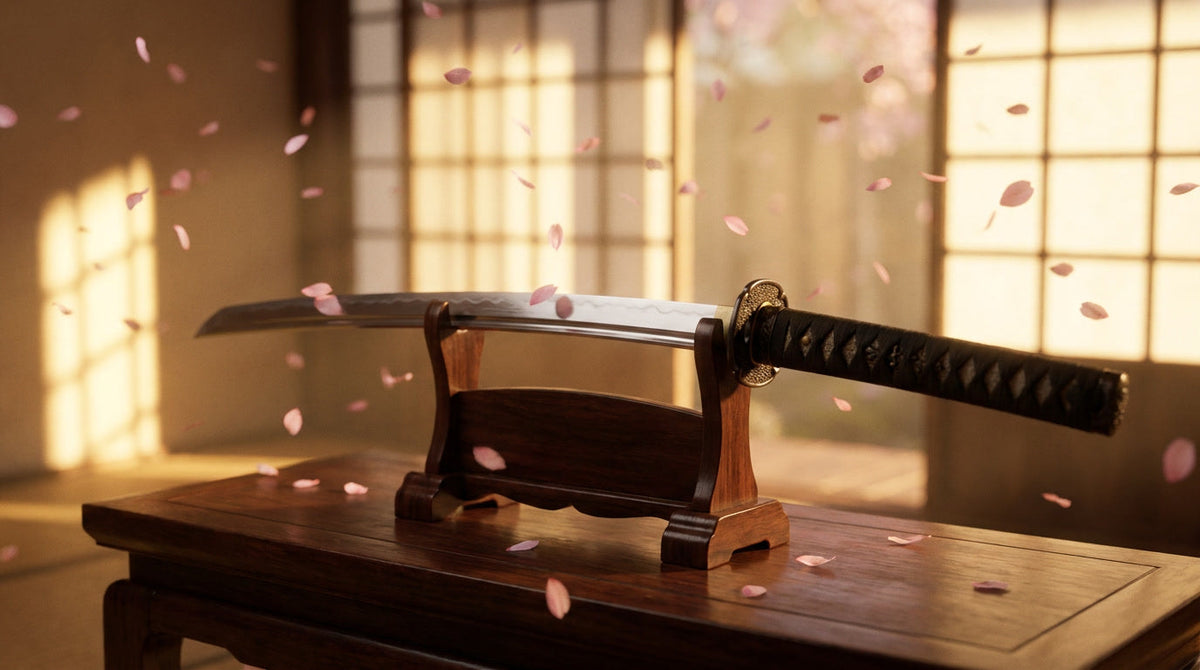
A katana cleaning kit and the kind of premium blades worth maintaining.


Why DIY Sharpening Destroys Katanas
Three hard reasons to keep amateur tools away from a Japanese sword.
1. The Blade Geometry Is Specific
A katana has a specific cross-section, called shinogi-zukuri, with a precise ridge line running along the side of the blade. Western sharpening tools are designed for flat-sided knives. Pull a katana through a pull-through sharpener or grind it on an angled jig and you flatten the shinogi ridge. The ridge is not decorative - it is structural. Once flattened, it cannot be restored without removing 1-2 mm of steel from the entire blade.
2. Heat Destroys the Hamon
The visible wavy line near the edge of a Japanese sword - the hamon - is the visible boundary of the differential hardening. Below the hamon, the steel is hardened to roughly 60 HRC. Above it, the steel is softer for shock absorption. Power tools and aggressive grinders generate enough heat to anneal the edge, undoing the hardening process the smith spent days on. A few seconds of grinder contact can permanently soften an inch of cutting edge.
3. The Polish Is the Value
On any quality katana, half or more of the sword's value is the polish - the surface finish that took hundreds of hours of skilled work to achieve. Sandpaper, metal polish, even a single pass with a buffing wheel destroys this work in minutes. Restoring it requires a full professional re-polish at $100 to $150 per inch. On a 28-inch blade, that is $2,800 to $4,200 - often more than the sword cost in the first place.
Bench grinders. Belt sanders. Pull-through knife sharpeners. Whetstones used at the wrong angle. Sandpaper of any grit. Dremels. Buffing wheels. Metal polish (Brasso, Flitz). Steel wool. Files. Anything sold as a "sword sharpener" online for under $50. If you own any of these and are tempted, lock the sword in another room first.
What Katanas Actually Need
Most katanas do not need to be sharpened. Here is the honest scope of what your sword likely needs:
If the Sword Is for Display
It needs no sharpening, ever. A well-maintained katana on a stand keeps its factory edge indefinitely. The risk of damage from any sharpening operation outweighs any benefit, since you will never use the cutting edge in the first place. Just keep it clean and oiled - see our katana maintenance and care guide for the routine.
If the Sword Is for Light Practice (Iaido, Kata)
Most iaido practitioners use a blunt training sword (iaitō) for safety. If you are using a live blade for slow forms practice, the edge does not contact targets and does not dull. A factory edge will hold for years.
If the Sword Is for Cutting (Tameshigiri)
This is the only case where edge maintenance matters. Even here, a good katana used on rolled tatami targets dulls slowly - you will see edge degradation after roughly 200 to 500 cuts depending on steel and target. Re-sharpening at that point is a job for a professional, not a stone in your garage. Detailed cutting practice mechanics are covered in our tameshigiri guide.
Safe At-Home Maintenance
There are a few maintenance tasks the careful owner can do at home that improve cutting performance without touching the edge geometry. None of these is "sharpening" in the strict sense.
Clean and Oil
The single most impactful thing you can do for any blade. A clean, properly oiled edge cuts noticeably better than a dirty one of the same sharpness. Wipe the blade with a soft cloth, apply a thin layer of choji oil, wipe off the excess. Do this every six months for a stored sword and after every cutting session for an active one.
Inspect and Realign
Light cuts can roll the very tip of the cutting edge - bend it microscopically to one side. This shows up as a "feather" you can feel by lightly running your fingernail (perpendicular to the edge) along the length. A leather strop, used very gently and only on the bevel, can sometimes realign a rolled edge without removing material. This is the closest thing to sharpening you should attempt at home, and it has limits.
Handle Tightening
A loose handle makes any cut feel duller because the blade vibrates rather than driving forward. Inspect the mekugi peg every six months. Replace cracked or shrunken pegs immediately. A tight handle is the cheapest "sharpening" you can do.
The Professional Route
If your katana genuinely needs sharpening or restoration, the work goes to a certified togishi (sword polisher). Here is what that process looks like:
Finding a Togishi
In the US, the Japanese Sword Society of the United States (JSSUS) maintains a list of qualified polishers. In Europe, the European Token Society. In Japan, the Society for the Preservation of Japanese Art Swords (NBTHK) certifies practitioners. There are perhaps 30 to 50 togishi worldwide qualified to work on traditional Japanese blades. None of them advertise on Amazon.
Cost and Timeline
| Service | Typical Cost | Timeline |
|---|---|---|
| Edge touch-up only | $200-$500 | 2-4 weeks |
| Partial polish (window) | $300-$800 | 4-6 weeks |
| Full traditional polish | $2,500-$4,500 | 3-6 months |
| Restoration (rust, chips) | $3,500-$8,000+ | 6-12 months |
Insurance and shipping for the round trip add another $200 to $500 depending on the value of the blade. The math is simple: for any sword worth less than $1,500 to $2,000, professional polishing costs more than buying a new sword. This is a real reason serious collectors invest upfront in good steel and good polish - re-polishing is rarely economical.
The 15 stones used in a traditional katana polish each have a specific name and grit, ranging from coarse arato stones (around 80-120 grit) to the final uchigumori (12,000+ grit) used for the surface finish. The finest stones are quarried from a single mine in Japan and cost $2,000 to $10,000 each. A togishi's stone collection is often worth more than their car.
Common Mistakes to Avoid
If you are tempted to sharpen anyway, here are the mistakes that do the most damage. Avoiding them does not mean the result will be good - it means it will be less catastrophic.
| Mistake | What Goes Wrong |
|---|---|
| Using a power grinder | Heat anneals the edge, destroys the hamon |
| Pulling through a knife sharpener | Crushes the shinogi ridge geometry |
| Sanding the flat of the blade | Removes the polish on 80% of the visible surface |
| "Mirror polishing" with metal polish | Erases the hamon and reduces value 50%+ |
| Sharpening the kissaki tip | Distorts yokote line, the most visible defect on any katana |
| Using oil instead of water as lubricant | Ruins the abrasive properties of any stone you use |
If your katana is already damaged from a DIY attempt, do not try to fix it with more DIY. Stop, photograph the damage, and contact a togishi. Some damage is reversible by a professional. More damage caused by panicked re-attempts is not.
Frequently Asked Questions
How often does a katana need to be sharpened?
For a display sword, never. For an iaido practitioner using a live blade, possibly every several years if at all. For a tameshigiri practitioner doing weekly cutting practice, every 200 to 500 cuts depending on the targets. The honest answer for most owners is "less often than you think."
Can I use whetstones to sharpen my katana?
Technically yes, in the same sense that you can technically perform surgery on yourself. The required skill, the specific stones (15 progressive grits), and the experience to maintain blade geometry mean amateur whetstone work almost always damages the sword. If you are determined to learn, do it on a $50 throwaway sword first, not a real katana.
What is the difference between sharpening and polishing a katana?
Sharpening focuses on the cutting edge alone. Polishing reshapes the entire blade surface, restoring geometry and bringing out the steel's grain pattern; the cutting edge is a byproduct. Traditional Japanese practice does not really separate the two - what Westerners call sharpening is one small part of what a togishi does during a polish.
Is a "razor sharp" katana safer or more dangerous than a dull one?
More dangerous in untrained hands. A dull blade slips and glances; a sharp one cuts whatever it touches, including you, in a split second. For display and beginner practice, a factory edge that is "shaving sharp" is more than sufficient and significantly safer than a freshly polished blade off a togishi's stones.
My new katana doesn't seem sharp. What should I do?
First, check whether you bought a "battle ready" or a "decorative" sword. Many display swords ship intentionally blunt. If you bought a functional katana that arrived blunt, contact the seller - most reputable manufacturers offer a free initial sharpening or will exchange the blade. Do not sharpen it yourself; you will void any warranty and risk damaging the geometry.
The Cheapest Sharpening Is Not Sharpening
A katana is one of the few cutting tools where the right answer to "how do I sharpen this" is "you don't." Keep it clean. Keep it oiled. Keep it stored properly. When the edge truly needs work, send it to someone with fifteen stones, a thousand hours of training, and the patience to spend a hundred hours on your sword.
Browse our katana collection for blades that arrive properly sharpened from the maker, and read our katana maintenance guide for the routine that keeps that edge alive.
A grinder takes ten seconds. A togishi takes ten weeks. The difference is the rest of the sword's life.
Keep Your Blade Sharp
The right tools and the right katana, both essential to a properly maintained collection.
Share:
Parts of a Katana: Complete Anatomy Guide