

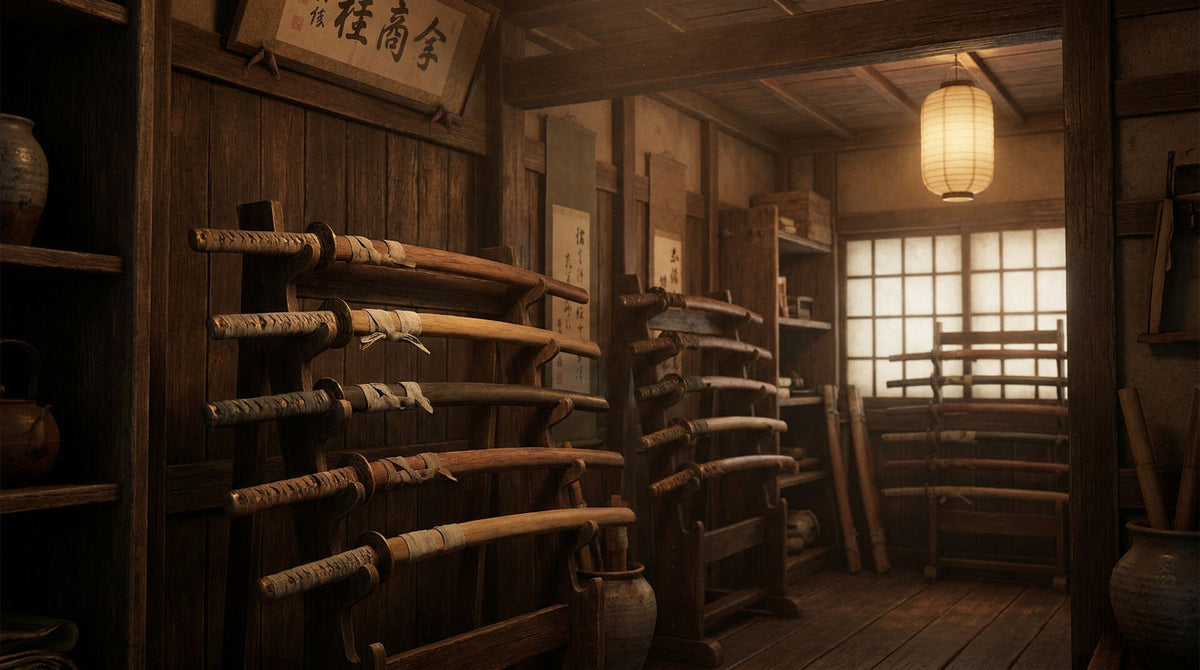
Buying a katana is not like buying a kitchen knife. The marketplace has more dishonest descriptions than honest ones, the price range stretches from $80 to $80,000, and the difference between a perfect first sword and a dangerous wall hanger often comes down to details that listings deliberately obscure. Most first-time buyers spend money twice: once on a sword that disappoints, then again on the one they should have bought first. This guide is the one that ends that cycle.
A katana buying guide that actually helps has to do three things at once. It has to explain the technical vocabulary so you can read spec sheets honestly. It has to walk through the realistic price tiers so you can match budget to use case. And it has to flag the recurring traps so you do not lose money to marketing language that sounds authoritative but means nothing. Everything below is built around those three goals.
By the end of this guide, you will be able to evaluate any katana listing on its merits, match the right sword to your real needs, and avoid the mistakes that cost most buyers their first $200-$400.
Start Here: Define Your Use Case
Before reading any spec sheet, decide what the sword is for. This single decision determines roughly 80% of every other choice you will make.
Display. The sword sits on a stand, gets occasionally admired, and never gets swung. The blade does not need to be sharp; the steel does not need to be premium; the fittings just need to look good under home lighting.
Training. You are starting iaido, kendo, or kenjutsu, or doing solo basics at home. The sword needs to handle correctly through repeated motion but does not need to cut targets. In most cases this means a blunt iaitō for safety, not a sharp blade.
Cutting. You will do tameshigiri - actual cutting practice on rolled tatami, water bottles, or pool noodles. This requires real functional steel, full tang construction, and a maintenance commitment that display buyers do not need to think about.
Collecting. You want a katana for the metallurgy, the artistry, and the long-term value. Hand-forged blades, traditional polishing, real differential clay tempering. Budget starts where the cutting tier ends.
The detailed walkthrough of these paths is in our dedicated katana for beginners guide. The principle is simple: pick the path before picking the sword. Buyers who skip this step usually buy something that fits no path well.
Real Katanas in Stock
Hand-forged blades that meet every criterion in this guide.


Know What You Are Looking At
A katana has roughly thirty named parts spread across the blade, handle, scabbard, and fittings. You do not need to memorize all of them, but the vocabulary matters because product listings assume it. When a listing mentions "clay-tempered hamon with itame hada and traditional habaki," you should know what each of those terms claims.
The minimum vocabulary every buyer should recognize:
| Part | What It Is |
|---|---|
| Hamon | The visible temper line near the cutting edge |
| Hada | The grain pattern visible on the polished steel surface |
| Shinogi | The structural ridge running along the side of the blade |
| Kissaki | The curved tip of the blade |
| Nakago | The tang - the part hidden inside the handle |
| Habaki | The metal collar at the base of the blade |
| Tsuba | The hand guard between blade and handle |
| Tsuka | The handle itself |
| Saya | The scabbard |
| Mekugi | The bamboo peg locking the blade to the handle |
For the full breakdown including the secondary parts (yokote, mune, fuchi, kashira, menuki, koiguchi, kojiri, sageo, and the rest), see our deep dive on the parts of a katana. Knowing the vocabulary changes how you read every listing on the market.
Choosing the Right Steel
The steel grade is the single most-cited spec on katana listings, and the most often misunderstood. The number after the "10" prefix corresponds to the carbon percentage - 1095 means 0.95% carbon, 1060 means 0.60% carbon. More carbon usually means harder steel and better edge retention but lower toughness.
The steel grades you will actually encounter:
For most modern buyers in the $400-$800 range, T10 tool steel offers the best performance-to-price ratio. For budget-conscious first-time cutters, 1060 is forgiving and reliable. For collectors with the budget for tradition, tamahagane is unmatched. The full comparison including hardness, toughness, and use-case matching is in our dedicated best katana steel guide.
One steel to specifically avoid: stainless. Despite frequent marketing claims, stainless steel is too brittle in katana lengths to be safely swung. A stainless katana is a display sword regardless of what the listing says. Anything sold as "stainless steel battle-ready" is contradicting itself.
Construction: The Make-or-Break Details
Steel grade gets the headlines, but construction details determine whether the sword is safe to use, whether it will hold up, and whether the steel grade even matters. The two construction details that matter most:
Full Tang
The tang (nakago) is the part of the blade hidden inside the handle. A proper functional katana has a full tang - the steel of the blade extends the full length of the handle and is locked in place by a bamboo mekugi peg. A wall hanger has a rat-tail tang: a short, narrow stub of metal welded to the blade and embedded in a hollow handle.
Rat-tail tangs fail under lateral stress. The blade flies off the handle mid-cut and travels unpredictably. This is the single most common cause of katana-related injuries among amateur cutters. Before buying any sword you intend to swing, demand a tang photo. Reputable sellers can produce one within 24 hours; fake or wall-hanger sellers cannot or will not. Detailed coverage in our full tang vs rat tail guide.
Heat Treatment
The right steel poorly heat-treated performs worse than a lesser steel done correctly. Differential clay tempering - the technique that creates the visible hamon - produces a hard cutting edge (60+ HRC) and a tough spine (around 40 HRC). This is what gives a katana its signature combination of sharp edge and shock-absorbing body.
The catch: real clay tempering is hard to fake but easy to imitate visually. Many production blades have acid-etched fake hamon lines applied to non-tempered steel. The fake hamon looks similar in photos but lacks the metallurgical reality - the cutting edge is no harder than the rest of the blade. Real differential hardening shows organic, irregular variation in the hamon line. Fake hamon shows uniform, repetitive patterns.

Realistic Price Tiers
Here is what each price range honestly delivers in 2026, stripped of marketing exaggeration:
| Budget | What You Get | Best For |
|---|---|---|
| $80-$200 | Decorative or basic 1045 carbon. Often rat-tail tang. | Display only |
| $200-$400 | 1060 carbon, full tang, basic fittings, rough polish | Beginner display + light cutting |
| $400-$700 | Clay-tempered T10 or 1095, real hamon, decent polish | Serious cutters, iaido |
| $700-$1,500 | Hand-finished hybrid, refined fittings, traditional construction | Advanced practitioners |
| $1,500-$5,000 | Fully hand-forged Chinese workshops, museum-grade polish | Collectors |
| $5,000+ | Tamahagane Japanese-licensed smith, traditional polish, NBTHK papers | Investment, heirloom |
The most common mistake is buying at the wrong tier for the use case. A $150 sword for serious tameshigiri fails. A $1,500 hand-forged blade for pure display is wasted. The detailed reasoning behind each tier and the trade-offs you accept at each level is covered in our best katana under $200 guide for the budget end and our hand-forged vs machine guide for the upper tiers.
$80-$150 is the most dangerous price range. Sellers in this tier compete on price by skipping the construction details (full tang, real heat treatment, proper fittings) while keeping the marketing language of premium swords. Anything below $200 marketed as "battle-ready" is almost certainly a wall hanger with a sharp edge. Either spend less ($60-$100) for honest decoration, or spend more ($250+) for honest functionality. The middle is a trap.
Real vs Fake: The Authenticity Layer
Beyond construction quality, there is the separate question of whether the sword is what the listing claims. There are three categories of fake to watch for: dangerous fakes (wall hangers sold as functional), cosmetic fakes (real swords with fake hamon or fake folding), and provenance fakes (modern blades sold as antiques).
The five tests that filter for honesty across all three:
Tang photo. Ask for one before paying. Reputable sellers produce it within a day. Wall-hanger sellers refuse, delay, or claim the sword cannot be disassembled.
Magnet test. Carbon steel is strongly magnetic; stainless is weakly so. A magnet on the blade tells you whether the steel grade matches the listing.
Light angle test. Real hamon and real folded grain change appearance under different light angles. Acid-etched fakes stay flat. This is the single most reliable visual test for cosmetic fakes.
Weight test. A 28-inch katana weighs 2.0-2.6 lb without the saya. Heavier suggests stainless or oversized fittings. Lighter suggests a hollow or thin blade. See our katana weight and balance guide for the full mechanics.
Forum verification. For purchases over $500, post photos on a sword forum (SwordForum, NMB, Reddit r/SWORDS) and ask for community evaluation. Free, fast, and saves significant money. Detailed coverage in our real vs fake katana guide.
Approximately 60-70% of all katanas sold worldwide outside Japan are produced in the Longquan region of China. Longquan workshops range from purely industrial mass production to traditional hand-forging in the Japanese style - the same factory complex sometimes makes $200 wall hangers and $1,500 hand-forged blades on different lines. "Made in China" by itself tells you nothing about quality; the workshop reputation and specific production line matter more than the country.
Choosing a Seller
The single highest-leverage choice in any katana purchase is the seller. A $400 sword from a reputable retailer outperforms a $400 sword from an unknown dropship operation almost every time. Construction quality varies less between price tiers than it does between sellers at the same tier.
Signs of a Reputable Seller
Transparent specs (steel grade, weight, balance point, tang photo on request). Real customer reviews on independent platforms (forums, YouTube, Reddit, not just testimonials on the seller's own site). A return policy that works in practice. Responsive customer service that answers technical questions accurately. Years of operation with a consistent reputation.
Red Flags in Sellers
No return policy, or a return policy that explicitly excludes "opened" or "inspected" swords. Stock photos used for unique antiques. Marketing language that contradicts itself ("battle-ready stainless steel"). Refusal to provide tang photos or technical details. Pressure tactics ("limited time," "last one in stock"). New listings with no review history or hidden seller identity.
| Seller Type | Risk Level | Notes |
|---|---|---|
| Established specialty retailer | Low | Years of reviews, transparent specs |
| Reputable forum-recommended seller | Low | Community-vetted reputation |
| General Amazon / eBay listings | Medium-high | Quality varies wildly by listing |
| New dropship sites | High | Limited recourse if anything goes wrong |
| Social media direct sales | Very high | No buyer protection, frequent fraud |
After the Purchase: First Steps
The sword arrives. What now?
Inspect on arrival. Before doing anything else, photograph the sword from multiple angles, check for shipping damage, verify the specs match the listing, and confirm the tang construction by removing the mekugi peg and sliding off the handle. If anything is wrong, document it within 24 hours - most return policies depend on prompt reporting.
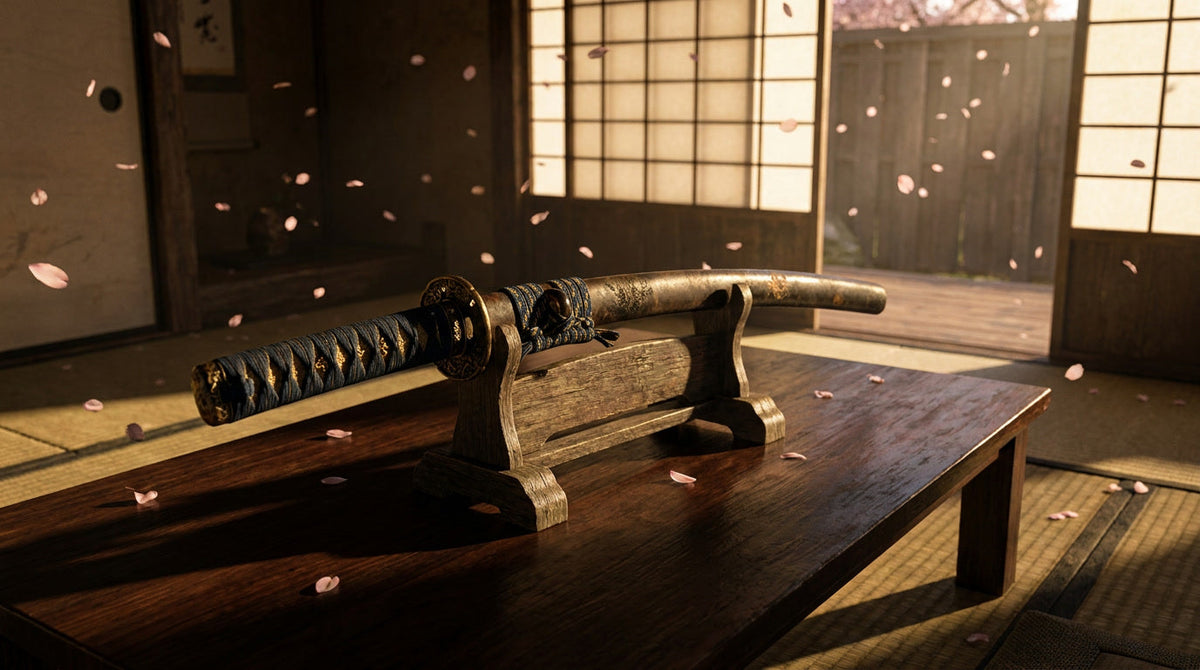
Set up display or storage. A katana stored badly develops rust within months. For display, a horizontal stand with edge up and handle to the viewer's left, in a dry area away from temperature swings. For long-term storage, the sword should rest horizontally in its saya with a light coating of choji oil. Detailed storage and display guidance in our how to display a katana guide.
Establish a maintenance routine. Wipe the blade with a soft cloth and apply choji oil every six months for storage, more often for active swords. Inspect the mekugi peg for cracks. Check the saya fit. None of this is optional - even a $400 carbon steel sword needs basic care to avoid rust spots and loose fittings.
Learn handling etiquette. Even if the sword is purely decorative, knowing how to pick it up, draw it, examine it, and pass it to others properly prevents damage and injury. Our Japanese sword etiquette guide covers the full handling protocol.
If it is for cutting, do not start with tatami. Practice form on rolled newspapers, water bottles, or pool noodles before moving to real targets. Light targets reveal edge alignment issues without putting the blade at risk. Coverage of cutting mechanics in our tameshigiri test cutting guide.
Frequently Asked Questions
What is the most important thing in a katana buying guide?
Matching the sword to your real use case. Steel grade, price tier, fittings, and seller all matter, but they all flow downstream from the question "what will I actually do with this sword?" Display, training, cutting, and collecting each have different sweet spots. Buyers who define their use case first end up with one good sword. Buyers who skip this step usually end up with two or three regrets.
How much should a beginner spend on a first katana?
For pure display, $150-$400 is realistic. For light cutting practice, $400-$700 is the honest range. For serious tameshigiri or training, $500-$1,000 is where consistent quality begins. Spending less almost always means construction shortcuts; spending more on a first sword often buys features you cannot yet evaluate. The middle of each tier is usually the safest first purchase.
What steel is the best for a katana?
For most modern buyers, T10 tool steel offers the best performance-to-price ratio in the $400-$800 range. 1060 carbon is the safest entry-level choice. 1095 has higher edge retention but lower toughness. 9260 spring steel is the most forgiving for heavy targets. Tamahagane is reserved for traditional Japanese swords and starts at $5,000+. The full breakdown is in our best katana steel guide.
Is hand-forged always worth the extra money?
Not always. A poorly hand-forged katana can perform worse than a reputable production blade at the same price. Hand-forged is worth it for buyers who want metallurgical character, real differential hamon, and long-term value retention - typically in the $1,200+ range. Below that, hybrid hand-finished production blades give you most of the meaningful properties at a fraction of the cost. Our hand-forged vs machine guide covers the trade-offs in detail.
How do I avoid buying a fake katana?
Run five detection tests before any significant purchase: ask for a tang photo, test magnetic response with a small magnet, examine the hamon and grain in direct light, weigh the assembled sword, and post photos on a sword forum for community verification. Most fakes fail at least two of these tests. Real swords pass all five and welcome inspection. Detailed methodology in our real vs fake katana guide.
Do I need a license to own a katana?
In most US states and most European countries, no, a non-folding sword over 25 cm is legal to own and display in private. Some countries (UK, Australia, Germany, Canadian provinces) have stricter rules requiring exemptions or registrations for sharp blades. Carrying a katana in public is restricted nearly everywhere. Always check your local laws before buying. Owning a katana legally is straightforward in most places; transporting or carrying it is more regulated.
What is the single most common buyer mistake?
Buying a "battle-ready" sword under $200 and trying to actually use it. Below that price point, construction shortcuts are nearly universal - rat-tail tangs, soft heat treatment, sloppy fittings. The sword either fails dangerously during the first hard cut, or simply does not perform well enough to give the buyer a positive first experience. Either spend less for honest decoration, or spend $250+ for honest functionality. The $80-$150 "functional" category is where most regret originates.
The Right Katana Is the One You Bought Honestly
A katana buying guide that helps does not promise a single "best" sword. It teaches you to read listings, match the spec to your real use, verify construction before paying, and recognize the patterns that separate honest sellers from the rest. Apply those skills, and any price tier from $300 to $30,000 can deliver a sword you will be glad to own for decades. Skip them, and the cheapest sword still costs too much.
Browse our full katana collection for transparent listings across every tier covered in this guide, from beginner-appropriate carbon steel blades to clay-tempered premium options. For specialized variants, see our high-end katana, wakizashi, and tantō collections.
Define the use. Verify the construction. Trust the seller. The sword takes care of the rest.
Apply What You've Learned
Each katana below ticks the boxes: real steel, full tang, traditional construction.

Share:
Yoru: The Black Blade of Mihawk Explained (Size, Steel & Real-World Equivalents)