

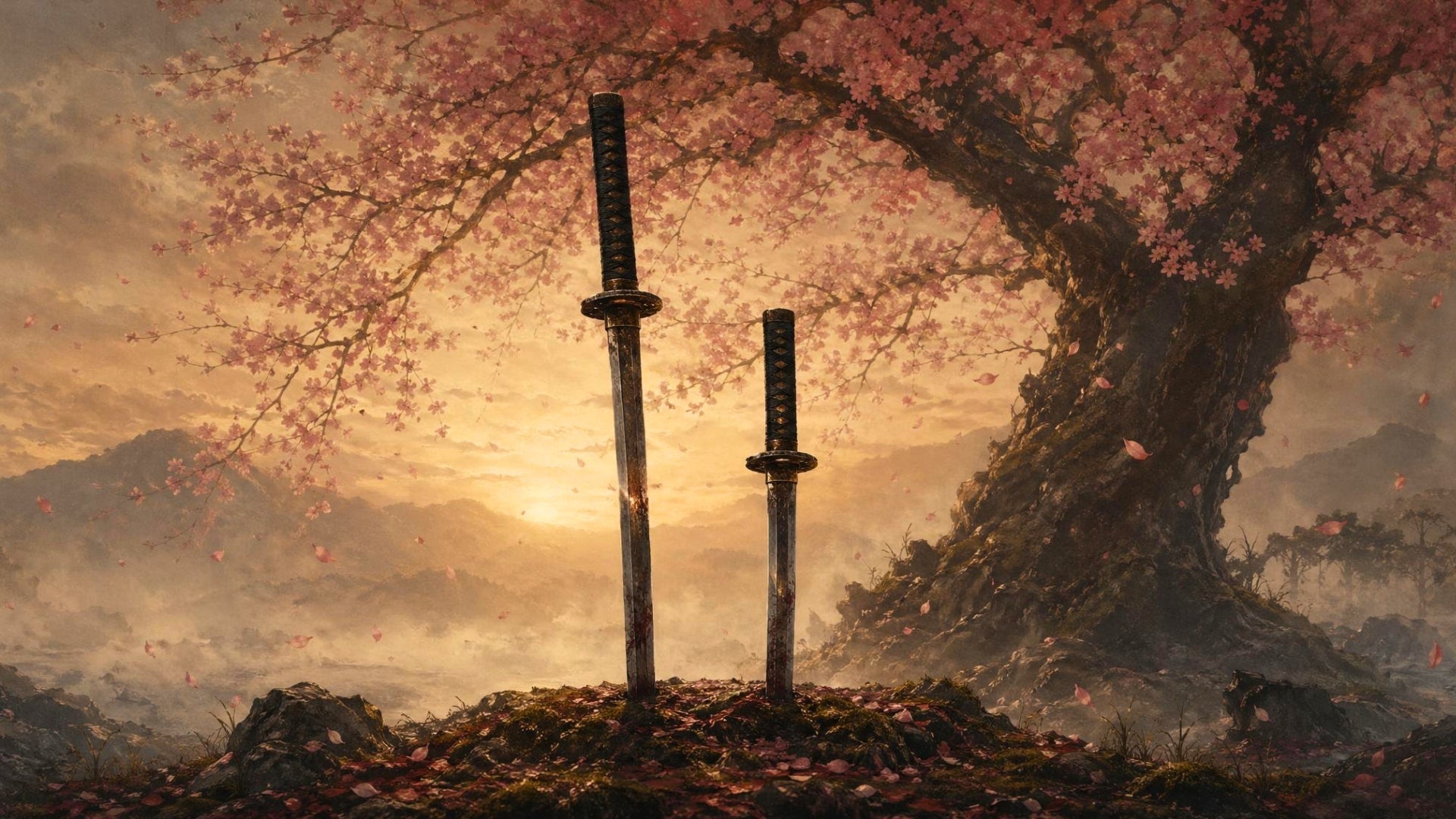
Age 13: kills a man in his first duel. Age 21: develops a fighting style no one has seen before - two swords, one in each hand. Age 29: defeats the most feared swordsman in Japan with a wooden oar. Age 60: writes a book about strategy that CEOs, generals, and martial artists still study 400 years later. Age 61: dies in a cave, meditating, having never lost a single fight.
That's the life of Miyamoto Musashi, and separating the facts from the legend is almost impossible, because the man lived as if he were writing his own myth in real time.
Musashi is not just the most famous swordsman in Japanese history. He's the most famous swordsman in human history. His fighting record (60+ duels, zero defeats), his philosophy (The Book of Five Rings), and his dual-wielding style (Niten Ichi-ryū) have influenced everything from martial arts to military theory to Wall Street trading floors. This is his story.
- Early Life: A Killer at 13
- The Wandering Years: 60 Duels, Zero Defeats
- Ganryū Island: The Most Famous Duel in History
- Niten Ichi-ryū: Two Swords, One School
- The Book of Five Rings: Strategy Beyond the Sword
- The Artist: Musashi Beyond the Blade
- Death and Legacy
- Frequently Asked Questions
- Walk His Path
Early Life: A Killer at 13
Musashi was born around 1584 into a Japan still convulsing with civil war. The Sengoku period was ending, but violence was the default state of the country. His father, Shinmen Munisai, was himself a martial artist renowned for his skill with the jitte (a truncheon-like weapon used to disarm sword-wielding opponents). Whether Musashi received formal training from his father is debated - some accounts suggest they were estranged, but the martial environment of his childhood is not.
At age 13, Musashi fought his first duel against Arima Kihei, a swordsman practicing the Kashima Shintō-ryū style. Kihei had posted a public challenge, an open invitation for any warrior to face him. Musashi, a child, accepted. He charged Kihei and beat him to death with a wooden staff. The contest was over before it began.
This moment set the pattern for Musashi's entire life: he would seek out the strongest opponents, fight them on his terms, and win, not through superior equipment, but through superior strategy.

A Daisho for the Modern Warrior
Musashi mastered two swords. Today, you can wield the daisho he made legendary.


The Wandering Years: 60+ Duels, Zero Defeats
Between ages 13 and 29, Musashi wandered Japan as a rōnin, a masterless samurai - seeking duels. He fought anyone who would face him: established school masters, famous swordsmen, groups of opponents simultaneously. The total count varies by source - 60, 61, or 66 depending on the account, but the result never varies: Musashi won every single one.
Some of his most notable duels during this period:
The Yoshioka School (1604)
Musashi challenged the Yoshioka clan of Kyoto - one of the most prestigious swordsmanship schools in Japan. He fought and defeated the school's head, Yoshioka Seijūrō, breaking his arm. When Seijūrō's brother Denshichirō challenged him to a rematch, Musashi killed him. The clan then sent an ambush of dozens of students and retainers. Musashi fought through them all. The Yoshioka school never recovered.
Battle of Sekigahara (1600)
At age 16, Musashi fought on the losing side at Sekigahara - the largest and most decisive battle in Japanese history. He survived the defeat and the aftermath, which saw tens of thousands killed. Whether this experience shaped his later philosophy of personal combat over mass warfare is speculation, but it's hard to imagine it didn't leave a mark.
Legend claims Musashi never bathed, never cut his hair, and lived in a state of perpetual readiness - he refused to be caught unarmed or vulnerable. Historian Kamiko wrote: "For his entire life, Musashi never took a bath." Whether this is fact or myth, it speaks to the image of a man who lived entirely for combat and refused to let his guard down for even a moment.
Ganryū Island: The Most Famous Duel in History
This is the duel that made Musashi immortal. His opponent was Sasaki Kojirō - called "The Demon of the Western Provinces", who was famous for his nodachi (extra-long sword) and his signature technique, the tsubame gaeshi (swallow reversal), a strike so fast it could supposedly cut a bird out of the air.
Musashi arrived late. Hours late. When his boat finally reached the island, he stepped ashore carrying not a katana but a bokken, a wooden sword he had carved from an oar during the crossing. The delay may have been deliberate psychological warfare: Kojirō, already agitated by the wait, threw his scabbard into the sea before the fight began. Musashi reportedly said: "You've already lost. A winner would never throw away his scabbard."
The duel lasted seconds. Kojirō lunged with his nodachi. Musashi stepped inside the strike's range and brought the wooden sword down on Kojirō's skull. The blow was fatal. Musashi walked back to his boat without looking back.
He was 29 years old. He never fought another serious duel. He had nothing left to prove.

Niten Ichi-ryū: Two Swords, One School
Around age 21, Musashi began developing what would become his signature: Niten Ichi-ryū (二天一流), "Two Heavens as One School", a fighting system using both the katana and the wakizashi simultaneously, one in each hand.
This was radical. In an era where every major school taught two-handed katana technique, Musashi argued that gripping a sword with both hands limited mobility. One-handed use freed the other hand for a second weapon, allowing simultaneous offense and defense. His father's jitte training - where a truncheon in one hand parried while a sword in the other struck - may have been the seed of this idea.
Musashi's core principle: technique exists only to cut the opponent. No flourishes. No aesthetic posturing. If a movement doesn't serve cutting, it's waste. Efficiency, timing, and adaptability - these mattered more than style. The school is still practiced today under its 12th headmaster, Yoshimoti Kiyoshi.
The daishō - the katana and wakizashi set carried by every samurai - is a direct conceptual descendant of Musashi's approach. While samurai carried two swords, Musashi was among the first to systematize using both simultaneously in combat. Our guide to Japanese sword types covers how the katana and wakizashi relate to each other in the daishō tradition.
The Book of Five Rings: Strategy Beyond the Sword
In his final years, Musashi retreated to a cave called Reigandō and wrote Go Rin No Sho (五輪書, The Book of Five Rings), a treatise on strategy, combat, and philosophy that he completed shortly before his death in 1645.
The five "rings" (books) correspond to the five Buddhist elements:
The book is deceptively simple. Musashi writes in a direct, no-nonsense style - he despises ornamentation in writing as much as in swordsmanship. But the depth is extraordinary. His insights on timing, positioning, and psychological manipulation apply far beyond the duel. Modern readers include military strategists, corporate executives, competitive athletes, and chess players.
His most quoted principle: "Do nothing which is of no use." Every action must serve a purpose. Every movement, thought, and decision must be stripped of waste and directed toward the objective. It's a philosophy of radical efficiency, and it applies to everything from sword combat to product design.
The Book of Five Rings became a surprise bestseller on Wall Street in the 1980s, when American business leaders began studying it as a guide to competitive strategy. The idea that business is combat - requiring timing, positioning, and psychological dominance - resonated deeply with the era's corporate culture. Musashi's 17th-century sword manual became a 20th-century executive handbook.
The Artist: Musashi Beyond the Blade
Here's what surprises most people: the greatest swordsman in Japanese history was also a serious artist. In his later years, Musashi produced ink paintings, calligraphy, and wood sculptures that are now considered masterworks of the Edo period.
His most famous paintings - of birds, Bodhidharma (the founder of Zen Buddhism), and solitary figures in nature - share the same aesthetic as his swordsmanship: stripped of excess, precise in execution, and profoundly still. There are no wasted brushstrokes, just as there were no wasted sword movements.
Musashi himself wrote in The Book of Five Rings that a warrior should cultivate skill in many arts, not just combat. He practiced architecture, metalwork, and even gardening. His philosophy was holistic: mastery in one domain should illuminate all others. The sword and the brush were two expressions of the same discipline.
Death and Legacy
Musashi died on June 13, 1645, in Reigandō cave, near Kumamoto. He was approximately 61 years old. In the week before his death, he gave his final texts - The Book of Five Rings and the Dokkōdō ("The Path of Aloneness," a set of 21 aphoristic precepts for life) - to his most trusted student, Terao Magonojō.
The Dokkōdō's 21 rules are as stark and uncompromising as the man himself. Among them: "Do not seek pleasure for its own sake." "Think lightly of yourself and deeply of the world." "Never be jealous." "Never let yourself be saddened by a separation." They read less like philosophy and more like operating instructions for a life lived at maximum intensity.
Musashi's influence on Japanese culture, and global culture - is immeasurable. Eiji Yoshikawa's novel Musashi (1935) shaped the modern image of the wandering swordsman. Takehiko Inoue's manga Vagabond brought his story to millions more. He appears as a character in countless films, anime series, and video games. The image of the lone samurai - disciplined, fearless, seeking perfection through combat - draws more from Musashi than from any other historical figure.
And his school, Niten Ichi-ryū, is still practiced. The techniques Musashi developed 400 years ago are taught today under the lineage he established. The swords may be wooden now, but the principles are unchanged.
Frequently Asked Questions
How many duels did Miyamoto Musashi fight?
Over 60 - the exact count varies between 60, 61, and 66 depending on the source. He won every single one. His next closest rival in recorded duels was Itō Ittōsai, with 33. Musashi's undefeated record is unmatched in documented history.
What is The Book of Five Rings about?
It's a treatise on strategy and combat written by Musashi in 1645. Organized into five chapters (Earth, Water, Fire, Wind, Void), it covers technique, timing, psychology, and philosophy. Though written for swordsmen, its principles have been applied to business strategy, military planning, and competitive sports worldwide.
What is Niten Ichi-ryū?
Musashi's two-sword fighting style - "Two Heavens as One School." It uses the katana and wakizashi simultaneously, one in each hand, prioritizing fluidity, efficiency, and the ability to attack and defend at the same time. It broke every convention of its era and is still practiced today under its 12th headmaster.
Why did Musashi fight with a wooden sword at Ganryū Island?
The exact reason is debated. Theories include: deliberate psychological warfare (showing contempt for Kojirō's skill), practical advantage (the bokken was longer than Kojirō expected), or philosophical statement (proving that the warrior matters more than the weapon). Whatever the reason, it worked - one strike ended the most famous duel in Japanese history.
Was Musashi a real person or a legend?
He was real - his existence is confirmed by multiple contemporary sources and official records. However, many details of his life have been embellished through centuries of oral tradition and fictional retellings. The core facts (his dueling record, his founding of Niten Ichi-ryū, his authorship of The Book of Five Rings) are well-documented. The colorful details (never bathing, arriving late to psychologically dominate) are harder to verify.
Walk His Path
Musashi's life was the katana personified, every moment sharpened by discipline, every decision governed by strategy, every action stripped of waste. He spent his life perfecting the blade. And then he spent his final years proving that the blade was only the beginning.
If Musashi's story inspires you, explore our hand-forged katana collection - each blade built with the efficiency and craftsmanship he would have demanded. Or dive deeper into the warriors and blades that shaped Japan in our guide to famous samurai and their legendary swords.
To understand the code Musashi lived by, read our complete guide to the 7 Virtues of Bushido.
"Do nothing which is of no use." - Miyamoto Musashi, The Book of Five Rings
Adopt the Two-Sword Path
Hand-forged katana and wakizashi pairings - built for those who follow the way of the sword.
Share:
The 7 Virtues of Bushido: Samurai Code Explained
The Katana in Japanese Culture: Why It's Called the Soul of the Samurai