

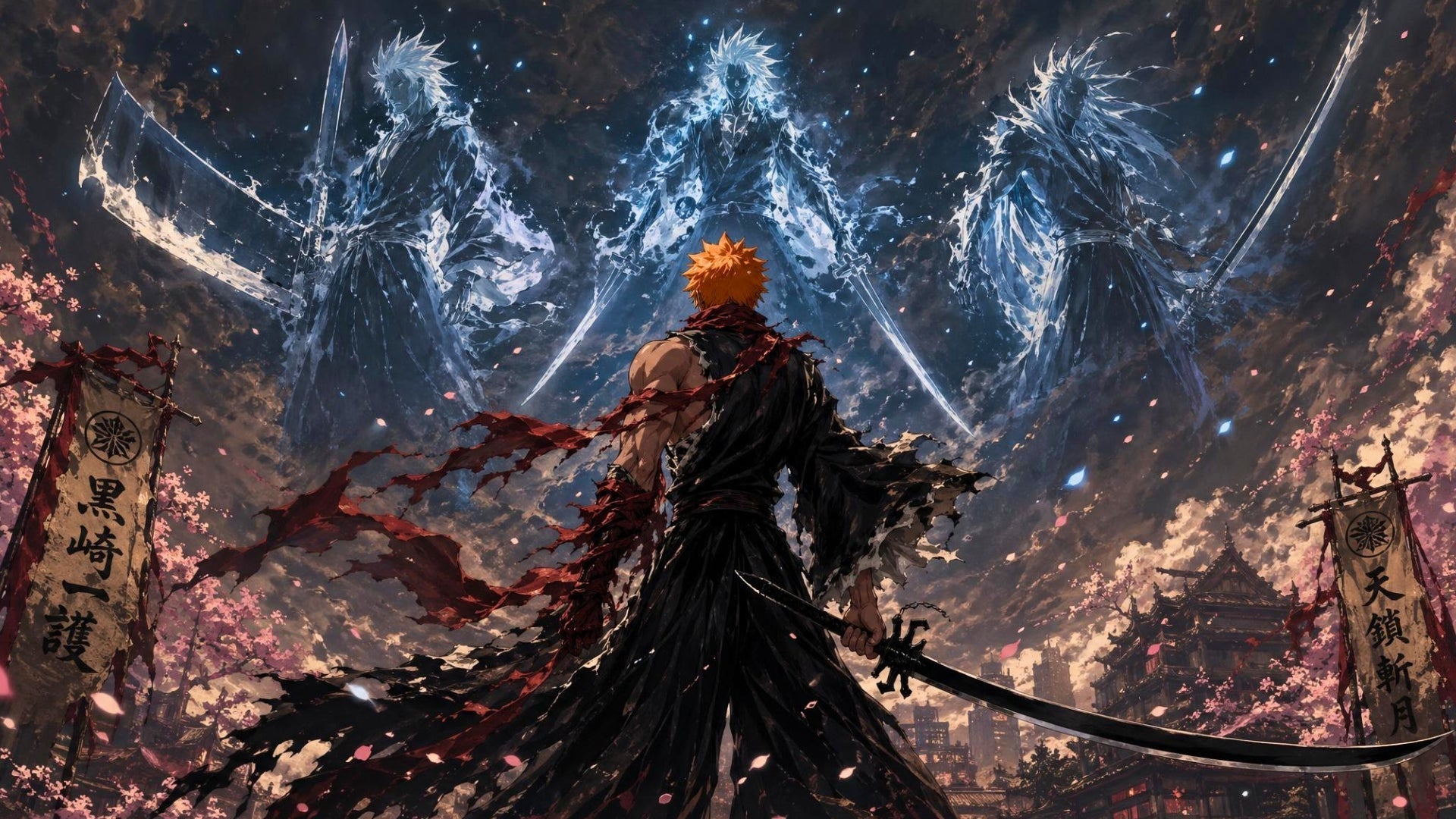
For 366 chapters of Bleach, Ichigo Kurosaki believed his sword's spirit was an old man in a black cloak who called himself Zangetsu. He trusted him. Trained with him. Nearly died for him. Then came the Thousand-Year Blood War, and the revelation that changed everything: the old man wasn't Zangetsu. He never was. He was a fragment of Ichigo's Quincy powers, deliberately suppressing Ichigo's true potential to protect him. The real Zangetsu? That was the white, hollow-eyed monster Ichigo had been fighting to suppress since the Soul Society arc.
That twist rewrites every sword fight in the entire series. And it makes Zangetsu, a weapon that literally embodies its wielder's identity crisis - the most narratively complex blade in anime history.
This guide traces every form of Ichigo's sword from the first oversized cleaver to the reforged dual blades - what each form represents, how it connects to Ichigo's fractured heritage, and why "The Blade Is Me" is the most important line in all of Bleach.
- What Is a Zanpakutō? The Bleach Sword System
- Shikai: The Oversized Cleaver
- Bankai: Tensa Zangetsu - The Black Katana
- The Twist: Who Is the Real Zangetsu?
- True Zangetsu: The Dual Blades
- Final Bankai: The Merged Blade
- All Zangetsu Forms at a Glance
- How Zangetsu Connects to Real Swords
- Frequently Asked Questions
- Wield Zangetsu
What Is a Zanpakutō? The Bleach Sword System
In the Bleach universe, every Soul Reaper (Shinigami) carries a Zanpakutō, a soul sword that is literally a manifestation of their spiritual power. Unlike normal weapons, a Zanpakutō has a living spirit inside it that the wielder can communicate with. The sword's power, form, and personality are unique to each Soul Reaper.
Each Zanpakutō has three states:
Ichigo's Zangetsu is abnormal from the start: it can't seal into a normal katana form. It's always in Shikai, a permanent release state that reflects the chaotic, uncontrolled nature of Ichigo's spiritual power. This detail, which seemed like a minor quirk early in the series, becomes critical once the truth about Zangetsu's identity is revealed.
Bleach-Inspired Steel
Zangetsu and his fellow icons of the Soul Society, forged into real katanas.


Shikai: The Oversized Cleaver (Arcs 1-4)
Zangetsu's first form is iconic: a massive, oversized khyber knife - closer to a cleaver than a katana. No guard, no sheath, just a raw slab of blade with white wrapping at the hilt that Ichigo uses to throw and retrieve the sword. It's crude, enormous, and completely unlike any other Zanpakutō in Soul Society.
Its signature ability is the Getsuga Tenshō ("Moon Fang Heaven-Piercer"), a crescent-shaped blast of concentrated spiritual energy launched from the blade's edge. It's Ichigo's bread-and-butter attack, and its visual impact defined early Bleach's combat identity.
The cleaver form represents Ichigo at his most unrefined - enormous power with no finesse. The blade is perpetually in Shikai because Ichigo's spiritual pressure is so massive and uncontrolled that the sword can't compress into a sealed state. It's a feature, not a bug, but also a sign that something deeper is wrong with the relationship between Ichigo and his blade.

Bankai: Tensa Zangetsu: The Black Katana
When Ichigo activates Bankai, the cleaver doesn't get bigger - it compresses. Tensa Zangetsu takes the form of a sleek, all-black katana with a short chain dangling from the pommel and a swastika-shaped (manji) guard. Instead of overwhelming force, it grants Ichigo blinding speed and a more devastating version of his signature attack: the Kuroi Getsuga, a black Getsuga Tenshō with vastly more destructive power.
The compression concept is brilliantly thematic: where most Bankai expand into massive forms (giant snakes, ice dragons, cathedral-sized structures), Ichigo's consolidates all that power into a single, efficient blade. Maximum output, minimum waste. It mirrors Ichigo's fighting philosophy: direct, no wasted movement, all-or-nothing.
Ichigo achieved Bankai in just three days, a process that normally takes decades. This unprecedented speed was another red flag that something about his power was deeply unusual.
Tensa Zangetsu's design is explicitly based on a Japanese daitō (long katana). Creator Tite Kubo has stated that the compression from cleaver to katana represents Ichigo's growth from raw power to refined skill. The chain at the pommel echoes real historical sword designs where chains were occasionally used to prevent losing the weapon in mounted combat.
The Twist: Who Is the Real Zangetsu?
This is the revelation that rewrote Bleach. During the Thousand-Year Blood War arc, Ichigo discovers that the two spirits inside his soul have been lying to him - by omission - for the entire series.
The "Old Man Zangetsu" - the cloaked, bearded figure who guided Ichigo - was not his Zanpakutō spirit. He was a manifestation of Ichigo's Quincy powers, a fragment of Yhwach (the Quincy King) embedded in Ichigo's soul through his mother Masaki. He deliberately suppressed Ichigo's full power to protect him from destroying himself.
The "Inner Hollow" - the white, psychotic version of Ichigo that he spent arcs fighting and suppressing - was the real Zangetsu all along. Born from the fusion of his Shinigami and Hollow powers, this entity was always trying to push Ichigo to his full potential. Every time Ichigo resisted his Hollow, he was resisting his own sword.
Every sword form Ichigo used before this reveal was operating at a fraction of its true power. The "Old Man" was deliberately holding back Ichigo's abilities. The blade Ichigo called Zangetsu was technically a Quincy weapon, not a true Zanpakutō forged from an Asauchi. To reach his real power, Ichigo had to accept both sides of himself and reforge the blade from scratch.
True Zangetsu: The Dual Blades
After learning the truth, Ichigo travels to the Soul King's Palace and meets Ōetsu Nimaiya - the legendary smith who created all Zanpakutō. Nimaiya destroys Ichigo's old blade, forcing him to confront both spirits and accept his complete identity: Shinigami, Hollow, Quincy, and human.
The result: the True Zangetsu, a pair of dual black blades. The larger blade represents his fused Shinigami and Hollow powers. The smaller blade represents his Quincy heritage. Together, they are the first time in the series that Ichigo wields his full, unrestrained power.
The dual-blade design isn't just cool - it's a visual metaphor for Ichigo's acceptance. He no longer suppresses one half to empower the other. Both sides fight together. As Kubo later confirmed in an interview, the two blades function as "sword and sheath" - two halves of one complete weapon.

Final Bankai: The Merged Blade
When Ichigo activates Bankai with his true Zanpakutō, the two blades merge. The smaller blade slots into the hollowed-out center of the larger one, creating a single weapon: a sleek, black-centered blade with a white outer edge, a horn-like protrusion at the guard, and a black chain at the hilt.
This final form - still called Tensa Zangetsu - represents the ultimate synthesis: every part of Ichigo's heritage compressed into one unified weapon. Its full power is never completely shown in the manga (Yhwach shatters it before Ichigo can fully unleash it), which has frustrated fans for years. But the thematic statement is clear: Ichigo's greatest strength isn't any single ability - it's the integration of all his contradictions into one coherent self.
Creator Tite Kubo confirmed that the two blades function as "sword and sheath." When Yhwach broke the outer white portion during their final battle, Ichigo absorbed the fragments - revealing the original cleaver shape underneath. The very first form of Zangetsu was hidden inside the final form all along. Full circle.
All Zangetsu Forms at a Glance
| Form | Appearance | Arc | Significance |
|---|---|---|---|
| Shikai (Original) | Oversized black cleaver, white wrap | Soul Society → Arrancar | Raw, unrefined power. Permanently released. |
| Bankai (Original) | Sleek black katana, chain, manji guard | Soul Society → Fullbring | Compressed power = speed. Kuroi Getsuga. |
| Hollow Bankai | White version with horned mask | Arrancar (Hollow takeover) | True Zangetsu fighting for control. |
| True Shikai | Dual black blades (large + small) | Thousand-Year Blood War | Ichigo accepts all sides. Getsuga Jūjishō. |
| True Bankai | Merged single blade (black center, white edge) | TYBW Final Battle | Ultimate synthesis. "Sword and sheath" fused. |
| Final Form | Original cleaver hidden inside merged blade | TYBW vs Yhwach | Full circle - the first form was always within. |
How Zangetsu Connects to Real Japanese Swords
Zangetsu's Bankai form - Tensa Zangetsu - is explicitly a daitō (long katana): curved, single-edged, with a tsuba guard and wrapped handle. It's the closest any of Ichigo's sword forms comes to a real katana, and Kubo designed it with clear reference to traditional Japanese blade design.
The Zanpakutō system itself parallels real swordsmithing philosophy: the idea that a sword has a "soul" or personality shaped by its maker. In Japanese tradition, master swordsmiths spoke of blades having individual characters - aggressive, peaceful, cursed, noble. Bleach literalizes this into spirits that fight alongside (or against) their wielder. Our guide to legendary samurai swords covers how real smiths like Masamune and Muramasa created blades with reputations as vivid as any Zanpakutō.
Frequently Asked Questions
What does Zangetsu mean?
Zangetsu (斬月) translates to "Slaying Moon" or "Moon Cutter." The Bankai form, Tensa Zangetsu (天鎖斬月), means "Heaven Chain Slaying Moon." The name reflects the crescent-moon shape of Ichigo's signature Getsuga Tenshō attack.
Who is the real Zangetsu: the Old Man or the Hollow?
The white Hollow is the real Zangetsu - born from the fusion of Ichigo's Shinigami and Hollow powers. The "Old Man" was a manifestation of Ichigo's Quincy heritage (a fragment of Yhwach) who suppressed Ichigo's true power to protect him. Both are "Zangetsu" in the sense that both are part of Ichigo's soul, but the Hollow is the actual sword spirit.
Why does Ichigo have two swords?
The True Zangetsu consists of two blades because Ichigo has two distinct power sources: his Shinigami/Hollow powers (large blade) and his Quincy powers (small blade). Creator Tite Kubo described them as "sword and sheath" - two halves of one complete weapon that can separate or merge at Ichigo's will.
What is Ichigo's strongest form?
His True Bankai - the merged single blade combining both dual swords. It represents the complete unification of all his powers (Shinigami, Hollow, Quincy, and human). Its full capabilities were never fully shown in the manga, but the heat from its reforging alone evaporated the ocean used to quench it.
Is Zangetsu based on a real sword?
Tensa Zangetsu (Bankai) is designed as a Japanese daitō (long katana) with a black blade. The Shikai form has no real-world equivalent - it's closer to a massive cleaver. The True Zangetsu dual blades are a fantasy design unique to Bleach, though the concept of a sword having a "spirit" is deeply rooted in Japanese swordsmithing tradition.
Wield Zangetsu
From oversized cleaver to dual blades to the merged Bankai - Zangetsu is one of anime's most iconic and meaningful weapons. And now you can hold it.
Our manga katana collection features hand-forged Zangetsu replicas across multiple forms. Real carbon steel. Full tang. Whether you want the original Shikai or the Bankai katana, it's here.
New to collecting? Our beginner's guide helps you choose between display and functional grades.
"There is no meaning in this world without me." - Zangetsu
Channel the Soul Reaper
Hand-forged blades for fans who want more than a poster on their wall.

Share:
Zoro's Swords Explained: Every Blade in One Piece
The Reverse Blade Katana: Kenshin's Sakabato - Fact or Fiction?