


Here's something that surprises most people: the katana starts out straight. When a swordsmith finishes shaping the blade on the anvil, it's a flat, uncurved bar of steel. The iconic curve doesn't come from hammering. It comes from physics — specifically, from what happens in the five seconds after the blade is plunged into water during quenching.
The curve of a katana — called sori in Japanese — is simultaneously a byproduct of metallurgy and a deliberate engineering advantage. It makes the blade easier to draw, more efficient at cutting, and structurally stronger than a straight sword of the same steel. Understanding why katanas are curved means understanding the most fascinating step in the entire forging process.
- The Physics: How Quenching Creates the Curve
- Martensite Expansion: The Molecular Reason
- Three Practical Advantages of the Curve
- Types of Sori: Where the Curve Sits Matters
- Myths About Katana Curvature — Debunked
- Wait — Don't Some Japanese Swords Have No Curve?
- Frequently Asked Questions
- Feel the Curve in Your Hands
The Physics: How Differential Quenching Creates the Curve
Before quenching, the smith coats the blade in a clay compound. Thin layer on the cutting edge. Thick layer on the spine. The blade is heated to around 750–800°C — a specific shade of cherry-orange that experienced smiths recognize by eye in a darkened forge.
Then, the decisive moment: the blade is plunged into water. Everything happens at once.
The thinly coated edge cools rapidly. Within seconds, the steel undergoes a phase transformation — austenite converts to martensite, an extremely hard crystalline structure. The thickly coated spine cools much slower, transforming into pearlite — softer and more flexible.
Here's the key: martensite occupies more volume than the original austenite. The edge expands as it hardens. The spine doesn't expand as much because it forms pearlite instead. This uneven expansion causes the blade to bow — the edge pushes outward while the spine pulls inward.
The result: a formerly straight bar of steel emerges from the water with a gentle curve. Nobody hammered it in. The laws of thermodynamics put it there.

If quenching goes wrong — temperature too high, clay too thin, water too cold — the blade can crack instead of curving. Japanese swordsmiths call this failure hagire. The sound of steel cracking during quenching is a sharp ping that tells the smith months of work are lost. This is why yaki-ire is performed with almost ritual solemnity.
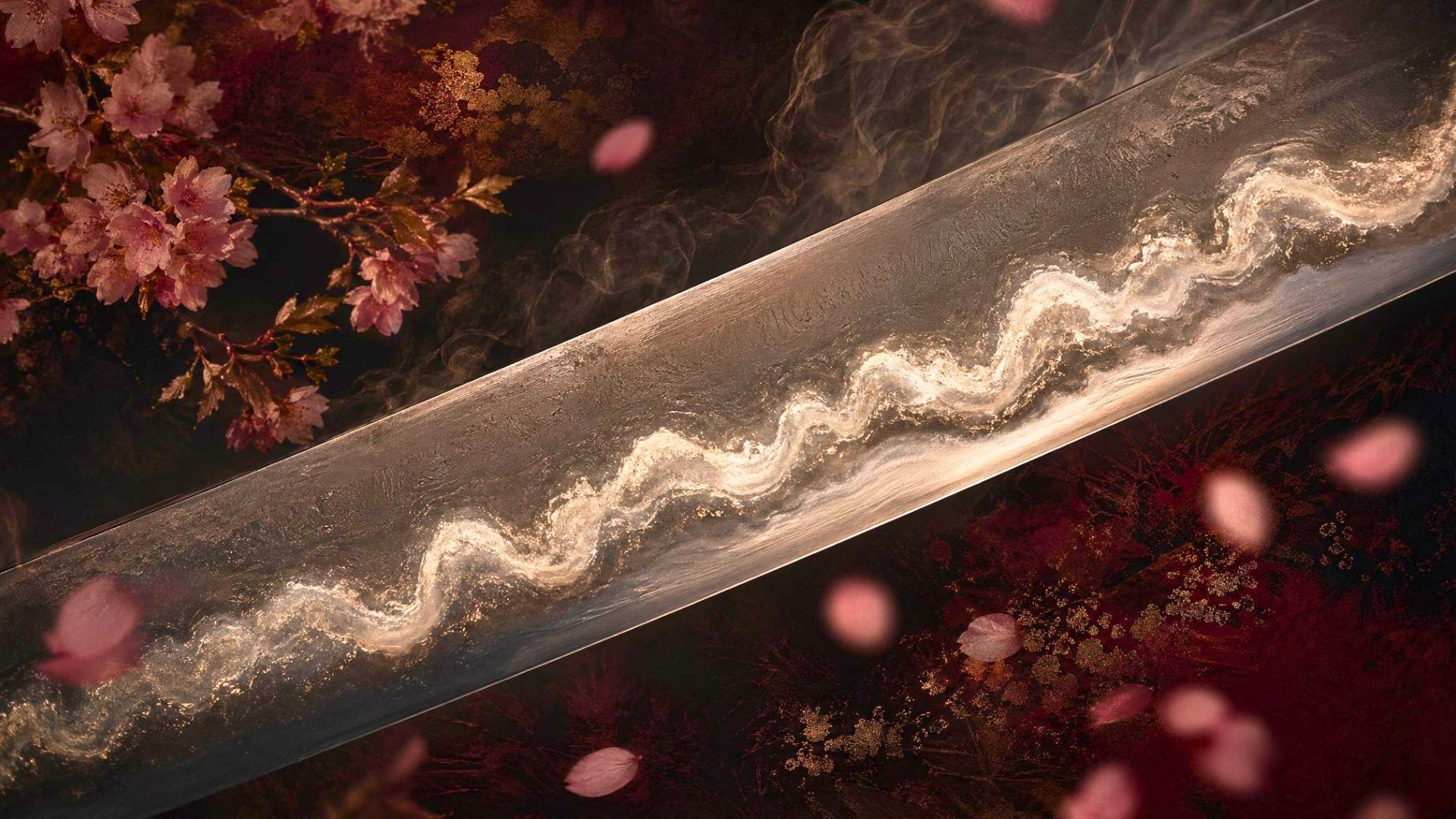
The Iconic Curve
Each blade below shows the elegant curve that defines the katana — born of the forging process itself.


Martensite Expansion: The Molecular Explanation
For those who want the deeper science: it's about crystal structure.
At high temperature, steel exists as austenite — a face-centered cubic (FCC) crystal structure where carbon atoms sit in the gaps between iron atoms. When cooled slowly, carbon has time to diffuse out and form pearlite (alternating layers of ferrite and cementite). Pearlite is stable and compact.
When cooled rapidly, there's no time for carbon to diffuse. The atoms get "trapped" and the structure snaps into a body-centered tetragonal (BCT) arrangement — martensite. This BCT lattice is physically larger than the FCC lattice it came from, because the trapped carbon atoms distort the crystal and force it to expand.
That ~4% volume expansion on the edge versus the spine is enough to produce the 1–2 cm of sori you see on a typical katana. The smith doesn't control the curve with a hammer — he controls it with clay thickness, heating temperature, and quenching speed. Master smiths can predict and adjust the final sori to within millimeters.
COMSOL Multiphysics — an engineering simulation platform — has actually modeled this process digitally, confirming that the differential quenching alone produces the characteristic curve without any mechanical bending.
Three Practical Advantages of the Curved Blade
The curve wasn't just an accident the smiths learned to live with. Over centuries, they recognized its functional benefits and refined it into a deliberate design feature.
1. Faster, Smoother Draw
A curved blade slides out of the scabbard (saya) more naturally than a straight one. The curve follows the arc of the drawing arm, allowing the blade to clear the saya in a single fluid motion. This is the foundation of iaijutsu — the art of drawing and cutting in one movement. A straight sword requires more clearance and a more deliberate pull.
2. More Efficient Cutting Geometry
When a curved blade strikes a target, only a small section of the edge makes contact at any given instant. The curve creates a natural slicing action — the blade doesn't just chop, it pulls through the material. This concentrates force on a smaller area, producing cleaner cuts with less effort. It's the same principle behind a kitchen knife's belly curve.
3. Stress Distribution
A curved blade distributes impact stress more evenly along its length than a straight one. When the katana strikes a target, the shock travels along the curve rather than concentrating at the point of impact. Combined with differential hardening, this means a curved katana absorbs cutting forces better and is less likely to fail catastrophically.

Types of Sori: Where the Curve Sits Changes Everything
Not all katana curves are the same. The position of the deepest point of curvature along the blade — the sori — determines how the sword handles and what it's best suited for.
| Sori Type | Curve Position | Characteristics | Best For |
|---|---|---|---|
| Toriizori | Center of blade | Balanced, even handling. The "default" katana curve. | Kenjutsu, general practice, collection |
| Koshizori | Near the handle | Better control on the draw. Common in tachi-era swords. | Iaido, mounted combat styles |
| Sakizori | Near the tip | Aggressive, tip-heavy feel. More cutting power at the point. | Tameshigiri, heavy cutting |
| Muzori | Almost none | Nearly straight. Optimized for thrusting. | Thrusting techniques, some tanto |
For a full breakdown of how sori interacts with blade length, balance, and martial arts style, our complete sori reference guide covers every variation with visual examples.
The position of the sori evolved with Japanese warfare. Early tachi swords (Heian–Kamakura era) had deep koshizori near the handle — ideal for downward cavalry strikes. As combat shifted to infantry in the Muromachi period, smiths moved the curve toward the center (toriizori) for faster drawing and more versatile cutting on foot.
Myths About Katana Curvature — Debunked
Myth: "The curve is hammered in by the swordsmith"
No. The blade is essentially straight before quenching. The curve forms naturally from differential expansion during yaki-ire. The smith controls it through clay application, not hammer work.
Myth: "More curve = better cutting"
Not necessarily. A moderate sori of 1–2 cm is optimal for most katana applications. Excessive curvature (like Middle Eastern scimitars at 5+ cm) changes the sword's character entirely and can actually hinder clean cuts on resistant targets like bamboo.
Myth: "The curve makes katanas fragile"
The opposite. The curve distributes stress, and the differential hardening that creates it also produces a blade that's hard at the edge and flexible at the spine. A straight blade of the same steel, through-hardened uniformly, would be more likely to snap under lateral stress.
Many cheap production katanas have a curve that's mechanically bent into a through-hardened blade — not created by differential quenching. These swords have a cosmetic curve but lack the structural benefits of natural sori. If the blade has no real hamon, the curve is almost certainly artificial.
Wait — Don't Some Japanese Swords Have No Curve?
Yes. The earliest Japanese swords — the chokutō (7th century and earlier) — were completely straight, modeled after Chinese and Korean designs. They were effective thrusting weapons but lacked the slicing efficiency of curved blades.
The ninjato (whether historically real or not) is also straight. And the tsurugi — the sacred double-edged blade — has no curve at all.
Curvature in Japanese swords developed during the late Heian period as a response to mounted combat. Cavalrymen needed a blade that could deliver effective downward cuts while riding past an enemy. A straight blade chops; a curved blade slices. On horseback, slicing is far more effective.
Once curvature proved itself in battle, it stuck. Every major Japanese sword type developed after the Heian period features some degree of sori. For a complete overview of all blade types — curved and straight — see our guide to Japanese sword types.
Frequently Asked Questions
Why are katanas curved and not straight?
The curve forms naturally during differential hardening (clay tempering). The edge hardens into martensite, which expands, while the spine forms softer pearlite, which doesn't. This uneven expansion bows the blade into a curve. The curve also provides practical advantages: smoother drawing, better slicing geometry, and improved stress distribution.
Is the curve hammered into the blade?
No. The blade is essentially straight before quenching. The sori forms from the physics of differential cooling — martensite expansion at the edge vs pearlite formation at the spine. The smith controls the degree of curvature through clay application patterns and quenching technique, not hammering.
How much curve does a typical katana have?
Most katanas have a sori (maximum perpendicular distance from a straight line connecting base to tip) of 1–2 cm. Historical swords vary: tachi often had 2.5+ cm, while some late Edo-period katana were nearly straight. Modern production katanas typically fall in the 1.5–2 cm range.
Does more curvature make a katana cut better?
Not always. Moderate sori optimizes the slicing action and draw speed. Excessive curvature can reduce control and hinder clean cuts on dense targets. For tameshigiri and general practice, 1–2 cm sori is considered ideal by most practitioners.
Can a katana's curve change over time?
On a properly forged blade, no — the sori is permanent because it's the result of the steel's internal structure. However, improper storage (extreme humidity or temperature), accidental impact, or amateur attempts at straightening can damage or alter the curve. This is why proper maintenance and storage matters.
Feel the Curve in Your Hands
Reading about sori is one thing. Holding a properly curved, clay-tempered blade — feeling how naturally it draws from the saya, how the edge flows through a target — that's something else entirely.
Every katana in our hand-forged collection features natural sori created by differential hardening, not mechanical bending. The curve you see is the curve that physics built.
New to katanas? Our beginner's guide helps you pick the right blade for your goals — including which sori type suits your practice style.
The curve isn't decoration. It's centuries of engineering, visible in steel.
The Curve, Made Real
Hand-forged katanas with the natural sori that comes from differential hardening.
Share:
Katana vs Longsword: The Ultimate East vs West Comparison