

A fingerprint. That's all it takes. One careless touch on an unprotected carbon steel blade, and within 48 hours, a reddish speck appears. Leave it a week, and that speck becomes a stain no amount of wiping will fix. A month? You're looking at permanent pitting that only a professional polisher — charging $50 to $200 per inch — can remove.
The samurai understood this. During the Edo period, sword maintenance was a ritual — performed with specific tools, in a specific order, with a reverence that bordered on spiritual. The blade, after all, was considered an extension of the warrior's soul. You don't let your soul rust.
The good news: keeping a modern katana in perfect condition doesn't require a ceremony. It requires about 10 minutes, a few simple tools, and the discipline to do it regularly. This guide walks you through the entire process — from the tools you need to the step-by-step cleaning routine, storage best practices, and the mistakes that ruin blades.
- The Maintenance Kit: What You Actually Need
- How Often Should You Clean Your Katana?
- Step-by-Step: The Complete Cleaning Routine
- Dealing With Rust: Early Catch vs. Serious Damage
- Storage: Where and How to Keep Your Blade Safe
- 5 Common Mistakes That Ruin Katanas
- Frequently Asked Questions
- Keep Your Blade Sharp, Keep Your Collection Growing
The Katana Maintenance Kit: What You Actually Need
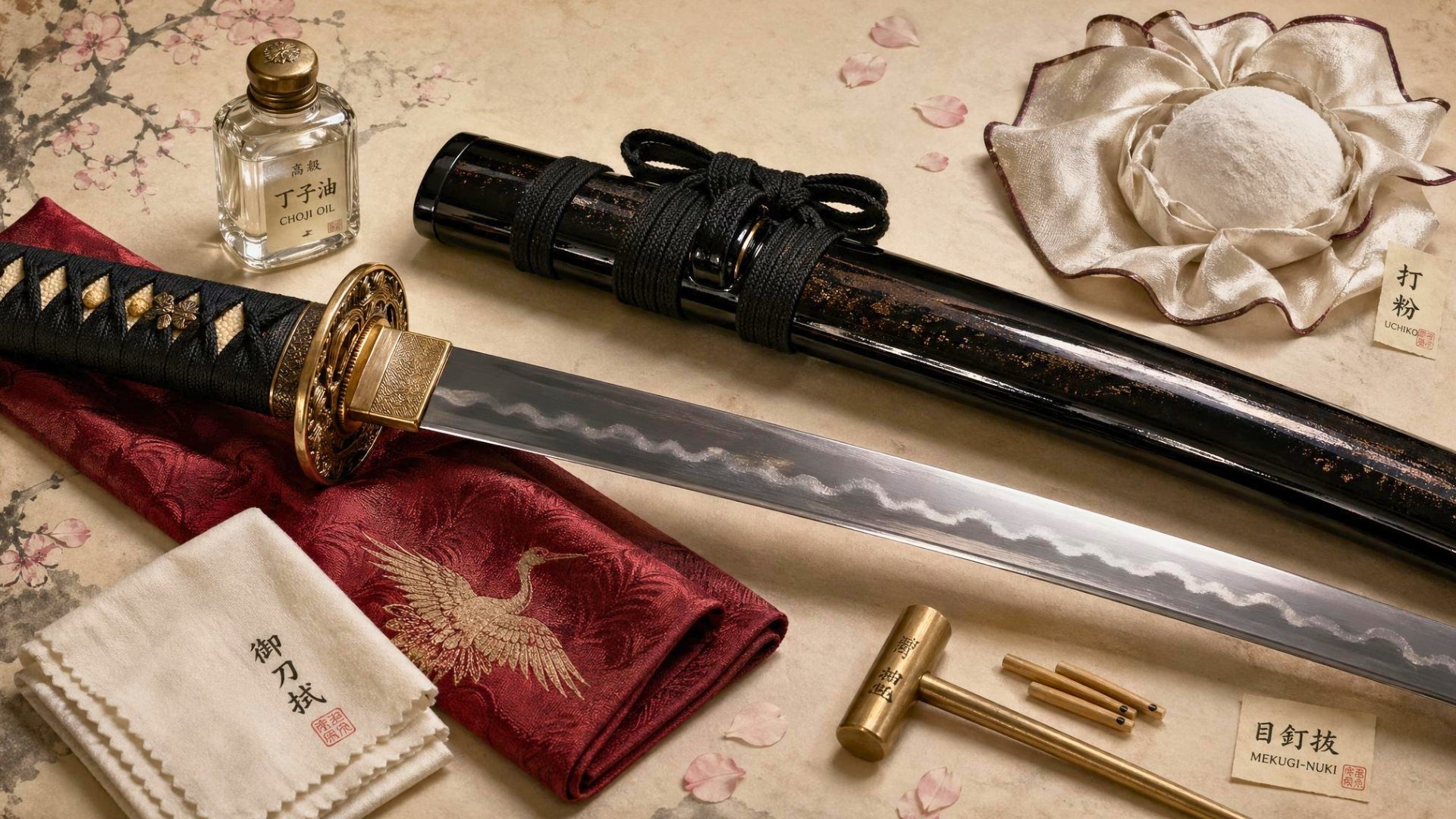
You don't need an expensive traditional Japanese kit to maintain your blade properly. You do need the right materials. Here's what matters — and what's optional.
Essential (use every time)
Optional (for deep cleaning)
Choji oil is the traditional choice — 99% mineral oil with 1% clove oil for fragrance. It's been used since the Edo period and works perfectly. But plain food-grade mineral oil from any pharmacy does the exact same job at a fraction of the price.
WD-40, gun oil, cooking oil, or any oil containing acids or sulfides. These attract dust, leave residue, or actively corrode high-carbon steel. Stick to mineral oil or choji oil — nothing else.

If you want to understand the anatomy of your blade before taking it apart, our katana parts guide covers every component in detail — including the mekugi pins you'll be removing during cleaning.
Care for Your Blade
Everything you need to keep a hand-forged katana in pristine condition.


How Often Should You Clean Your Katana?
It depends on three things: how often you handle it, where you live, and whether you use it for cutting.
If you live somewhere with high humidity — coastal areas, the American South, Southeast Asia — you'll need to check and oil more frequently. Moisture is the enemy. A katana stored in a damp basement can develop rust in weeks, even without being touched.
A freshly polished katana is more susceptible to rust than one that's been oiled for months. New polish opens up the steel's surface, making it more reactive. Japanese polishers recommend oiling a freshly polished blade every 10 days for the first 6 months.
Step-by-Step: The Complete Katana Cleaning Routine
This is the full process — disassembly, cleaning, oiling, reassembly. It takes about 10 minutes once you've done it a few times. For a quick maintenance session between deep cleans, you can skip the disassembly and uchiko steps.
1 Prepare Your Workspace
Work on a clean, flat surface with good lighting. Lay down a soft cloth or towel to protect the blade and prevent it from rolling. Have all your tools within reach before you start. Keep the blade edge facing away from you at all times.
2 Remove the Handle (Tsuka)
Use the mekugi-nuki to push out the bamboo pin (mekugi) that holds the handle in place. Grip the handle firmly and gently tap the back of your wrist to loosen the tsuka from the tang (nakago). Slide it off carefully. Set aside the mekugi — it's small and easy to lose.

3 Wipe Off Old Oil and Residue
Take a sheet of nuguigami or a clean microfiber cloth. Fold it over the blade — keeping the edge away from your fingers — and wipe from the base (habaki) toward the tip (kissaki) in a single smooth motion. Don't scrub back and forth. One direction only. Repeat until the cloth comes away clean.
If your katana has a bo-hi (groove), pinch the cloth between your fingers and run it through the groove separately.
4 Apply Uchiko Powder (Deep Clean Only)
Lightly tap the uchiko ball along the blade every 5 cm or so, on both sides and the spine. The powder absorbs remaining oil and grime. Then wipe it all away with a fresh cloth in the same base-to-tip motion. This step is only needed once or twice a year — or after heavy use.
5 Inspect the Blade
Hold the blade at an angle under good light. Look for fingerprints, moisture spots, discoloration, or small reddish specks (early rust). Catching these early is the difference between a 2-minute fix and a $500 professional re-polish.
6 Apply Fresh Oil
Put 2–3 drops of choji oil or mineral oil on a clean cloth. Wipe it evenly along both flats of the blade, the spine, and through the bo-hi if present. You want a thin, even coat — not dripping. Too much oil near the habaki can seep into the saya and damage the wood over time.
Never oil the nakago (tang). The tang is traditionally left dry and may bear the smith's signature (mei). Oil on the tang can deteriorate the wood of the tsuka and affect the patina that helps authenticate the blade's age.
7 Reassemble
Slide the tsuka back onto the tang, aligning the mekugi hole. Reinsert the bamboo pin and make sure it seats firmly. Give it a gentle tug to confirm it's secure.

Dealing With Rust: Early Catch vs. Serious Damage
Light Surface Rust (small reddish specks)
Caught early, this is fixable at home. Use a rust eraser — a soft abrasive block designed for blades — and rub gently on the affected spot only. Test on a small inconspicuous area first. Wipe clean and apply oil immediately. Do not use sandpaper, steel wool, or any household abrasive.
Deep Rust (dark pitting, flaking, spread)
Stop. Don't try to fix this yourself, especially on a traditionally polished blade. Aggressive rust removal on a hand-finished surface will destroy the polish and turn it into a mirror finish — erasing the subtle layers of work a togishi (professional polisher) spent hours creating. Send it to a professional.
A bottle of mineral oil costs $5. A professional re-polish starts at $50 per inch of blade. On a 28-inch katana, that's $1,400+. Prevention isn't optional — it's the only rational choice.
How to Store Your Katana: Position, Environment & Display
Position
Always store edge-up. Whether on a horizontal stand (kake) or a wall mount, the cutting edge should face upward. Edge-down storage presses the sharpened edge against the inside of the saya, dulling the blade and damaging the scabbard lining over time.
Environment
Basements and attics are the worst places for a sword — temperature swings cause condensation, and humidity fluctuations accelerate rust. A climate-controlled room with stable conditions is ideal. In humid areas, silica gel packets near the storage area make a real difference.
Display
If you display your katana on a stand, make sure the stand is stable and positioned away from high-traffic areas where it could get bumped. A wall mount is excellent for saving space — just verify the anchors can handle the weight (a full katana with saya weighs 1.2–1.8 kg).

5 Common Mistakes That Ruin Katanas
1. Touching the blade with bare hands
The oils and salts on your skin corrode high-carbon steel fast. If you accidentally touch the blade, wipe it immediately and re-oil. Always handle the blade with a cloth or clean cotton gloves.
2. Using WD-40 or gun oil
These contain solvents and additives that attract dust, leave sticky residue, and can discolor the steel over time. Choji oil or plain mineral oil — nothing else.
3. Storing in the saya long-term without maintenance
The inside of a wooden saya absorbs moisture. A blade left sheathed for months without oiling will develop rust where it contacts the scabbard. If you're storing long-term, oil the blade and leave it slightly pulled out (about 1 cm) to allow airflow.
4. Wiping the blade back and forth
Always wipe in one direction — base to tip. Back-and-forth motion creates micro-scratches that dull the polish over time.
5. Ignoring the fittings
The tsuba, fuchi, kashira, and menuki are often made of copper, brass, or iron. They need care too. Wipe them with a dry cloth after handling. For copper fittings, a gentle brass cleaner can remove tarnish — but test on an inconspicuous area first.
Frequently Asked Questions
What oil should I use on my katana?
Choji oil (99% mineral oil, 1% clove oil) is the traditional choice. Plain food-grade mineral oil works just as well and costs less. Avoid WD-40, gun oil, cooking oil, or anything with acids or additives.
How often should I oil my katana?
Display-only swords: every 2–3 months. Regularly handled blades: after every use. In humid climates: monthly or more. A freshly polished blade needs oiling every 10 days for the first 6 months.
Can I clean a katana without a maintenance kit?
Yes. A lint-free microfiber cloth and a bottle of food-grade mineral oil are the minimum. These two items handle 90% of routine maintenance. The uchiko ball and nuguigami are nice-to-haves for deep cleaning, not essentials.
How do I remove rust from a katana?
For light surface rust (small specks): use a rust eraser gently, then oil immediately. For deep rust (pitting, spreading): do not attempt DIY — send it to a professional sword polisher. Aggressive removal destroys traditional finishes.
Should I store my katana in the saya?
For display: yes, in the saya on a stand, edge-up. For long-term storage: oil the blade and leave it slightly pulled out (~1 cm) to allow airflow. Never store a dry, unoiled blade inside a saya for extended periods.
Keep Your Blade Sharp, Keep Your Collection Growing
Ten minutes of maintenance prevents hundreds of dollars in damage. Make it a habit — your katana will look better, last longer, and hold its value.
If you're new to sword ownership, our beginner's guide to choosing a katana covers steel types, construction, and what to look for before you buy.
Ready to add another blade? Browse our hand-forged katana collection — each one built to last with proper care.
Take care of the blade, and it takes care of itself.
Keep Your Steel Forever
A real katana lasts a lifetime — if you give it the care it deserves.


Share:
Are Katanas Legal? 2026 Laws by Country & US State
T10 Steel vs 1095 Carbon Steel: Best Katana Steel Compared