

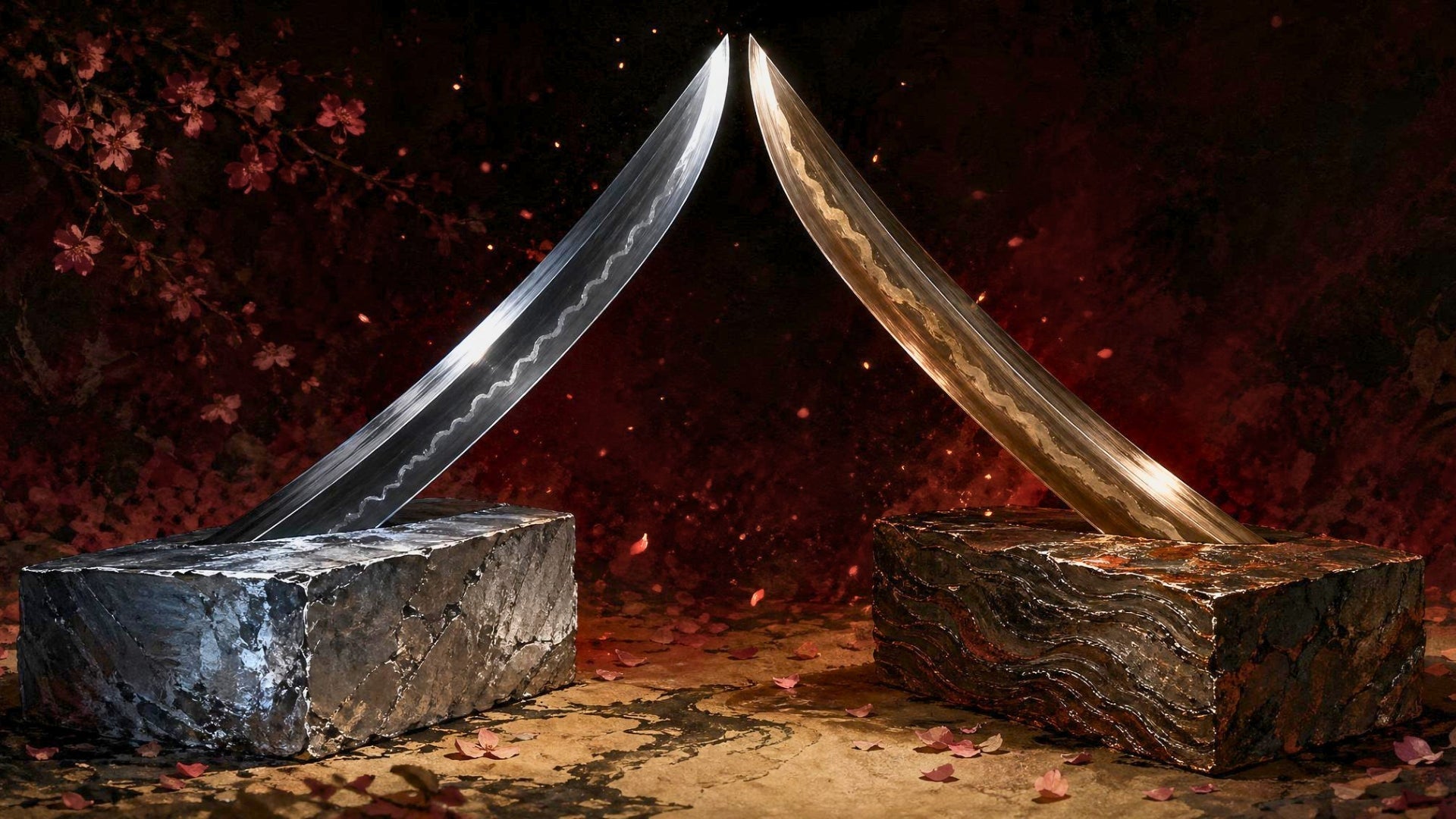
Two katanas sit on a table. Same length, same handle wrap, same saya color. One is forged from T10 tool steel. The other from 1095 high-carbon steel. Pick them up, and they feel almost identical. Cut tatami with both, and the difference starts to show. Keep cutting for six months, and you'll know exactly which steel suits your style.
T10 and 1095 are the two most popular steels in the functional katana market — and the source of more forum debates than any other topic in the sword world. Both are high-carbon, both can be clay tempered, both produce a real hamon, and both will take a razor edge. So what's actually different?
This guide cuts through the marketing. We compare composition, hardness, toughness, edge retention, maintenance, price — and tell you which steel makes sense for your specific use case.
Steel Composition: What's Actually Inside Each Blade
The difference between T10 and 1095 starts at the molecular level — and it's smaller than most people think.
1095 carbon steel is a simple high-carbon steel. The "10" means it's a plain carbon steel (no significant alloying elements), and the "95" tells you it contains approximately 0.95% carbon. That's it — iron and carbon, with trace amounts of manganese. It's been used for blades for decades, and its behavior is extremely well understood.
T10 tool steel started as a Chinese modification of 1095. It bumps the carbon content to roughly 1.0% and adds a small but meaningful amount of tungsten (around 0.3%) along with traces of silicon and vanadium. The "T" in T10 stands for tungsten. These additions change how the steel behaves under stress and wear — subtly, but enough to matter.
T10: ~1.0%
T10: ~0.3%
T10: ~0.25%
T10: Tool steel
That 0.3% tungsten is the headline difference. Tungsten is one of the hardest elements on earth — it increases wear resistance, meaning the edge degrades slower under repeated cutting. It's a small number with an outsized effect.
For a deeper dive into all katana steel types including 1045, 1060, spring steel, and Damascus, our complete steel guide covers every option.

T10 Steel in Our Forge
Premium katanas forged from T10 tool steel — clay-tempered for a real hamon.


Hardness & Edge Retention: Where T10 Pulls Ahead
Both steels can be hardened to impressive levels. But T10 consistently reaches the higher end of the range.
In real-world terms, that 2-point HRC difference means T10 holds its edge noticeably longer during sustained cutting sessions. If you're doing tameshigiri (test cutting on tatami or bamboo) regularly, you'll re-sharpen a 1095 blade more often than a T10 — maybe 30–40% more frequently, depending on technique and target density.
That said, harder steel is harder to sharpen. A 1095 blade responds beautifully to a whetstone in 10 minutes. T10 takes longer and requires more attention. For casual owners who cut occasionally, this difference is negligible. For serious practitioners who cut weekly, it's significant.
The Rockwell Hardness Scale (HRC) measures resistance to indentation. Each point represents a meaningful jump: a blade at 60 HRC is roughly 15% harder than one at 58 HRC. In katana terms, that gap can mean weeks of extra cutting before sharpening is needed.
Toughness & Durability: Where 1095 Fights Back
Hardness and toughness are inversely related in steel. The harder a blade gets, the more brittle it becomes. This is the fundamental tradeoff in metallurgy — and the reason clay tempering exists.
On paper, T10 is considered tougher than 1095 thanks to its tungsten and silicon content, which improve shock absorption. In practice, a well-heat-treated 1095 blade is remarkably durable. The difference only becomes obvious under extreme conditions — heavy cuts on dense targets, lateral stress from bad technique, or accidental impacts against hard surfaces.
For a beginner still developing proper form (hasuji), 1095 is slightly more forgiving. An off-angle cut that would chip a poorly tempered T10 edge might only dull a 1095 one. For an experienced practitioner with clean technique, T10's toughness is more than adequate.
A perfectly heat-treated 1095 will outperform a poorly heat-treated T10 every time. Steel grade matters, but the smith's skill matters more. Always prioritize the forge's reputation over the steel label.
Clay Tempering & Hamon: Both Steels Deliver
One of the most common questions: "which steel produces a better hamon?" The answer — both are excellent candidates for clay tempering, and both produce a genuine, functional hamon.
Clay tempering (yaki-ire) is the process of applying a clay mixture to the blade before quenching. The exposed edge cools rapidly and hardens. The spine, insulated by thicker clay, cools slowly and stays softer. The result: a hard cutting edge paired with a flexible spine, and a visible hamon line that marks the transition zone.
T10 tends to produce slightly more dramatic, higher-contrast hamons due to its higher carbon content and harder martensite. 1095 produces beautiful hamons as well — typically with softer, more subtle transitions. Both are real and functional, not etched or wire-brushed fakes.

A real hamon is three-dimensional — it exists throughout the thickness of the blade, not just on the surface. If you polish away the surface, the hamon is still there. An etched or acid-washed fake hamon disappears when polished. That's the quickest way to tell them apart.
Maintenance & Rust Resistance: Both Need Care
Neither T10 nor 1095 is stainless. Both are high-carbon steels with zero chromium content, which means both will rust if neglected. There's no meaningful difference in corrosion resistance between the two — a fingerprint on either blade will start oxidizing within 48 hours.
The maintenance routine is identical: wipe after handling, oil with choji or mineral oil regularly, store in a dry environment at 40–50% humidity. If you're already comfortable caring for a high-carbon blade, the steel type doesn't change anything. If you're not sure how, our complete maintenance guide covers every step.
The one small difference: T10's slightly harder edge can be more resistant to micro-scratches during maintenance. But we're talking about a marginal advantage that most owners will never notice.
Price: What's the Damage?
T10 katanas typically cost 10–20% more than equivalent 1095 models from the same forge. The premium reflects the more demanding heat treatment process and the slightly more expensive raw material.
At the entry level ($200–$300), the difference between a T10 and 1095 blade is minimal — you're more likely to notice variations in fit, finish, and handle quality than in steel performance. At the mid and high end ($400+), where heat treatment is more precise and consistent, T10's advantages become more apparent.
Head-to-Head: T10 vs 1095 at a Glance
| Category | T10 Tool Steel | 1095 Carbon Steel |
|---|---|---|
| Carbon Content | ~1.0% | ~0.95% |
| Tungsten | ~0.3% | None |
| Hardness (HRC) | 58–62 | 56–60 |
| Edge Retention | Excellent — longer between sharpenings | Very good — easier to sharpen |
| Toughness | Very good — tungsten adds resilience | Good — slightly more brittle at max hardness |
| Hamon Quality | High contrast, dramatic | Beautiful, slightly softer transitions |
| Rust Resistance | Low — same as any high-carbon steel | Low — identical maintenance needed |
| Ease of Sharpening | Harder — takes more time | Easier — responds quickly to whetstone |
| Price Range | $250–$600 | $200–$500 |
| Best For | Frequent cutters, serious practitioners | Beginners, collectors, occasional cutting |
Which Katana Steel Is Right for You?
Choose T10 if you:
You do tameshigiri regularly. You want maximum edge retention between sessions. You don't mind spending an extra $50–$100. You're comfortable with high-carbon maintenance. You appreciate a bold, high-contrast hamon.
Choose 1095 if you:
You're buying your first functional katana. You value ease of sharpening. You cut occasionally, not weekly. You want a proven, well-understood steel at a lower price point. You're a collector who prioritizes display and occasional handling.
Or honestly — choose 1060 if you're unsure
If this whole comparison feels overwhelming, 1060 carbon steel is the safe middle ground. It's tougher than both T10 and 1095, more forgiving of technique errors, and still produces a real hamon when clay tempered. It's the most popular "first katana" steel for a reason. Our beginner's buying guide covers this in detail.

Frequently Asked Questions
Is T10 steel better than 1095 for a katana?
T10 offers better edge retention and slightly more toughness thanks to its tungsten content. But 1095 is easier to sharpen and costs less. "Better" depends on your use case — T10 for frequent cutting, 1095 for collecting and occasional use.
Can both steels be clay tempered?
Yes. Both T10 and 1095 respond excellently to clay tempering (yaki-ire) and produce a genuine, functional hamon. T10 tends to yield higher-contrast hamons, but both are authentic.
Which steel is better for beginners?
1095 — it's more forgiving of technique errors and easier to maintain sharp. If you're a complete beginner, 1060 carbon steel is even better as a starting point due to its superior toughness.
Does T10 rust more than 1095?
No. Both are high-carbon steels with identical rust resistance (essentially none). Both require the same maintenance: regular oiling, dry storage, and no bare-hand contact with the blade.
What does the "T" in T10 stand for?
Tungsten. T10 contains approximately 0.3% tungsten, which is its key differentiator from plain carbon steels like 1095. Tungsten increases wear resistance and edge retention under sustained cutting.
Find Your Steel
Now you know the difference. The next step is picking the blade that matches your intent — not just the spec sheet.
Browse our full collection of hand-forged katanas in T10, 1095, 1060, and Damascus. Each product page lists the steel type, forging method, and hardness so you can compare confidently.
Not sure where to start? The entry-level collection features both T10 and 1095 blades starting at $199.
The best steel is the one you'll actually use. Choose accordingly.
Choose Your Steel
Whether T10 or 1095, every blade in our forge is built to perform, not just decorate.

Share:
How to Care for a Katana: Complete Maintenance Guide
What Is a Hamon? The Science Behind a Katana's Temper Line