

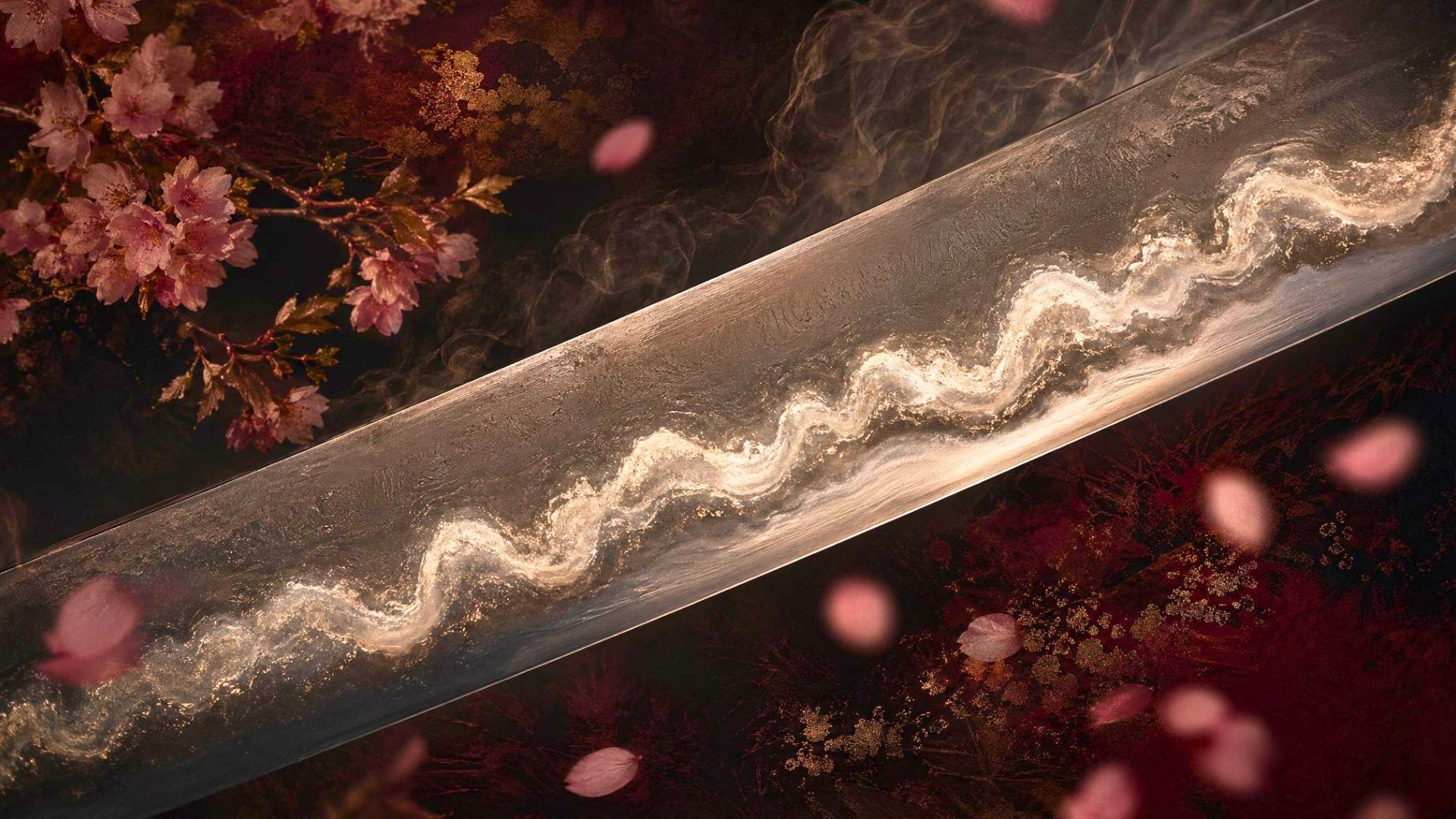
Look at a katana blade under the right light, and you'll see it — a misty, cloud-like line running along the edge. Sometimes straight as a ruled pencil. Sometimes wild and chaotic, like waves crashing against a cliff. That line is the hamon. And it's not painted on, etched in, or decorative. It's the visible boundary between two different types of steel structure inside the same blade.
The hamon is one of the few features in the sword world that is simultaneously functional, artistic, and diagnostic. It makes the blade sharper. It makes the blade beautiful. And it tells you — if you know how to read it — who forged it, where, when, and whether it's real.
This guide explains how a hamon is created, what the different patterns mean, how to tell a real hamon from a fake one, and why this single feature can be the difference between a $200 katana and a $20,000 one.
- What a Hamon Actually Is (and Isn't)
- How a Hamon Is Created: The Clay Tempering Process
- The Metallurgy: Martensite vs Pearlite
- Major Hamon Patterns and What They Mean
- Nie and Nioi: The Crystals Inside the Hamon
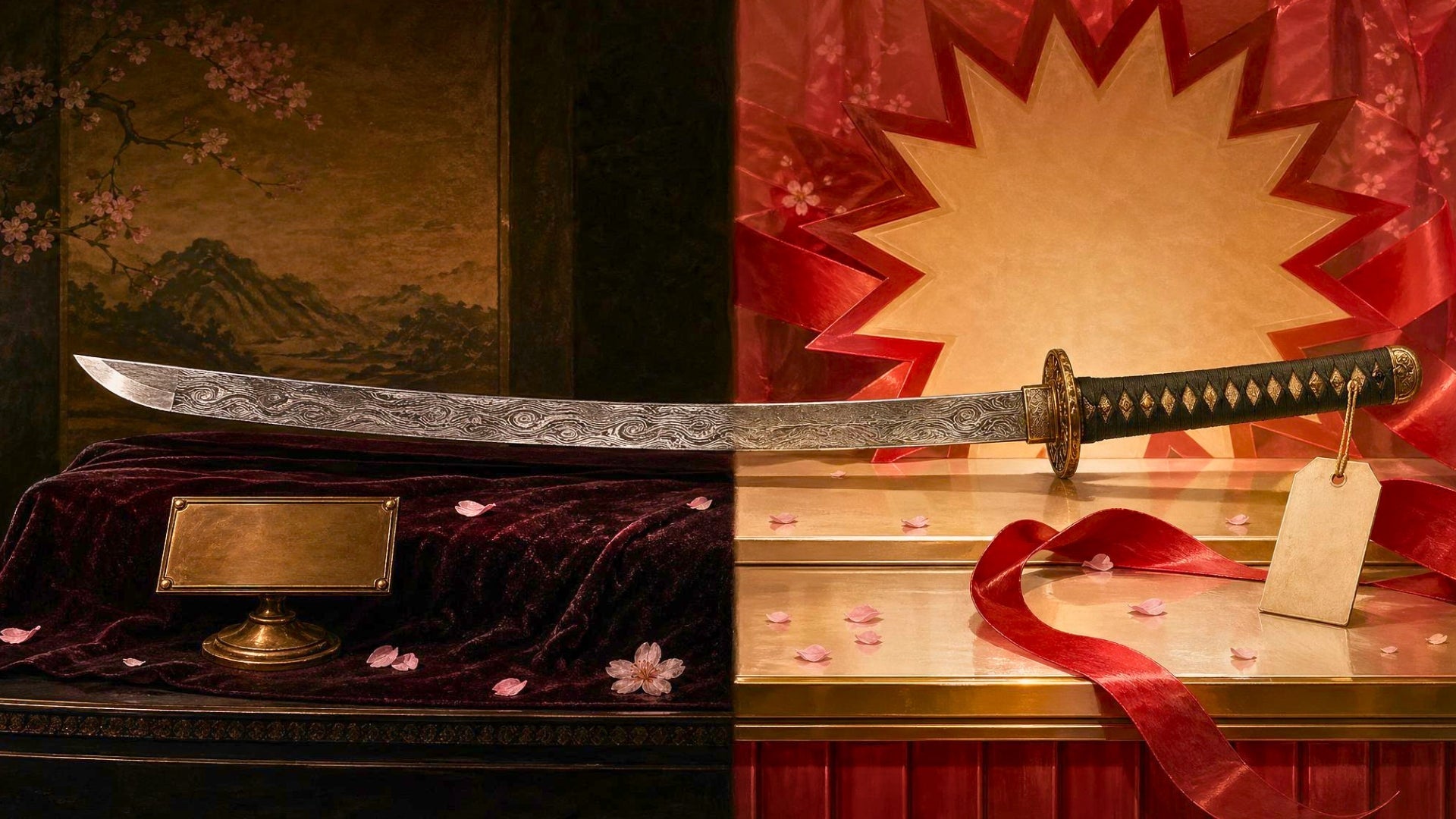
- Real Hamon vs Fake: How to Tell the Difference
- Why Hamon Affects a Katana's Value
- Frequently Asked Questions
- See It for Yourself
What a Hamon Actually Is — And What It Isn't
The word hamon (刃文) translates literally to "edge pattern." It's the visible line on a katana blade that marks the transition between the hardened cutting edge and the softer spine. Think of it as a geological fault line — except instead of rock layers, it separates two different crystalline structures of steel.
The hamon is not a surface treatment. It's not a coating, a stain, or a polish effect. A real hamon exists throughout the full thickness of the blade. If you ground away the surface, polished it fresh, the hamon would still be there — because it's a structural feature of the metal itself.
This is the single most important thing to understand: a hamon is three-dimensional. It lives inside the steel.

Genuine Hamon Blades
Each blade below features a real, clay-tempered hamon — visible under the right light.


How a Hamon Is Created: The Clay Tempering Process
The hamon is born during a step called yaki-ire — differential hardening. It's one of the most critical and nerve-wracking moments in the entire forging process. One mistake, and the blade cracks. Months of work, destroyed in a second.
Here's how it works, step by step:
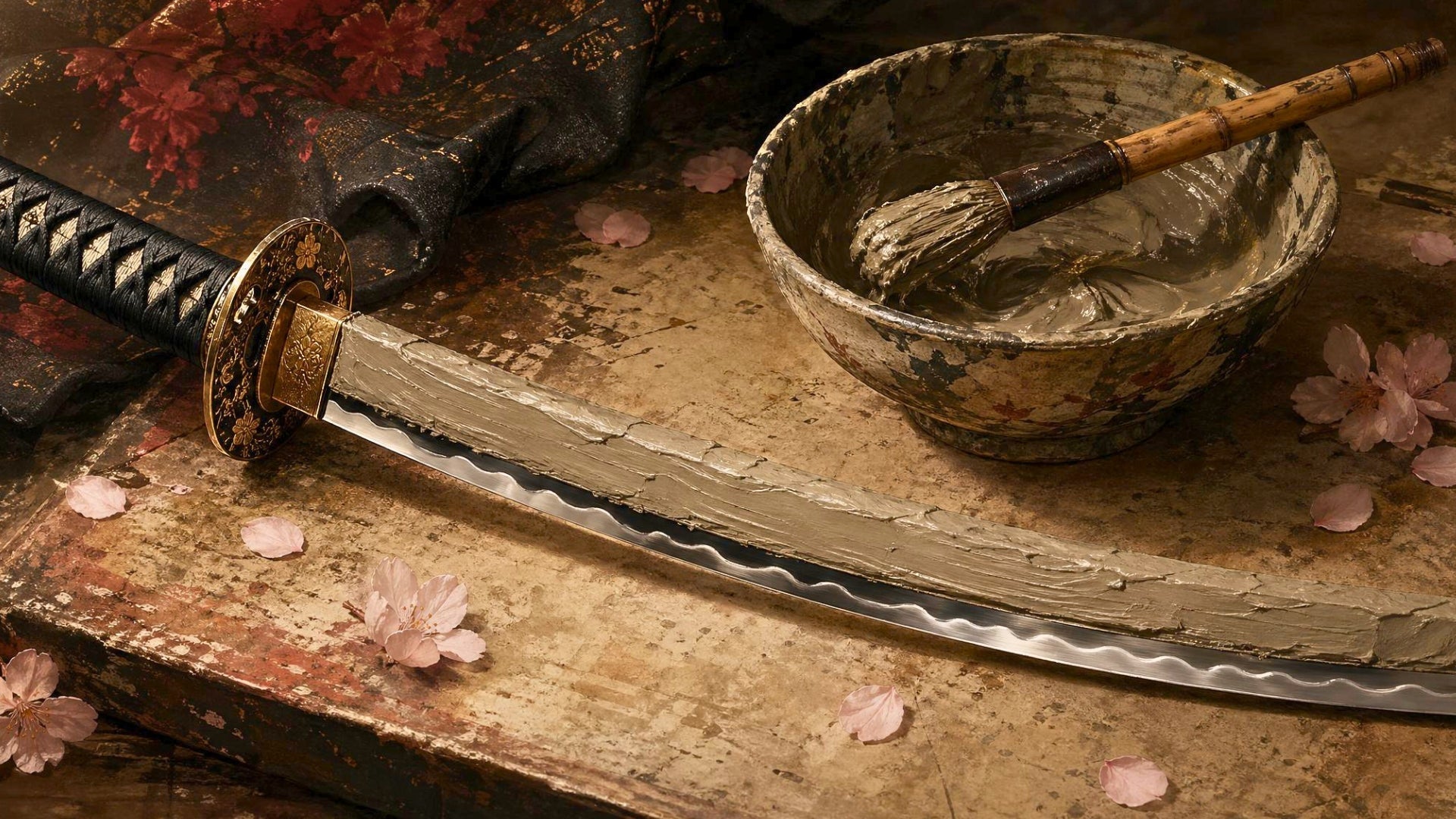
The swordsmith mixes a clay compound — traditionally a blend of clay, charcoal powder, and ground sandstone. The exact recipe is a closely guarded secret that varies by school and smith. He then paints this mixture onto the blade. The spine and body get a thick coat. The cutting edge gets a very thin layer — or none at all.
The blade is then heated to around 750–800°C in a charcoal forge, in near-total darkness. The smith judges the correct temperature by the color of the glowing steel — a specific shade of orange that no thermometer can replace. And then, in a single decisive motion, the blade is plunged into a trough of water.
Traditional Japanese swordsmiths perform yaki-ire in a darkened forge so they can read the exact color of the heated steel. A blade quenched at the wrong temperature will crack — and that crack often sounds like a sharp ping that tells the smith his blade is ruined before he even pulls it from the water.
The exposed edge cools rapidly and hardens into a crystalline structure called martensite. The insulated spine cools slowly and forms a softer structure called pearlite. The boundary between these two zones — that's your hamon.

The Metallurgy: Martensite vs Pearlite
To understand why the hamon works, you need two minutes of materials science.
When steel is heated above its critical temperature (~727°C for carbon steel), its internal structure transforms into a phase called austenite — atoms rearranged in a specific pattern. What happens next depends entirely on how fast the steel cools.
Cool it fast (the exposed edge): austenite transforms into martensite — an extremely hard, brittle crystalline structure. This is what gives the edge its razor sharpness and its ability to hold that sharpness through hundreds of cuts.
Cool it slowly (the clay-insulated spine): austenite transforms into pearlite — a softer, more ductile structure made of alternating layers of ferrite (iron) and cementite (iron carbide). This is what gives the spine its flexibility and shock absorption.
A blade that is entirely martensite would shatter on impact. A blade that is entirely pearlite would bend like a butter knife. The genius of clay tempering is combining both in a single blade — hard where it cuts, soft where it flexes. The hamon is the visible proof that this combination was achieved.
For more on how steel composition affects this process, our complete steel guide covers every grade from 1045 to T10.
Major Hamon Patterns and What They Mean
The shape of the hamon isn't random — it's controlled by how the smith applies the clay before quenching. Different schools developed signature patterns, and knowing them lets you trace a blade's lineage like a fingerprint.
| Pattern | Japanese | Description | Associated Schools |
|---|---|---|---|
| Suguha | 直刃 | Straight line, parallel to the edge. Simple but technically demanding — any imperfection is immediately visible. | Yamato, Yamashiro (Awataguchi) |
| Notare | 湾れ | Gentle, rolling waves like a calm ocean. Smooth undulations, never sharp or jagged. | Bizen, Soshu |
| Gunome | 互の目 | Regular semicircular waves, like rounded peaks. Structural and reliable. | Bizen |
| Choji | 丁子 | Clove bud shapes — rounded, overlapping petals. One of the most prized aesthetic patterns. | Bizen (Ichimonji school) |
| Midare | 乱れ | Irregular, chaotic pattern combining elements of other types. Wild and unpredictable. | Soshu (Masamune) |
| Hitatsura | 皆焼 | Hardened areas "spilling" beyond the hamon across the entire blade. Extremely rare, only master-level smiths. | Soshu (late Kamakura) |

For a deeper dive into every hamon variation with visual references, our complete hamon reference guide covers over 15 patterns in detail.
Nie and Nioi: The Crystals Inside the Hamon
If you look closely at a hamon under magnification, you'll see it's not a clean line — it's made up of tiny particles. These particles come in two forms, and their presence (or absence) defines the character of the hamon.
Nie (沸) are individual martensite crystals large enough to see as sparkling, distinct points — like tiny stars embedded in the steel. They appear bright and granular under light. Blades dominated by nie are called nie-deki.
Nioi (匂) are clusters of much finer crystals that appear as a soft, misty, cloud-like glow rather than individual points. You can't distinguish single particles — it looks like fog along the hamon line. Blades dominated by nioi are called nioi-deki.
The most celebrated antique blades feature complex interactions between nie and nioi — sparkling crystals floating in misty clouds, creating a depth and luminosity that photographs simply cannot capture. This is why serious collectors always insist on seeing a blade in person.
Inside the hamon, experienced collectors look for specific "activities" (hataraki) — including kinsuji (golden streaks like lightning), sunagashi (sand-like flowing lines), and ashi (leg-like formations extending toward the edge). These details are individual signatures of the swordsmith's technique and can authenticate a blade to a specific maker.
Real Hamon vs Fake: How to Spot the Difference
This is the section that saves you money. Not every "hamon" you see on a katana is real. There are three categories:
Real (Clay Tempered) Hamon
Created by actual differential hardening. The hamon is structural — it exists through the blade's full thickness. Polishing reveals it; re-polishing doesn't remove it. The edge is measurably harder than the spine (typically 58–62 HRC edge vs 38–42 HRC spine).
Etched / Acid-Washed Fake Hamon
A cosmetic line created by applying acid or chemicals to the surface of a through-hardened blade. It looks like a hamon from a distance, but it's superficial. Polish it away, and it's gone. The entire blade has uniform hardness — there's no functional benefit.
Wire-Brushed Fake Hamon
The cheapest trick — a line scratched into the steel with a wire brush or grinder. Obvious up close: no depth, no crystalline structure, no subtlety. Found on sub-$100 wall-hanger katanas.
The quickest check: look at the hamon under magnification. A real hamon has depth, crystalline activity (nie or nioi), and irregularity. A fake hamon looks flat, uniform, and "too perfect." If the entire blade has the same hardness throughout, the hamon is cosmetic regardless of how it looks.
Why the Hamon Affects a Katana's Value
Among collectors of antique nihonto (Japanese swords), the hamon is often the single most important factor in appraisal — more than steel, more than age, sometimes more than the smith's name.
A blade with a well-executed suguha by an unknown smith can be worth more than a poorly tempered midare by a famous one. The hamon tells you how skilled the smith was at the most critical moment of the forging process. It's the ultimate test of mastery.
For modern production katanas, the presence of a real (clay tempered) hamon instantly separates a functional blade from a decorative one. It's the feature that justifies the price jump from the $100–$200 range into the $300+ territory. When you see "real hamon" on a product listing, you're paying for differential hardening — and the cutting performance that comes with it.
Our guide to katana pricing explains exactly how hamon, steel type, and craftsmanship affect what you pay.
Frequently Asked Questions
What is a hamon on a katana?
The hamon is the visible temper line on a katana blade, created during differential hardening (clay tempering). It marks the boundary between the hard cutting edge (martensite) and the softer spine (pearlite). It's both a functional feature and an artistic signature of the swordsmith.
How can I tell if a hamon is real or fake?
A real hamon has depth, crystalline activity (tiny sparkling particles called nie), and natural irregularity. A fake hamon — created by acid etching or wire brushing — looks flat, perfectly uniform, and disappears if you polish the surface. Checking hardness at the edge vs spine is the definitive test.
Does the hamon pattern affect performance?
The pattern itself (suguha vs midare) has minimal impact on cutting performance. What matters is the quality of the differential hardening — a well-executed suguha cuts just as well as a well-executed midare. The pattern is primarily aesthetic and diagnostic.
Can a hamon be removed or damaged?
A real hamon is permanent — it exists through the blade's full thickness. However, it can be obscured by rust, scratches, or improper polishing. Professional re-polishing by a togishi can restore its visibility. Acid-etched fake hamons will disappear with polishing.
Which hamon pattern is the most valuable?
Among collectors, hitatsura (full-blade tempering) and well-executed choji are among the most prized — both require extreme skill. But value depends on execution quality, not pattern type. A flawless suguha by a master can be worth more than a mediocre midare by a lesser smith.
See It for Yourself
Reading about hamon is one thing. Seeing one catch the light in your hands is another. Every blade in our collection with differential hardening features a real, clay-tempered hamon — not etched, not faked.
Browse our high-end katana collection for the most striking hamon, or start with our entry-level range where T10 and 1095 blades come with genuine temper lines at accessible prices.
Want to go deeper? Our complete hamon reference covers over 15 patterns with visual breakdowns.
The hamon is the soul of the blade made visible. Now you know how to read it.
See the Hamon Up Close
Authentic temper lines, formed through traditional differential hardening — not chemical etching.
Share:
T10 Steel vs 1095 Carbon Steel: Best Katana Steel Compared
Katana vs Longsword: The Ultimate East vs West Comparison